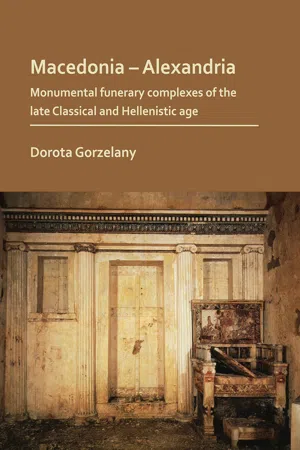
The type of monumental tomb that developed in Macedonia in the late Classical period was undoubtedly the most impressive of all the Greek funerary complexes. It was a burial chamber with a vestibule, built of stone blocks, vaulted and furnished with an architectural facade, concealed under a large tumulus rising above the ground. The concept of the Macedonian sepulcher, which the Macedonians and Greeks settling in Alexandria ad Aegyptum, the city founded by Alexander the Great on the Egyptian coast, brought with them, influenced the structural form of the underground tombs that were developed in the new city. 'Macedonia–Alexandria' explores the scope of this influence, comparing in synthetic form the structural elements of the cist graves, chamber and rock-cut tombs of Macedonia with the Alexandrian hypogea, while taking into account the different geographical factors that conditioned them. This is followed by a presentation of the facade and interior decoration, and a discussion of the themes of wall painting inside the tombs and a characteristic of the surviving tomb furnishings. The Macedonian tomb reflects in its form Greek eschatological beliefs ingrained in the mystery religions and the social ideology of the Macedonian kingdom. The assimilation of these beliefs is seen in the architectural arrangements, the vestibule and chamber plan, the facade (in Macedonia) or courtyard (in Alexandria), the structural and architectural interior decoration, and the furniture found in the chamber. These elements refer to palace architecture and determine the symbolic function of the tomb. The cult of the dead aspect is emphasized by wall painting iconography, the form of burial and the nature of the grave goods accompanying the deceased. In Alexandria, the role of rituals celebrated in the family tombs is attested by the declining size of burial chambers in favour of the vestibules and by the introduction of an open courtyard as well as the presence of altars. With regard to the ideology behind the Alexandrian complexes, the author explores the issue of the coexistence and the popularity of Egyptian beliefs adopted into Alexandrian sepulchral art, emphasizing the differences in the perception of the role of the tomb in the Macedonian and Egyptian consciousness.
eBook - PDF
Macedonia – Alexandria: Monumental Funerary Complexes of the Late Classical and Hellenistic Age
- 247 pages
- English
- PDF
- Available on iOS & Android
eBook - PDF
Macedonia – Alexandria: Monumental Funerary Complexes of the Late Classical and Hellenistic Age
About this book
Information
Table of contents
- Cover
- Title Page
- Copyright Page
- Dedication
- Contents Page
- List of Figures
- Introduction
- Historical outline
- Types of funerary complexes in Macedonia
- Figure 1. Macedonia, map of the more important sites
- Figure 2. Sedes, pottery from a cist grave (Vokotopoulou 1996, 188)
- Figure 3. Box tomb in Pella (photo Archaeological Museum in Pella)
- Figure 4. Pella, female protome from the eastern necropolis (Siganidou, Lilimbaki-Akamati 1997, Fig. 38)
- Figure 5. Vergina, Tomb of Persephone (Drougou 1994, 50)
- Figure 6. Ajani, decoration of cist grave II (Vokotopoulou 1996, 196)
- Figure 7. Ajani, myrtle wreath of gilded bronze with clay berries
- Figure 8. Derveni, grave A – lantern of bronze (Vokotopoulou 1996, 216)
- Figure 9. Kassandrea, olive wreath of gold (Tsigarida, Ignatiadou 2000, Fig. 94)
- Figure 10. Box tomb Derveni B (photo by the Author)
- Figure 11. Derveni, grave B, krater
- Figure 12. Derveni, grave B – vessels of bronze (Vokotopoulou 1996, 209)
- Figure 13. Derveni, grave B – glass vessel
- Figure 14. Sevasti, gold ivy wreath (Tsigarida, Ignatiadou 2000, Fig. 62)
- Figure 15. Pydna, reconstruction of the larnax decorated with gilded silver plaques, from a cist grave
- Figure 16. Amphipolis-Kastas, fragment of the decoration of a cist grave
- Figure 17 10. Vergina, Great Tumulus, tomb IV (photo by the Author)
- Figure 18. Section through the Great Tumulus in Vergina
- Figure 19 7. Pella, the tumulus of tomb Δ
- Figure 20 9. Vergina, plan of the Great Tumulus (Drougou 1994, 129)
- Figure 21. Vergina, section through the Tomb of ‘Rhomaios’ (Rhomaios 1951, Fig. 6)
- Figure 22. Lefkadia, Tomb of the Judgment, section (Touratsoglou 1998, Fig. 255)
- Figure 23. Lefkadia, Tomb of the Palmettes, chamber (Rhomiopoulou 1999, Fig. 30)
- Figure 24. Vergina, Great Tumulus, tomb II – tomb of Phillip II, facade, reconstruction by G. Mitsakakis (Drougou 1994, 4)
- Figure 25. Vergina, Great Tumulus, tomb III (Andronikos 1997, Fig. 160)
- Figure 26. Agios Athanasios, fragment of the façade (Tsimbidou-Avloniti 2007, Fig. 3)
- Figure 27. Tomb in Thessalonika-Maievtiriou (photo by the Author)
- Figure 28. Pella, tomb Δ (photo by the Author)
- Figure 29. Agios Athanasios, tomb with Ionian facade (photo by the Author)
- Figure 30. Pella, tomb Γ (photo by the Author)
- Figure 31. Lefkadia, Tomb of the Judgment (Touratsoglou 1998, Fig. 256)
- Figure 32. Lefkadia, Tomb of the Palmettes (Rhomiopoulou 1999, Fig. 26)
- Figure 33. Vergina, the Bella Tumulus, tomb II, facade and throne in the burial chamber (Andronikos 1997, Fig. 15)
- Figure 34. Lefkadia, Tomb of Lyson and Kallikles, chamber (Rhomiopoulou 1999, Fig. 39)
- Figure 35. Vergina, Great Tumulus, tomb III, wall painting in the vestibule (Drougou 1994, 83)
- Figure 36. Vergina, Tomb of Euridike, interior with the throne (Touratsoglou 1998, Fig. 318)
- Figure 37. Lefkadia, Tomb of the Palmettes, painted decoration of the vault in the vestibule (Descamps-Lequime 2007, 20)
- Figure 38. Potidea, kline (Vokotopoulou 1996, 100, 101)
- Figure 39. Dion, painted decoration of the kline (Miller 1993, Fig. 2)
- Figure 40. Vergina, Great Tumulus, tomb II – decorations of the kline (Vokotopoulou 1996, 168)
- Figure 41. Vergina, tomb II, larnax (Vokotopoulou 1996, 152, 153)
- Figure 42. Vergina, tomb II, chamber – silver table set (Vokotopoulou 1996, 161)
- Figure 43. Vergina, tomb II, oak wreath of gold (Vokotopoulou 1996, 154)
- Figure 44. Vergina, tomb III – hydria (Vokotopoulou 1996, 179)
- Figure 45. Pella, plan of rock-cut tomb Γ (Lilimbaki-Akamati 1994, Fig. 4)
- Figure 46. Pella, terracotta figurines from rock-cut tombs, 3rd- 2nd century BC (Siganidou, Lilimbaki-Akamati 1997, Fig. 23)
- Types of funerary complexes in Alexandria
- Figure 47. Alexandria, map marking the locations of the discussed tombs
- Figure 48. Sidi Gaber, plan of the tomb (Adriani 1966, Fig. 209)
- Figure 49. Sidi Gaber, beginning of the 20th century (Thiersch 1904, 2)
- Figure 50. Mustapha Pasha, plan of hypogeum II (Adriani 1966, Fig. 189)
- Figure 51. Mustapha Pasha, section through hypogeum II (Adriani 1966, Fig. 187)
- Figure 52. Mustapha Pasha, plan of hypogeum III (Adriani 1966, Fig. 192)
- Figure 53. Mustapha Pasha, section through hypogeum III (Adriani 1966, Fig. 191)
- Figure 54. Mustapha Pasha, courtyard of hypogeum III (Adriani 1966, Fig. 196)
- Figure 55. Suk el-Wardian, plan (Adriani 1966, Fig. 230)
- Figure 56. Suk el-Wardian, section (Adriani 1966, Fig. 231)
- Figure 57. Mustapha Pasha, hypogeum IV (Adriani 1966, Fig. 204)
- Figure 58. Mustapha Pasha, plan of hypogeum I (Adriani 1966, Fig. 181)
- Figure 59. Mustapha Pasha, section through hypogeum I (Adriani 1966, Fig. 182)
- Figure 60. Mustapha Pasha, burial chamber with kline (Adriani 1966, Fig. 195)
- Figure 61. Shatby, plan of hypogeum A (Breccia 1912, Fig. I)
- Figure 62. Shatby, hypogeum A, courtyard facade (Breccia 1912, Fig. II)
- Figure 63. Shatby, chamber g, back wall (Breccia 1912, Pl. IV)
- Figure 64. Anfushy, plan of the hypogea (Adriani 1966, Fig. 360)
- Figure 65. Alabaster tomb (http://commons.wikimedia.org/wiki/File:AlexAlabasterTombNorthSide.jpg?uselang=pl [18.09.2014])
- Figure 66. Sidi Gaber, chamber with kline (Adriani 1966, Fig. 210)
- Figure 67. Suk el-Wardian, burial chamber with kline (Adriani 1966, Fig. 232)
- Figure 68. Anfushy, painted decoration of the walls in hypogeum II (Adriani 1966, Fig. 385)
- Figure 69. Mustapha Pasha, hypogeum I, courtyard facade (Adriani 1966, Fig. 186)
- Figure 70. Gabbari B24, decoration of the vault (Guimier-Sorbets, Seif el-Din 2003, Fig. 2)
- Figure 71. Anfushy, decoration of the vault in chamber 2 of hypogeum II (Adriani 1966, Fig. 237)
- Figure 72. Anfushy, entrance to chamber 2 in hypogeum II (Adriani 1966, Fig. 392)
- Figure 73. Shatby, kline in chamber g’ (Breccia 1912, Fig. V)
- Figure 74. Gabbari B26, kline (Guimier-Sorbets, Nenna 2003, Figs 1,2)
- Figure 75. Mustapha Pasha, kline in chamber 5 (Adriani 1966, Fig. 207)
- Figure 76. Mustapha Pasha, kline in the burial chamber (Adriani 1966, Fig. 208)
- 2. Forms of the burial and grave goods
- 1. Architectural form, painted decoration, interior furnishings
- 2. Burial form and grave goods
- Conclusion
- Abbrevations and Bibliography
- Index of localities and tombs
- Topical index
Trusted by 375,005 students
Access to over 1.5 million titles for a fair monthly price.
Study more efficiently using our study tools.
Frequently asked questions
Yes, you can cancel anytime from the Subscription tab in your account settings on the Perlego website. Your subscription will stay active until the end of your current billing period. Learn how to cancel your subscription
No, books cannot be downloaded as external files, such as PDFs, for use outside of Perlego. However, you can download books within the Perlego app for offline reading on mobile or tablet. Learn how to download books offline
Perlego offers two plans: Essential and Complete
- Essential is ideal for learners and professionals who enjoy exploring a wide range of subjects. Access the Essential Library with 800,000+ trusted titles and best-sellers across business, personal growth, and the humanities. Includes unlimited reading time and Standard Read Aloud voice.
- Complete: Perfect for advanced learners and researchers needing full, unrestricted access. Unlock 1.5M+ books across hundreds of subjects, including academic and specialized titles. The Complete Plan also includes advanced features like Premium Read Aloud and Research Assistant.
We are an online textbook subscription service, where you can get access to an entire online library for less than the price of a single book per month. With over 1.5 million books across 990+ topics, we’ve got you covered! Learn about our mission
Look out for the read-aloud symbol on your next book to see if you can listen to it. The read-aloud tool reads text aloud for you, highlighting the text as it is being read. You can pause it, speed it up and slow it down. Learn more about Read Aloud
Yes! You can use the Perlego app on both iOS and Android devices to read anytime, anywhere — even offline. Perfect for commutes or when you’re on the go.
Please note we cannot support devices running on iOS 13 and Android 7 or earlier. Learn more about using the app
Please note we cannot support devices running on iOS 13 and Android 7 or earlier. Learn more about using the app
Yes, you can access Macedonia – Alexandria: Monumental Funerary Complexes of the Late Classical and Hellenistic Age by Dorota Gorzelany in PDF and/or ePUB format, as well as other popular books in Social Sciences & Archaeology. We have over 1.5 million books available in our catalogue for you to explore.