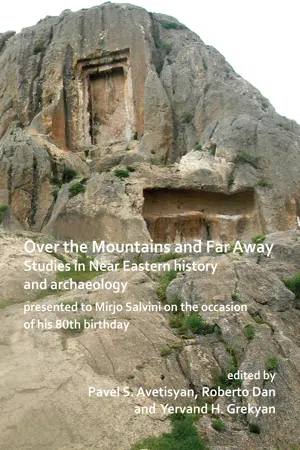
The publication of 'Over the Mountains and Far Away: Studies in Near Eastern history and archaeology presented to Mirjo Salvini on the occasion of his 80th birthday' was initiated by the Institute of Archaeology and Ethnography, National Academy of Sciences of Armenia, the International Association of Mediterranean and Oriental Studies (Rome, Italy) and the Association for Near Eastern and Caucasian Studies (Yerevan, Armenia) as a tribute to the career of Professor Mirjo Salvini on the occasion his 80th birthday. It is composed of 62 papers written by his colleagues and students from Italy, Germany, France, Spain, Poland, the Netherlands, Denmark, Austria, Great Britain, Russian Federation, Israel, Turkey, Islamic Republic of Iran, Georgia, United States and Armenia. The contributions presented here cover numerous topics, a wide geographical area and a long chronological period. However, most of the contributions deal with research in the fields of Urartian and Hittite Studies, the topics that attracted Prof. Salvini during his long and fruitful career most.
eBook - PDF
Over the Mountains and Far Away: Studies in Near Eastern history and archaeology presented to Mirjo Salvini on the occasion of his 80th birthday
- 593 pages
- English
- PDF
- Available on iOS & Android
eBook - PDF
Over the Mountains and Far Away: Studies in Near Eastern history and archaeology presented to Mirjo Salvini on the occasion of his 80th birthday
About this book
Information
Table of contents
- Cover
- Title Page
- Copyright Page
- Contents Page
- Editorial
- Foreword
- Bibliography
- Bīsotūn, ‘Urartians’ and ‘Armenians’ of the Achaemenid Texts,1 and the Origins of the Exonyms Armina and Arminiya2
- Human Images from the Eastern Urartian Periphery: Anthropomorphic Sculpture of Syunik on the Cusp of the 2nd and 1st Millennia BC
- Cult-Places of Ancient Armenia: A Diachronic View and an Attempt of Classification
- The Elamite Tablets from Armavir-Blur (Armenia): A Re-Examination*
- Šiuini: The Urartian Sun god
- Protective Clay Figurines in the Urartian Fortresses
- Mesopotamians and Mesopotamian Learning at Hattusa, Thirty Years On
- Too Many Horns in the Temple of the God Hadad of Aleppo at the Time of the Ebla Archives!1
- The Roots of the Urartian Kingdom: The Growth of Social Complexity on the Armenian Plateau Between Ancient Bronze and Early Iron Ages
- Thoughts about the Audience-Hall of Naramsin at Tell Asmar-Ešnunna
- The Urartian God Quera and the Metamorphosis of the ‘Vishap’ Cult
- Laḫmu, ‘The Hairy One’, and the Puzzling Issue of Mythology in Middle Assyrian Glyptic Art*
- The First Gilgamesh Conjectures About the Earliest Epic
- Ayanis Fortress: Only a Military Fortress or More?
- Granaries in Urartu and Neighboring States and the Monumentalization of Administrative Records
- Hasanlu, the Southern Caucasus and Early Urartu*
- The King of the Rock Revisited: The Site of As-Sila (Tafila, Jordan) and the Inscription of Nabonidus of Babylon
- A New Painting Fragment from Erebuni and an Overview of Urartian Wall Paintings
- New Observations Regarding the Urartian Inscription of the Tul-e Talesh Bracelet
- Nouvelles réflexions relatives à la fin du royaume d’Ourartou – la forteresse d’Erebuni vers la fin du VIIe siècle av. J.-C.
- Quand dieu aide les vainqueurs...
- The Relationship between State and Nomads in the Urartian Kingdom
- Alcune considerazioni sulla posizione di Uršum e Ḫaššum/Ḫaššuwa: dal commercio paleo-assiro al regno di Ḫattušili I
- L’espressione (ANA) PANI NP nei colofoni ittiti
- From Khazane Kapoussi/Hazine Kapısı to Analıkız: Rethinking a Place at Tušpa Citadel
- Some Remarks on Qulḫa
- The Problem of the Origin of the Urartian Scribal School
- The Cross Statue as a Symbol of Christianizing Armenia
- Oshakan Tomb No. 25 Revisited*
- Urartian Envoys to Ashurbanipal’s Court – Some Remarks on the Assyro - Urartian Relations in the First Half of the 7th Century BC
- The ‘City of Ḫaldi’ in the Land of Uaza
- Urartian Inscriptions at the Van Museum. A New Collection
- Towards the Reconstruction of the Hurro-Urartian Protolanguage
- A New Rock-Cut Tomb in Van Fortress/Tushpa
- Upper Euphrates Political Geography Reconsidered
- The Urartian Rock-Cut Chamber at Yelpin / Armenia
- Le terre di Urartu nella descrizione di Strabone
- The Armenian Patronymic Arcruni
- Iron Age Luvian tarrawann(i)-
- An Echo of Assyria in Plutarch’s Life of Alexander
- Lo strano caso del Sig. VITA+RA/I, scriba ‘4’ alla corte ittita
- From Petroglyphs to Alphabet. A Brief Characterization of the Writing Culture of Pre-Christian Armenia
- New Iri-Saĝrig Ration Distribution and Related Texts
- Le melograne della basilica di Santa Cecilia in Trastevere
- On the Ethnic Origin of the Ruling Elite of Urartu
- Solak 1. Una fortezza urartea nella valle del Hrazdan, Armenia
- Un piccolo frammento di una lunga storia: un cammello a Tell Barri/Kahat (Siria)
- New Ways of Etymologizing Certain Fragments of the Cuneiform Inscription of Tanahat
- A Note about an Ewer of Probable Anatolian Production, from One of the Tombs of the Assyrian Queens at Nimrud*
- Armenian Toponyms in the ‘Patria Quae Dicitur Parthia’ according to the Cosmographia of Ravennas Anonymus
- Updates on Verbal Transitivity and Nominal Ellipsis in Hittite
- The Assyria-Urartu Relationship and the Political Role of Mercenaries
- Zur Frage des Weiterlebens urartäischer Namen in achaimenidischer Zeit
- Auf der Suche nach einem Reichsgott für Urartu
- Everyday Life in Trialeti (South Caucasus) in the Middle and the Second Half of the 2nd Millennium BC
- A New Fragment of an Inscription of Rusa, Son of Argišti, from the susi Temple of Bastam, Iran1
- ‘Excavating’ Looted Tombs at Pessinus (2011-2013)
- The Bronze Stamp Seals of Marlik: Evidence of Bronze Age Links with Eastern Iran and Central Asia
- Beyt’a Mêzînê A Trace of the Qur’anic Influence on the Yezidi Oral Religious Tradition
- The Ethno-Cultural Diversity of Central Anatolian Early Iron Age Inhabitants
- The Mighty Weapon of Tarhunt
- Illiterate Urartians: Writing and the Ayanis Outer Town
Trusted by 375,005 students
Access to over 1.5 million titles for a fair monthly price.
Study more efficiently using our study tools.
Frequently asked questions
Yes, you can cancel anytime from the Subscription tab in your account settings on the Perlego website. Your subscription will stay active until the end of your current billing period. Learn how to cancel your subscription
No, books cannot be downloaded as external files, such as PDFs, for use outside of Perlego. However, you can download books within the Perlego app for offline reading on mobile or tablet. Learn how to download books offline
Perlego offers two plans: Essential and Complete
- Essential is ideal for learners and professionals who enjoy exploring a wide range of subjects. Access the Essential Library with 800,000+ trusted titles and best-sellers across business, personal growth, and the humanities. Includes unlimited reading time and Standard Read Aloud voice.
- Complete: Perfect for advanced learners and researchers needing full, unrestricted access. Unlock 1.5M+ books across hundreds of subjects, including academic and specialized titles. The Complete Plan also includes advanced features like Premium Read Aloud and Research Assistant.
We are an online textbook subscription service, where you can get access to an entire online library for less than the price of a single book per month. With over 1.5 million books across 990+ topics, we’ve got you covered! Learn about our mission
Look out for the read-aloud symbol on your next book to see if you can listen to it. The read-aloud tool reads text aloud for you, highlighting the text as it is being read. You can pause it, speed it up and slow it down. Learn more about Read Aloud
Yes! You can use the Perlego app on both iOS and Android devices to read anytime, anywhere — even offline. Perfect for commutes or when you’re on the go.
Please note we cannot support devices running on iOS 13 and Android 7 or earlier. Learn more about using the app
Please note we cannot support devices running on iOS 13 and Android 7 or earlier. Learn more about using the app
Yes, you can access Over the Mountains and Far Away: Studies in Near Eastern history and archaeology presented to Mirjo Salvini on the occasion of his 80th birthday by Pavel S. Avetisyan,Roberto Dan,Yervand H. Grekyan, Pavel S. Avetisyan, Roberto Dan, Yervand H. Grekyan in PDF and/or ePUB format, as well as other popular books in Social Sciences & Archaeology. We have over 1.5 million books available in our catalogue for you to explore.