eBook - PDF
Rome and Barbaricum: Contributions to the Archaeology and History of Interaction in European Protohistory
- 164 pages
- English
- PDF
- Available on iOS & Android
eBook - PDF
Rome and Barbaricum: Contributions to the Archaeology and History of Interaction in European Protohistory
About this book
Rome and Barbaricum: Contributions to the archaeology and history of interaction in European protohistory asks the following questions: How did the 'Barbarians' influence Roman culture? What did 'Roman-ness' mean in the context of Empire? What did it mean to be Roman and/or 'Barbarian' in different contexts? The papers presented here explore the concepts of Romanisation and of Barbaricum from a multi-disciplinary and comparative standpoint, covering Germania, Dacia, Moesia Inferior, Hispania, and other regions of the Roman Empire. They deal with issues such as conceptual analysis of the term 'barbarian', military and administrative organization, inter-cultural and linguistic relations, numismatics, religion, economy, prosopographic investigations, constructing identities; and they present reflections on the theoretical framework for a new model of Romanisation.
Information
Subtopic
ArchaeologyIndex
HistoryTable of contents
- Cover
- Title Page
- Copyright Page
- Contents Page
- List of Figures
- Foreword
- Alexander Rubel
- What the Romans really meant when using the word ‘Barbarian’. Some thoughts on ‘Romans and Barbarians’
- What the Romans really meant when using the word ‘Barbarian’. Some thoughts on ‘Romans and Barbarians’
- Figure 1. ‘The Dying Gaul’. Hellenistic sculpture for the Pergamon Altar (Capitoline Museum); photo: Anthony Mayanlahti (antmoos), Wikicommons.
- Figure 2. Germanic ‘Barbarian’ in a gesture of submission, Gherla (Romania); photo: Sigurd Rubel.
- Figure 3. The Missorium of Theodosius, copy at the Museum of Roman Art, Merida (Spain); photo: Manuel de Corselas, Wikicommons.
- Gabriele Rasbach
- Germany East of the Rhine, 12 BC – AD 16. The first step to becoming a Roman province
- Germany East of the Rhine, 12 BC – AD 16. The first step to becoming a Roman province
- Figure 1. Map of Roman sites in Caesarian and Augustan times in Germany.
- Figure 2. Comparison by size of different military camps of Augustan times and the civil site of Waldgirmes.
- Figure 3. Rödgen. Reconstruction of the military camp.
- Figure 4. Hedemünden. LiDAR-scan of the archaeological site (Grote 2012).
- Figure 5. View across the village of Waldgirmes towards the conical Dünsberg.
- Figure 6. Reconstruction of Roman Waldgirmes on the basis of archaeological data.
- Figure 7. Waldgirmes. Plan of the first constructions, dated before 4 BC.
- Figure 8. Waldgirmes. Plan of the military barrack with separate officer’s quarters.
- Figure 9. Waldgirmes. Plan of the Augustan civil site.
- Fig. 10. Waldgirmes. Foundation pit in the inner courtyard of the forum with fragments of shell-bearing limestone from the Champagne region.
- Fig. 11. Waldgirmes. Silver, gold plated disk fibula with inlays of different coloured glass.
- Figure 12. Waldgirmes. Early eye-fibula, silver.
- Figure 13. Waldgirmes. The second well in photogrammetric reconstruction.
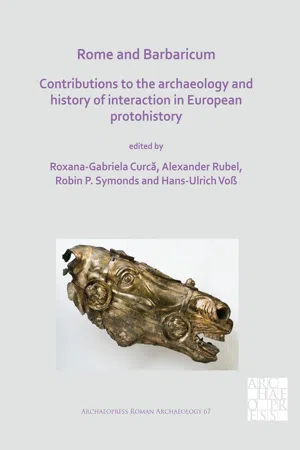
- Figure 14. Waldgirmes. Life-size gilded bronze horse’s head with images of Victory and Mars.
- Daniel Burger-Völlmecke
- The Gallo-Roman temple ‘Auf dem Spätzrech’ (Schwarzenbach/Saarland) – From a Late Laténe cult place to a Gallo-Roman pilgrim shrine?
- The Gallo-Roman temple ‘Auf dem Spätzrech’ (Schwarzenbach/Saarland) – From a Late Laténe cult place to a Gallo-Roman pilgrim shrine?
- Figure 1. Eastern part of the civitas Treverorum with Schwarzenbach and the civitas-border. Map based on: Heinen 1985, supl. 1 (redrawing and processing: D. Burger).
- Figure 2. Situation of the temple (white) to the southeast of the Dollberg plateau.
- Figure 3. Section of the temenos area within the temple. The map shows post-pits 3, 5, 8 and offering pits I and III. The allocation of find numbers follow the orientation of the original publication. The dotted line is the reconstruction of the temenos w
- Figure 4. Selected finds from the Late Latène Period (1-3) and from the Early Roman Imperial Period (4-8) M 1:4, brooches 7-8 M 1:2 (drawings: State Department for Heritage Preservation Saarland. Ministry for Environment, Energy and Traffic).
- Figure. 5. East and west profiles of the trial trench (redrawing and processing: D. Burger).
- Figure. 6. Diagram of the coins. 1: n=88 (phases by Peter 2001); 2: n=99.
- Figure. 7. Phases 1-4 of the ‘Auf dem Spätzrech’ temple.
- Figure 8. Distribution of the coins n=70.
- Figure. 9. Tabula ansata (bronze) for Mars Cnabetius; 6 x 4 cm, scale available (photo and drawing: State Department for Heritage Preservation Saarland, Ministry for Environment, Energy and Traffic).
- Figure. 10. Inscriptions of Mars Cnabetius. 1) Schwarzenbach (St. Wendel); 2) Hüttigweiler (Neunkirchen) [CIL XIII, 04508]; 3) Tholey (St. Wendel) [CIL XIII, 04258]; 4) Wahlschied (Saarbrücken) [CIL XIII, 04507]; 5) Osterburken (Neckar-Odenwald) [CIL XIII
- Figure 11. Selected small finds: 1-3) Figurines of Mars (bronze) M 1:1; 4) Figurine of Apollo (bronze) M 1:1; 5) Phallus (bronze) M 1:1; 6) Snake (bronze) M 1:2 (drawings: State Department for Heritage Preservation Saarland, Ministry for Environment, Ener
- After the ‘Great War’ (AD 166-180) – A ‘New Deal’ in internal relations within the Central and Northern European Barbaricum?
- After the ‘Great War’ (AD 166-180) – A ‘New Deal’ in internal relations within the Central and Northern European Barbaricum?
- Hans-Ulrich Voß
- Figure 1. Overview of the geographical position of the cemeteries of Himlingøje on Zealand (DK), Hagenow and Häven in Mecklenburg (D), Lubieszewo/Lübsow in Pommerania (PL), Gommern and Leuna in Central Germany, Zauschwitz in Saxony (D) and Mušov in Moravi
- Figure 2. Erfurt-Frienstedt, Thuringia (D), settlement. Roman and Germanic metal finds. After Schmidt 2013: fig. 8; 9.
- Figure 3. Combination of buckets with facial handle attachments and bronze basins in Early Roman Iron Age graves. Squares are inhumations, circles are cremations. B1: AD 1-70; B2: AD 70-215/220. After Voß 2005: Abb. 11.
- Figure 4. Furniture pattern of Early Roman Iron Age cremation graves: Kostolná pri Dunaji, western Slovakia, grave 37 (after Kolník 1980: 111 Taf. 9-93); 5.10.14-16 similar to Hagenow, Mecklenburg (D); grave 9/1995; all other except No. 7 identical with g
- Figure 5. 1/2 Mušov, Moravia (CZ), ‘Royal Tomb’. Pair of belt buckles, gilded silver, (object C 3, C 4); 3 Hagenow, Mecklenburg (D), grave1/1995, cremation. Belt buckle, silver, partly gilded; 4 Zauschwitz, Saxony (D), grave 14, cremation. Belt buckle, br
- Figure 6. Fittings with trumpet-shaped ornament Oldenstein (1976: Taf. 69) type 897 und 905.
- Figure 7. ‘Schalenurnen’ (bowl urn) and brooches with high catch-plate Almgren VII, from the Late Roman Iron Age cremation cemeteries of Pritzier, Mecklenburg (D) and Kostelec na Hané, Moravia (CZ) (after Voß 2008: Abb. 13).
- Figure 8. 1 Häven, Mecklenburg (D), inhumation graves VII/1872 (1) and 2/1967 (2). Overview of the burial equipment.
- Figure 9. 1) Gommern, Saxony-Anhalt (D), ‘Princely Grave’, inhumation. Waist belt (belt 2), belt fittings, silver; 2) Häven, Mecklenburg (D), grave V/1869, inhumation. Waist belt, belt fittings, silver. M. 1: 1. 1 After Becker 2010: Taf. 7-9.
- Figure 10. Häven, Mecklenburg (D), inhumation graves. Origin of grave goods (after Voß 2014: Abb. 28).
- Figure 11. Silver vessels in 1st/3rd-century graves. I: AD 1-160/180; II: AD 150/160-200; III: AD 160/180-310/320. 1) Roman silver vessels; 2) Germanic imitations (or Dacian vessels). Encircled symbols are cremations, the remainder are inhumations (after
- Inter-cultural and linguistic relations north of the Danube
- Iulia Dumitrache, Roxana-Gabriela Curcă
- Lucreţiu Mihailescu-Bîrliba
- Prosopographic notes on Flavius Reginus from Arrubium
- Prosopographic notes on Flavius Reginus from Arrubium
- Figure 1. Map of Moesia Inferior.
- Lucian Munteanu
- Some considerations on the coin finds in the sites of Roman Dacia
- Some considerations on the coin finds in the sites of Roman Dacia
- Figure 1. The chronological distribution of the share of denarii subaerati (D*) in the civilian settlements (Civ) and military fortifications (Mil) of Dacia, Pannonia Inferior, Pannonia Superior, Noricum, Raetia, Germania Superior, Germania Inferior and
- Figure 2. The monetary index (‰/year) of the cities of Dacia.
- Figure 3. The monetary index (‰/year) of the rural settlements of Dacia.
- Figure 4. The monetary index (‰/year) of the military settlements of Dacia.
- Figure 5. The monetary index (‰/year) of the military fortifications of Dacia.
- Figure 6. The monetary index (‰/year) of civilian settlements and military fortifications of Dacia, Pannonia Inferior, Pannonia Superior, Noricum, Raetia, Germania Superior, Agri Decumates, Germania Inferior and Gallia Belgica (years AD 98-275).
- Figure 7. The monetary index (‰/year) of the civilian settlements of Dacia, Pannonia Superior, Noricum, Raetia, Germania Superior and Gallia Belgica (years AD 98-253).
- Figure 8. The monetary index (‰/year) of the civilian settlements of Dacia, Pannonia Inferior, Pannonia Superior, Noricum, Raetia, Germania Superior, Germania Inferior and Agri Decumates (years AD 244-275).
- Figure 9. The monetary index (‰/year) of the military fortifications of Dacia, Pannonia Superior, Raetia, Germania Superior and Agri Decumates (years AD 98-253).
- Figure 10. The monetary index (‰/year) of the military fortifications of Dacia, Pannonia Inferior, Pannonia Superior, Raetia, Germania Superior, Germania Inferior and Agri Decumates (years AD 244-275).
- Alexandru Popa
- Überlegungen zur Romanisierung jenseits des dako-moesischen Limes im Spannungsfeld zwischen Schulbuch, Fachwissenschaft und Politik
- Constructing identities within the periphery of the Roman Empire: NW Hispania
- Constructing identities within the periphery of the Roman Empire: NW Hispania
- Manuela Martins, Cristina Braga, Fernanda Magalhães, Jorge Ribeiro
- Figure 1. Pre-Roman political geography of the NW of Iberia according to written and epigraphic sources.
- Figure 2. D. Junius Brutus’ campaign itinerary (138-136 BC).
- Figure 3. Plan of ‘Citânia de Briteiros’ (Guimarães).
- Figure 4. S. Julião Galician warrior (Archaeological Museum D. Diogo de Sousa, Braga).
- Figure 5. Decorated door at Sabroso hill fort (Martins Sarmento Museum, Guimarães).
- Figure 6. The administrative division of Hispania as implemented by Augustus.
- Figure 7. Pre-Roman hill forts around Bracara Augusta.
- Figure 8. Statue pedestal honouring Augustus (Martins Sarmento Museum, Guimarães).
- Figure 10. Funerary monument honouring a descendant of Bloena with indigenous origin (Archaeological Museum D. Diogo de Sousa, Braga).
- Figure 9. Funerary monument of an indigenous family (Caturus son of Camalus, Meditia daughter of Medamus and Medamus son of Caturus, Culaeciensis) (Archaeological Museum D. Diogo de Sousa, Braga).
Trusted by 375,005 students
Access to over 1.5 million titles for a fair monthly price.
Study more efficiently using our study tools.
Frequently asked questions
Yes, you can cancel anytime from the Subscription tab in your account settings on the Perlego website. Your subscription will stay active until the end of your current billing period. Learn how to cancel your subscription
No, books cannot be downloaded as external files, such as PDFs, for use outside of Perlego. However, you can download books within the Perlego app for offline reading on mobile or tablet. Learn how to download books offline
Perlego offers two plans: Essential and Complete
- Essential is ideal for learners and professionals who enjoy exploring a wide range of subjects. Access the Essential Library with 800,000+ trusted titles and best-sellers across business, personal growth, and the humanities. Includes unlimited reading time and Standard Read Aloud voice.
- Complete: Perfect for advanced learners and researchers needing full, unrestricted access. Unlock 1.5M+ books across hundreds of subjects, including academic and specialized titles. The Complete Plan also includes advanced features like Premium Read Aloud and Research Assistant.
We are an online textbook subscription service, where you can get access to an entire online library for less than the price of a single book per month. With over 1.5 million books across 990+ topics, we’ve got you covered! Learn about our mission
Look out for the read-aloud symbol on your next book to see if you can listen to it. The read-aloud tool reads text aloud for you, highlighting the text as it is being read. You can pause it, speed it up and slow it down. Learn more about Read Aloud
Yes! You can use the Perlego app on both iOS and Android devices to read anytime, anywhere — even offline. Perfect for commutes or when you’re on the go.
Please note we cannot support devices running on iOS 13 and Android 7 or earlier. Learn more about using the app
Please note we cannot support devices running on iOS 13 and Android 7 or earlier. Learn more about using the app
Yes, you can access Rome and Barbaricum: Contributions to the Archaeology and History of Interaction in European Protohistory by Roxana-Gabriela Curcă, Alexander Rubel, Robin P. Symonds, Hans-Ulrich Voß, Roxana-Gabriela Curcă,Alexander Rubel,Robin P. Symonds,Hans-Ulrich Voß in PDF and/or ePUB format, as well as other popular books in History & Archaeology. We have over 1.5 million books available in our catalogue for you to explore.