eBook - PDF
‘Scènes de Gynécées’ Figured Ostraca from New Kingdom Egypt
Iconography and Intent
- 136 pages
- English
- PDF
- Available on iOS & Android
eBook - PDF
About this book
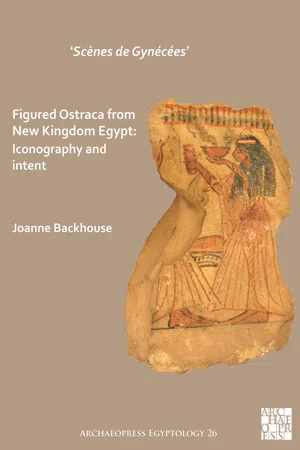
'Scènes de Gynécées' Figured Ostraca from New Kingdom Egypt: Iconography and intent examines images of women and children drawn on ostraca from Deir el-Medina, referred to in previous scholarship as 'Scènes de Gynécées'. The images depict women with children either sitting on beds in a domestic setting or in outdoor kiosks. The former are likely to show celebrations carried out in the home to mark the birth of a child. This may have included the bringing of gifts, mainly consumables and small household items. It is possible this was recorded in hieratic texts, also on ostraca, described in earlier research as gift-giving lists. The kiosk scenes may have depicted the place women gave birth in or more likely the place of confinement after birth. However, given the dense nature of settlement at Deir el-Medina it is possible these scenes were symbolic evoking the protection of Isis who nurtured Horus in the papyrus thicket of the Delta. In order to understand the purpose and intent of these images, repeat motifs are considered and their similarities to wall paintings within the village are examined. The objects are important as they represent rare examples of regional art, found only at Deir el-Medina. Also, women are the main protagonists in the scenes, which is unusual in Egyptian art as women are generally depicted alongside the male patron of the work, as his wife, daughter or sister. This publication represents the first systematic study of this material and it brings together ostraca from museums worldwide to form a corpus united contextually, thematically and stylistically.
Information
Archaeopress
Egyptoloy
www.archaeopress.com
‘
Scènes
de
Gynécées
’
Figured
Ostraca
from
New
Kingdom
Egypt:
Iconography
and
intent
examines
images
of
women
and
children
drawn
on
ostraca
from
Deir
el-Medina,
referred
to
in
previous
scholarship
as
‘
Scènes
de
Gynécées
’
.
The
images
depict
women
with
children
either
sitting
on
beds
in
a
domestic
setting
or
in
outdoor
kiosks.
The
former
are
likely
to
show
celebrations
carried
out
in
the
home
to
mark
the
birth
of
a
child.
This
may
have
included
the
bringing
of
gifts,
mainly
consumables
and
small
household
items.
It
is
possible
this
was
recorded
in
hieratic
texts,
also
on
ostraca,
described
in
earlier
research
as
gift-giving
lists.
The
kiosk
scenes
may
have
depicted
the
place
women
gave
birth
in
or
more
likely
the
place
of
confinement
after
birth.
However,
given
the
dense
nature
of
settlement
at
Deir
el-Medina
it
is
possible
these
scenes
were
symbolic
evoking
the
protection
of
Isis
who
nurtured
Horus
in
the
papyrus
thicket
of
the
Delta.
In
order
to
understand
the
purpose
and
intent
of
these
images,
repeat
motifs
are
considered
and
their
similarities
to
wall
paintings
within
the
village
are
examined.
The
objects
are
important
as
they
represent
rare
examples
of
regional
art,
found
only
at
Deir
el-Medina.
Also,
women
are
the
main
protagonists
in
the
scenes,
which
is
unusual
in
Egyptian
art
as
women
are
generally
depicted
alongside
the
male
patron
of
the
work,
as
his
wife,
daughter
or
sister.
This
publication
represents
the
first
systematic
study
of
this
material
and
it
brings
together
ostraca
from
museums
worldwide
to
form
a
corpus
united
contextually,
thematically
and
stylistically.
Joanne
Backhouse
completed
her
PhD
at
the
University
of
Liverpool
in
2016.
Her
research
interests
focus
on
depictions
of
non-royal
women
in
ancient
Egypt,
both
two
and
three-
dimensional.
She
also
has
a
wider
interest
in
the
art
of
ancient
Egypt
and
the
evolution
of
style
over
time.
She
teaches
in
the
Continuing
Education
department
at
the
University
of
Liverpool
and
at
a
variety
of
educational
venues
in
the
North
West
of
England,
focusing
on
the
material
culture
of
ancient
Egypt.
Table of contents
- Cover
- Title Page
- Copyright Page
- Contents
- List of Figures
- General Abbreviations
- Acknowledgements
- Introduction
- Deir el-Medina: The History of Excavation and the Nature of the Site
- Catalogue of Painted Wall Decoration Found in the Village
- Catalogue of ‘Scènes de Gynécées’ Figured Ostraca and Comparative Evidence
- ‘Scènes de Gynécées’: The Corpus
- ‘Scènes de Gynécées’: Repeat Motifs
- Conclusions
- Bibliography
- Index
Trusted by 375,005 students
Access to over 1.5 million titles for a fair monthly price.
Study more efficiently using our study tools.
Frequently asked questions
Yes, you can cancel anytime from the Subscription tab in your account settings on the Perlego website. Your subscription will stay active until the end of your current billing period. Learn how to cancel your subscription
No, books cannot be downloaded as external files, such as PDFs, for use outside of Perlego. However, you can download books within the Perlego app for offline reading on mobile or tablet. Learn how to download books offline
Perlego offers two plans: Essential and Complete
- Essential is ideal for learners and professionals who enjoy exploring a wide range of subjects. Access the Essential Library with 800,000+ trusted titles and best-sellers across business, personal growth, and the humanities. Includes unlimited reading time and Standard Read Aloud voice.
- Complete: Perfect for advanced learners and researchers needing full, unrestricted access. Unlock 1.5M+ books across hundreds of subjects, including academic and specialized titles. The Complete Plan also includes advanced features like Premium Read Aloud and Research Assistant.
We are an online textbook subscription service, where you can get access to an entire online library for less than the price of a single book per month. With over 1.5 million books across 990+ topics, we’ve got you covered! Learn about our mission
Look out for the read-aloud symbol on your next book to see if you can listen to it. The read-aloud tool reads text aloud for you, highlighting the text as it is being read. You can pause it, speed it up and slow it down. Learn more about Read Aloud
Yes! You can use the Perlego app on both iOS and Android devices to read anytime, anywhere — even offline. Perfect for commutes or when you’re on the go.
Please note we cannot support devices running on iOS 13 and Android 7 or earlier. Learn more about using the app
Please note we cannot support devices running on iOS 13 and Android 7 or earlier. Learn more about using the app
Yes, you can access ‘Scènes de Gynécées’ Figured Ostraca from New Kingdom Egypt by Joanne Backhouse in PDF and/or ePUB format. We have over 1.5 million books available in our catalogue for you to explore.