eBook - PDF
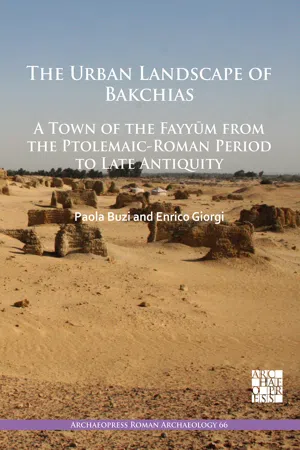
The Urban Landscape of Bakchias: A Town of the Fayyūm from the Ptolemaic-Roman Period to Late Antiquity
- 120 pages
- English
- PDF
- Available on iOS & Android
eBook - PDF
The Urban Landscape of Bakchias: A Town of the Fayyūm from the Ptolemaic-Roman Period to Late Antiquity
About this book
The Urban Landscape of Bakchias: A Town of the Fayy?m from the Ptolemaic-Roman Period to Late Antiquity summarises the results of field research conducted on the archaeological site of Bakchias, located in the north-eastern part of the Fayy?m region. Historical, historico-religious and papyrological studies are also presented. The book provides a clear and comprehensive overview of the rise and fall of the kome of Bakchias. The settlement was a thriving centre from at least the 26th dynasty up until the ninth or tenth centuries CE, although with differing levels of economic prosperity and urban development. Equal weight is given not only to the archaeological and topographical aspects but also to the historical and the religious, whilst never forgetting the relationship between the urban settlement and other villages of the Arsinoite nomos, which is famously a peculiar exception in Egyptian geography.
Information
Table of contents
- Cover
- Title Page
- Copyright page
- Introduction Bakchias and its geographical context
- Paola Buzi
- Reshaping Bakchias
- Bakchias: Its rediscovery, its cults
- Chapter I
- The rediscovery of an ancient Ptolemaic-Roman village… which turned out to have had a much longer life than previously supposed
- After Grenfell, Hunt and Hogarth
- The multiple names of Bakchias
- The changes in the environment in the twentieth century and the lost necropoleis of Bakchias
- A subject still to be still explored: the administrative relation between Bakchias and some neighboring komai
- The cults of Bakchias in the Ptolemaic-Roman period…and before
- Enrico Giorgi
- The Urban Landscape of Bakchias
- Chapter II
- The genesis and urban development of Bakchias
- The pre-Ptolemaic village
- Figure 1. The Fayyum with some of the main villages (Rossetti 2018 from Google Map).
- Figure 2. Plan of Bakchias with base Google Map (Rossetti 2018).
- Figure 3. Bakchias plan with the locations of the excavation seasons (Rossetti 2018).
- The Ptolemaic Town
- Figure 4. Bakchias plan with some of the edifices testified by papyri (Rossetti 2018).
- Figure 5. The Fayyūm with the expansion of the lake during the Middle Kingdom of Egypt, when the first reclamation of the region took place (Morini 2007b).
- Figure 6. The Fayyūm in the Ptolemaic Period, when the second reclamation of the region took place (Morini 2007b).
- Figure 7. Bakchias plan during the early Ptolemaic period (Rossetti 2017).
- Figure 8. Views of the North Kom with the main sacred area in the middle.
- Figure 10. Bakchias plan during the Late Ptolemaic period (Rossetti 2017).
- Figure 9. Bakchias plan during the Ptolemaic period (Rossetti 2017).
- Figure 11. Bakchias plan during the Roman period (Rossetti 2017).
- The Roman Age Town
- The abandonment of the North Kom and the development of the South Kom
- Figure 12. Views of the South Kom.
- Figure 13. A disused mill in the archaeological area.
- The Modern Era
- Figure 14. Stellite image taken in 1968, within the framework of American Corona project (Buzi et al. 2011).
- Chapter III
- Figure 1. General plan of the two temple areas.
- The central sacred area
- The sacred areas of the town
- Figure 2. Plan of the area of the kiln.
- Figure 3. View of the kiln.
- Temple B
- The oldest phases
- Figure 4. The area with of the Amphora near the kiln.
- Figure 5. The Amphora imported from Tyre, that can be dated to the seventh-sixth centuries BC.
- Temple A
- Figure 6. View of the Temple A, on the right, and of Temple B in the background.
- Figure 7. View of the area of the Temple B from south.
- Figure 10. View of the Temple A from east.
- Figure 9. Temple B: floor plan.
- Figure 11. Temple A: floor plan.
- Figure 12. Temple A: a view of kiosk BSE 314, seen from the east, with the temple complex in the background.
- Figure 13. View of the entrance to the Temple A, raised with stones in Roman times, with what remains of the propylon (BSE 385).
- Figure 15. The headless statue of a kneeling male figure with the inscription erased.
- Figure 16. The base for a sphinx or lion that still bears part of the paws and a Demotic inscription.
- Temple C
- Figure 17. Temple C: floor plan with the Temple A on the left.
- Figure 18. Temple C: the sancta sanctum in sandstone blocks, where traces of structures are still visible.
- Figure 19. Temple C: the pylon seen from the north-west.
- Temple D
- The eastern sacred area
- Figure 20. Temple D: floor plan.
- Figure 21. Temple D: the area outside the temple seen from the south-west. Clerical accommodation in the foreground (BSE 330) with storage rooms behind (BSE 404 – BSE 405).
- Temple E
- Figure 22. Temple E: floor plan.
- Chapter IV
- The Northern District
- The house of the priestess of Isis and the surrounding city block
- The northern gate and adjacent buildings
- Figure 1. General plan of the northern district.
- Figure 2. The ceiling made of wooden beams and rush matting.
- Figure 3. The flask decorated with erotic depictions.
- Figure 4. A view of the southern end of the block where the house of the priestess of Isis is located.
- Figure 5. A view of the southern end of the block with rooms A and B (BNO 360).
- Figure 6. The wooden fence built after the houses were abandoned.
- Figure 7. The wooden fences.
- Figure 8. A view of room C.
- Figure 9. A view of room D.
- Figure 10. A view of the inner corner of the room D.
- Figure 11. The ritual store of ceramics and animal bones.
- The rubbish dump
- Figure 12. Egyptian amphora with inscription containing a date (the fifth year of the reign of a Ptolemaic sovereign) followed by other letters that have recently been interpreted as two names, perhaps a certain Etearcus and definitely an Alexander.
- The houses furthest east
- Chapter V
- Figure 1. A section of the general plan including the baths and kiln.
- The Roman baths
- The buildings along the canal and the South Kom
- Figure 2. A section of the general plan including the baths and granary.
- Figure 3. The plan of the baths.
- Figure 4. The plan of the baths during the reigns of Augustus and Hadrian.
- Figure 5. A view of room C, with one of the most well-preserved floors.
- Figure 6. A view of room H, with remains of the floors.
- Figure 7. A view of room G, with remains of the mosaic.
- Figure 8. The tank fout of its original position.
- Figure 9. A possible reconstruction of the baths during Hadrian’s reign.
- Figure 10. A view of hypocaust L.
- Figure 11. A view of hypocaust E.
- The craftsmen’s district
- Figure 12. The tank D, on the left, with the channel on the right.
- Figure 13. A plan of the craftsmen’s district with kiln G.
- Figure 14. A view of tanks B and A in the craftsmen’s district.
- Figure 15. The kiln during excavation work.
- The granary and storerooms
- Figure 16. A view of the public granary.
- The South Kom
- Paola Buzi
- The Last Bakchias
- Bakchias in Late Antiquity and the Early Middle Ages
- Chapter VI
- Christian Bakchias: archaeological and documentary evidence before the 2006 excavation campaign
- The churches of Bakchias
- The discovery of the Eastern Church
- Figure 1. Planimetric representation the Estern church.
- Figure 2. The Estern church seen from east.
- Figure 3. The floor composed of a first level of stretcher bond mud-brick acted as a bed for a second level that was the actual floor, made of small limestone slabs.
- Figure 4. The silo located south-west of the church, made out of yellowish-white limestone slabs cut in irregular shapes, barely held together by a small amount of lime mortar.
- The Western Church
- Towards the discovery of a second church
- Figure 5. Planimetric representation of the Western church.
- Figure 6. Hypothetical reconstruction of the Western Church.
- Figure 7. One of the mud-brick pedestals that belonged to the late phase of the building’s use and were found in both room D (the apse) and room B (the pastophorium).
- Figure 8. The large, complex building located below the Western Church, whose floors and interior walls had been coated in hydraulic lime and that was used as a workshop that handled liquids.
- Chronological and stylistic considerations
- Figure 10. An example of a Corinthian-inspired capital with a large kalathos at the top, wrapped in four stylised acanthus leaves.
- Figure 9. Two examples of a Corinthian-inspired capital with closed, smooth leaves (Bakchias’ first type).
- Figure 11. A capital – which is very similar to those that can be ascribed to the first type found in Bakchias – used as the base of a column in the church of Dayr al Hammām, near Hawārah.
- Concluding reflections regarding the Christian phase of Bakchias
- Figure 12. Stone materials that were probably taken from Temple C and used to make the foundations of the columns in the Western Church.
- Bibliographical references
- Plates
- Plate 1. Plan of Bakchias.
- Plate 2. Plan of the Central Area of Bakchias.
- Plate 3. Plan of the Northern Area of Bakchias.
- Plate 4. Plan of the Eastern Area of Bakchias.
- Plate 5. Plan of the Western Area of Bakchias.
- Plate 6. Plan of the Southern Area of Bakchias.
- Back cover
Trusted by 375,005 students
Access to over 1.5 million titles for a fair monthly price.
Study more efficiently using our study tools.
Frequently asked questions
Yes, you can cancel anytime from the Subscription tab in your account settings on the Perlego website. Your subscription will stay active until the end of your current billing period. Learn how to cancel your subscription
No, books cannot be downloaded as external files, such as PDFs, for use outside of Perlego. However, you can download books within the Perlego app for offline reading on mobile or tablet. Learn how to download books offline
Perlego offers two plans: Essential and Complete
- Essential is ideal for learners and professionals who enjoy exploring a wide range of subjects. Access the Essential Library with 800,000+ trusted titles and best-sellers across business, personal growth, and the humanities. Includes unlimited reading time and Standard Read Aloud voice.
- Complete: Perfect for advanced learners and researchers needing full, unrestricted access. Unlock 1.5M+ books across hundreds of subjects, including academic and specialized titles. The Complete Plan also includes advanced features like Premium Read Aloud and Research Assistant.
We are an online textbook subscription service, where you can get access to an entire online library for less than the price of a single book per month. With over 1.5 million books across 990+ topics, we’ve got you covered! Learn about our mission
Look out for the read-aloud symbol on your next book to see if you can listen to it. The read-aloud tool reads text aloud for you, highlighting the text as it is being read. You can pause it, speed it up and slow it down. Learn more about Read Aloud
Yes! You can use the Perlego app on both iOS and Android devices to read anytime, anywhere — even offline. Perfect for commutes or when you’re on the go.
Please note we cannot support devices running on iOS 13 and Android 7 or earlier. Learn more about using the app
Please note we cannot support devices running on iOS 13 and Android 7 or earlier. Learn more about using the app
Yes, you can access The Urban Landscape of Bakchias: A Town of the Fayyūm from the Ptolemaic-Roman Period to Late Antiquity by Paola Buzi,Enrico Giorgi in PDF and/or ePUB format, as well as other popular books in Social Sciences & Archaeology. We have over 1.5 million books available in our catalogue for you to explore.