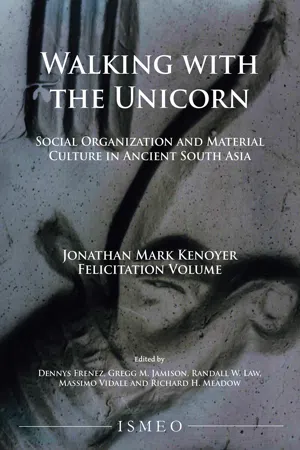
Walking with the Unicorn – Jonathan Mark Kenoyer Felicitation Volume' is an important contribution highlighting recent developments in the archaeological research of ancient South Asia, with specific reference to the Indus Civilization. As suggested by the title, it is a compilation of original papers written to celebrate the outstanding contributions of Jonathan Mark Kenoyer to the archaeology of South Asia over the past forty years. Many interpretations now commonly accepted in the study of the Indus Civilization are the results of Kenoyer's original insights, which combine his instinctive knowledge of the indigenous culture with the groundbreaking application of ethnoarchaeology, experimental studies and instrumental analyses. The numerous contributions from international specialists cover central aspects of the archaeological research on Bronze Age South Asia, as well as of the neighboring regions. They include socio-economic implications of craft productions, the still undeciphered Indus script and related administrative technologies and procedures. The inter-regional exchanges that allowed the rooting of the Indus culture over a vaste territory, as well as the subtle regional variations in this 'Harappan veneer' are also studied.
eBook - PDF
Walking with the Unicorn: Social Organization and Material Culture in Ancient South Asia
Jonathan Mark Kenoyer Felicitation Volume
- 665 pages
- English
- PDF
- Available on iOS & Android
eBook - PDF
Walking with the Unicorn: Social Organization and Material Culture in Ancient South Asia
Jonathan Mark Kenoyer Felicitation Volume
About this book
Information
Table of contents
- Cover
- Title Page
- Copyright Page
- Contents
- Fish Exploitation during the Harappan Period at Bagasra in Gujarat, India. An Ichthyoarchaeological Approach
- The Sincerest Form of Flattery? Terracotta Seals as Evidence of Imitation and Agency in Bronze Age Middle Asia
- Reflections on Fantastic Beasts of the Harappan World. A View from the West
- Fish Symbolism and Fish Remains in Ancient South Asia
- Some Important Aspects of Technology and Craft Production in the Indus Civilization with Specific Reference to Gujarat
- Chert Mines and Chert Miners. The Material Culture and Social Organization of the Indus Chipped Stone Workers, Artisans and Traders in the Indus Valley (Sindh, Pakistan)
- Ceramic Analysis and the Indus Civilization. A Review
- Family Matters in Harappan Gujarat
- Revisiting the Ornament Styles of the Indus Figurines: Evidence from Harappa, Pakistan
- The Harappan ‘Veneer’ and the Forging of Urban Identity
- Private Person or Public Persona? Use and Significance of Standard Indus Seals as Markers of Formal Socio-Economic Identities
- Lithic Blade Implements and their Role in the Harappan Chalcolithic Cultural Development in Gujarat
- Who Were the ‘Massacre Victims’ at Mohenjo-daro? A Craniometric Investigation
- Indus Copper and Bronze: Traditional Perspectives and New Interpretations
- A Short Note on Strontium Isotope Analysis of Human Skeletal Remains from the Site of Sarai Khola
- The Organization of Indus Unicorn Seal Production. A Multi-faceted Investigation of Technology, Skill, and Style
- The Size of Indus Seals and its Significance
- The Art and Technology of Reserving a Slip. A Complex Side of Indus Ceramic Tradition
- The Art of the Harappan Microbead – Revisited
- The North Gujarat Archaeological Project – NoGAP. A Multi-Proxy and Multi-Scale Study of Long-Term Socio-Ecological Dynamics
- Toponyms, Directions and Tribal Names in the Indus Script
- Ganweriwala – A New Perspective
- Personal Reflections on some Contributions of Jonathan Mark Kenoyer to the Archaeology of Northwestern South Asia
- Invisible Value or Tactile Value? Steatite in the Faience Complexes of the Indus Valley Tradition
- What Makes a Pot Harappan?
- Dilmun-Meluhhan Relations Revisited in Light of Observations on Early Dilmun Seal Production during the City IIa-c Period (c. 2050-1800 BC)
- Unicorn Bull and Victory Parade
- Analytical Study of Harappan Copper Artifacts from Gujarat with Special Reference to Bagasra
- Looking beneath the Veneer. Thoughts about Environmental and Cultural Diversity in the Indus Civilization
- Decorated Carnelian Beads from the Indus Civilization Site of Dholavira (Great Rann of Kachchha, Gujarat)
- Artifact Reuse and Mixed Archaeological Contexts at Chatrikhera, Rajasthan
- Pre-Prabhas Assemblage in Gujarat. An Assessment based on the Material Culture from Somnath, Datrana and Janan
- The Indus Script and Economics. A Role for Indus Seals and Tablets in Rationing and Administration of Labor
- Beads of Possible Indus Origin with Sumerian Royal Inscriptions
- The Role of Archaeology in National Identity: Muslim Archaeology in Pakistan
- The Smallest Scale of Stone. Pebbles as a Diminutive Form of Nature
- Five Thousand Years of Shell Exploitation at Bandar Jissah, Sultanate of Oman
- Indus Stone Beads in the Ghaggar Plain with a Focus on the Evidence from Farmana and Mitathal
- Locard’s Exchange Principle and the Bead-Making Industries of the 3rd Millennium BC
- Inscription Carving Technology of Early Historic South Asia. Results of Experimental Archaeology and Assessment of Minor Rock Edicts in Karnataka
- The Volumetric System of Harappa
- An Harappan History of US Researchers in Pakistan. In Celebration of Jonathan Mark Kenoyer
- Editors
- Authors Contacts
Trusted by 375,005 students
Access to over 1.5 million titles for a fair monthly price.
Study more efficiently using our study tools.
Frequently asked questions
Yes, you can cancel anytime from the Subscription tab in your account settings on the Perlego website. Your subscription will stay active until the end of your current billing period. Learn how to cancel your subscription
No, books cannot be downloaded as external files, such as PDFs, for use outside of Perlego. However, you can download books within the Perlego app for offline reading on mobile or tablet. Learn how to download books offline
Perlego offers two plans: Essential and Complete
- Essential is ideal for learners and professionals who enjoy exploring a wide range of subjects. Access the Essential Library with 800,000+ trusted titles and best-sellers across business, personal growth, and the humanities. Includes unlimited reading time and Standard Read Aloud voice.
- Complete: Perfect for advanced learners and researchers needing full, unrestricted access. Unlock 1.5M+ books across hundreds of subjects, including academic and specialized titles. The Complete Plan also includes advanced features like Premium Read Aloud and Research Assistant.
We are an online textbook subscription service, where you can get access to an entire online library for less than the price of a single book per month. With over 1.5 million books across 990+ topics, we’ve got you covered! Learn about our mission
Look out for the read-aloud symbol on your next book to see if you can listen to it. The read-aloud tool reads text aloud for you, highlighting the text as it is being read. You can pause it, speed it up and slow it down. Learn more about Read Aloud
Yes! You can use the Perlego app on both iOS and Android devices to read anytime, anywhere — even offline. Perfect for commutes or when you’re on the go.
Please note we cannot support devices running on iOS 13 and Android 7 or earlier. Learn more about using the app
Please note we cannot support devices running on iOS 13 and Android 7 or earlier. Learn more about using the app
Yes, you can access Walking with the Unicorn: Social Organization and Material Culture in Ancient South Asia by Dennys Frenez,Gregg M. Jamison,Randall W. Law,Massimo Vidale,Richard H. Meadow, Dennys Frenez, Gregg M. Jamison, Randall W. Law, Massimo Vidale, Richard H. Meadow in PDF and/or ePUB format, as well as other popular books in Social Sciences & Archaeology. We have over 1.5 million books available in our catalogue for you to explore.