'Filled with wonderment and awe ... Greene's eloquent memoir is equal parts escape and comfort.' Publishers Weekly
A powerful reflection on life in isolation, in pursuit of the dream of Mars.
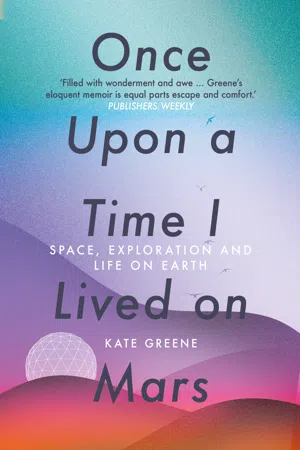
In 2013 Kate Greene moved to Mars.
On NASA's first HI-SEAS simulated Mars mission in Hawaii, she lived for four months in an isolated geodesic dome with her crewmates, gaining incredible insight into human behaviour in tight quarters, as well as the nature of boredom, dreams and isolation that arise amidst the promise of scientific progress and glory.
Greene draws on her experience to contemplate what makes an astronaut, the challenges of freeze-dried eggs and time-lagged correspondence, the cost of shooting for a Planet B.
The result is a story of space and life, of the slippage between dreams and reality, of bodies in space, and of humanity's incredible impulse to explore. From trying out life on Mars, Greene examines what it is to live on Earth.
'In her thoughtful, well-written account of the mission, Greene reflects on what this and other space missions can teach us about ourselves and life on Earth.' Physics Today
- 240 pages
- English
- ePUB (mobile friendly)
- Available on iOS & Android
eBook - ePub
About this book
Trusted by 375,005 students
Access to over 1.5 million titles for a fair monthly price.
Study more efficiently using our study tools.
Information
Topic
Physical SciencesSubtopic
Astronomy & AstrophysicsNOTES
1 “W. H. Hudson says”: “Between Your House and Mine”: The Letters of Lorine Niedecker to Cid Corman, 1960–1970, Lisa Pater Faranda, ed. (Durham, NC: Duke University Press, 1986), 149.
NOTES
1 “Ed White floated”: “Gemini IV: Learning to Walk in Space,”: www.nasa.gov/feature/gemini-iv-learning-to-walk-in-space
2 “first American space walker,”: www.nasa.gov/multimedia/imagegallery/image_feature_1098.html
3 “NASA wanted Gene Cernan”: www.americaspace.com/2014/06/08/date-with-an-alligator-the-trials-of-gemini-ix-a-part-2; “Astronaut and Cosmonaut Medical Histories,” http://www.doctorzebra.com/drz/s_medhx.html
4 “Ten days after”: Michael J. Neufeld and John B. Charles, “Practicing for Space Underwater: Inventing Neutral Buoyancy Training, 1963–1968,” Endeavor, vol. 39, 3–4.
5 “There is no there there”: Stein’s longer quote is “What was the use of my having come from Oakland it was not natural to have come from there yes write about it if I like or anything if I like but not there, there is no there there.” Gertrude Stein, Everybody’s Autobiography (New York: Vintage Books, 1973), 289.
6 “The essayist John D’Agata”: John D’Agata, “Yucca Mountain as Metaphor in About a Mountain,” interview by Ira Flatow, Science Friday, NPR, March 5, 2010, www.npr.org/templates/story/story.php?storyId=124361803
7 “to contend with complicated questions of who we, in our complexity”: A note on the narrative We: Throughout this text, I use the first person plural we (and related pronouns us and our) to mean a fewdifferent groups. We is certainly shifty, even more so than the narrative I, and it’s certainly more politically fraught. I’d like to try to clarify a few types of we I used in this text that explain my relationship to the use of the we in these cases. In the above case, I’m interested in the complexity of the most general human-we there is, the we as a species. It’s a grand gesture, and one I don’t take lightly. I hope that it can be read in a spirit of g enerosity and solidarity and not as an act of claiming or omniscience. No one can speak for each human on the planet. Of course not. But I hope a number of the questions asked in this book have the potential to be relevant to a great many humans alive today. That’s what I aim to get at with this we. Occasionally, I use we to refer, colloquially, to people who may be similar to me in terms of interests or perspectives or experiences. This is the loosest kind of we there is and the trickiest to deploy. It assumes a kinship with the reader that may or may not be there. I’m aware that it doesn’t always work for all readers, and I’ve tried to use it sparingly. In other cases, I use we to refer to my crewmates and me. I can’t speak for them at all times either, but there were enough shared experiences, goals, schedules, observations, etc., that in certain cases, I feel confident, though not perfectly, in speaking for the collective. And finally, there are times when I use we to refer to Earthlings in the most general sense. That is, all creatures of this planet. We really are all in it together.
NOTES
1 “poutine”: OED Online. September 2019. Oxford University Press. www-oed-com.ezproxy.sfpl.org/view/Entry/263616?redirectedFrom=poutine
2 “In 2001, chef Martin”: Crystal Luxmore, “Martin Picard,” The Canadian Encyclopedia, March 10, 2014. www.thecanadianencyclopedia.ca/en/article/martin-picard
3 “The psycho-social preparation”: Kim Binsted et al., “Human Factors Research as Part of a Mars Exploration Analogue Mission on Devon Island,” Planetary and Space Science 58, no. 7–8 (2010): 994–1006.
4 “An NPR headline”: Joe Palca. “Why Astronauts Crave Tabasco Sauce,” All Things Considered, www.npr.org/sections/thesalt/2012/02/23/147294191/why-astronauts-crave-tabasco-sauce
5 “space camp as a kid”: My space camp hopes and dreams were localized to Hutchinson, Kansas, home to the Cosmosphere, an excellent space museum, and space camp. https://cosmo.org/
6 “Fantasy is hardly”: www.youtube.com/watch?v=GilIovrb4uE&feature=youtu.be&t=5m43s
7 “The first food”: https://aas.org/posts/news/2016/11/month-astronomical-history-launch-sputnik-2
8 “The second food”: https://airandspace.si.edu/exhibitions/apollo-to-the-moon/online/astronaut-life/food-in-space.cfm and www.bbc.com/news/science-environment-12460720
9 “In Packing for Mars”: Mary Roach, Packing for Mars: The Curious Science of Life in the Void (New York: W. W. Norton, 2010), 298–299.
10 “there’s a YouTube video”: Canadian astronaut Chris Hadfield makes a burrito in space here: www.youtube.com/watch?v=f8-UKqGZ_hs
11 “After months ensnared”: This is the one of many different accounts of Shackleton and his crew and ship that are referenced throughout this book. Alfred Lansing, Endurance: Shackleton’s Incredible Voyage (New York: Basic Books, 2014).
12 “It is scandalous”: Ibid.
13 “the celebrated food writer”: All of M. F. K. Fisher is worth reading, but these quotes appear in the foreword to her book The Gastronomical Me (San Francisco: North Point Press, 1989).
14 “they wanted to avoid”: Skylab wardroom table and hierarchy observation can be found here: Deborah Schne...
Table of contents
- TITLE PAGE
- DEDICATION
- CONTENTS
- EPIGRAPH
- I: INTRODUCTION
- II: ASTRO-GASTRONOMY
- III: ON BOREDOM
- IV: THE STANDARD ASTRONAUT
- V: GUINEA-PIGGING
- VI: ON VESSELS
- VII: ON ISOLATION
- VIII: ON CORRESPONDENCE
- IX: DREAMS OF MARS, DREAMS OF EARTH
- X: DEEP TIME, DEEP SPACE
- XI: HUNDREDS OF BILLIONS OF DOLLARS
- XII: EXITS AND AIR LOCKS
- ACKNOWLEDGMENTS
- NOTES
- COPYRIGHT
Frequently asked questions
Yes, you can cancel anytime from the Subscription tab in your account settings on the Perlego website. Your subscription will stay active until the end of your current billing period. Learn how to cancel your subscription
No, books cannot be downloaded as external files, such as PDFs, for use outside of Perlego. However, you can download books within the Perlego app for offline reading on mobile or tablet. Learn how to download books offline
Perlego offers two plans: Essential and Complete
- Essential is ideal for learners and professionals who enjoy exploring a wide range of subjects. Access the Essential Library with 800,000+ trusted titles and best-sellers across business, personal growth, and the humanities. Includes unlimited reading time and Standard Read Aloud voice.
- Complete: Perfect for advanced learners and researchers needing full, unrestricted access. Unlock 1.5M+ books across hundreds of subjects, including academic and specialized titles. The Complete Plan also includes advanced features like Premium Read Aloud and Research Assistant.
We are an online textbook subscription service, where you can get access to an entire online library for less than the price of a single book per month. With over 1.5 million books across 990+ topics, we’ve got you covered! Learn about our mission
Look out for the read-aloud symbol on your next book to see if you can listen to it. The read-aloud tool reads text aloud for you, highlighting the text as it is being read. You can pause it, speed it up and slow it down. Learn more about Read Aloud
Yes! You can use the Perlego app on both iOS and Android devices to read anytime, anywhere — even offline. Perfect for commutes or when you’re on the go.
Please note we cannot support devices running on iOS 13 and Android 7 or earlier. Learn more about using the app
Please note we cannot support devices running on iOS 13 and Android 7 or earlier. Learn more about using the app
Yes, you can access Once Upon a Time I Lived on Mars by Kate Greene in PDF and/or ePUB format, as well as other popular books in Physical Sciences & Astronomy & Astrophysics. We have over 1.5 million books available in our catalogue for you to explore.