Finite Element Methods in Civil and Mechanical Engineering
eBook - ePub

Finite Element Methods in Civil and Mechanical Engineering

A Mathematical Introduction

  1. 167 pages
  2. English
  3. ePUB (mobile friendly)
  4. Available on iOS & Android
eBook - ePub

Finite Element Methods in Civil and Mechanical Engineering

A Mathematical Introduction

About this book

The finite element method is widely employed for numerical simulations in engineering and science due to its accuracy and efficiency. This concise introduction to the mathematical theory of the finite element method presents a selection of applications in civil and mechanical engineering including beams, elastic membranes, the wave equation, heat transfer, seepage in embankment, soil consolidation, incompressible fluids, and linear elasticity. Jupyter notebooks containing all Python programs of each chapter can be downloaded from the book's companion website.

Arzhang Angoshtari is an assistant professor and Ali Gerami Matin is a graduate student, both in the department of Civil and Environmental Engineering at the George Washington University, USA. Their research interests cover theoretical and computational mechanics and finite element methods.
Frequently asked questions

Yes, you can cancel anytime from the Subscription tab in your account settings on the Perlego website. Your subscription will stay active until the end of your current billing period. Learn how to cancel your subscription.
No, books cannot be downloaded as external files, such as PDFs, for use outside of Perlego. However, you can download books within the Perlego app for offline reading on mobile or tablet. Learn more here.
Perlego offers two plans: Essential and Complete
  • Essential is ideal for learners and professionals who enjoy exploring a wide range of subjects. Access the Essential Library with 800,000+ trusted titles and best-sellers across business, personal growth, and the humanities. Includes unlimited reading time and Standard Read Aloud voice.
  • Complete: Perfect for advanced learners and researchers needing full, unrestricted access. Unlock 1.4M+ books across hundreds of subjects, including academic and specialized titles. The Complete Plan also includes advanced features like Premium Read Aloud and Research Assistant.
Both plans are available with monthly, semester, or annual billing cycles.
We are an online textbook subscription service, where you can get access to an entire online library for less than the price of a single book per month. With over 1 million books across 1000+ topics, we’ve got you covered! Learn more here.
Look out for the read-aloud symbol on your next book to see if you can listen to it. The read-aloud tool reads text aloud for you, highlighting the text as it is being read. You can pause it, speed it up and slow it down. Learn more here.
Yes! You can use the Perlego app on both iOS or Android devices to read anytime, anywhere — even offline. Perfect for commutes or when you’re on the go.
Please note we cannot support devices running on iOS 13 and Android 7 or earlier. Learn more about using the app.
Yes, you can access Finite Element Methods in Civil and Mechanical Engineering by Arzhang Angoshtari,Ali Gerami Matin in PDF and/or ePUB format, as well as other popular books in Technology & Engineering & Mechanics. We have over one million books available in our catalogue for you to explore.

Information

1 Overview

In this introductory chapter, we briefly discuss the basic aspects of the finite element method for solving differential equations. The goal is to give an overview of the book and to motivate the topics that will be discussed in the following chapters. Only main ideas are discussed and the readers are expected to focus only on the big picture and not on details. Technical details of this chapter are the subject of the following ones. This chapter is not a prerequisite for the rest of the book and the readers may skip this chapter if they wish.
Roughly speaking, one may consider the following four stages for the approximation of responses of a system using the finite element method: (i) Identifying the governing equations, which are assumed to be differential equations in this book; (ii) Deriving weak forms of the governing equations; (iii) Discretizing weak forms by using the Galerkin method to obtain a discrete problem; and (iv) Employing piecewise polynomial finite element spaces to solve the discrete problem.
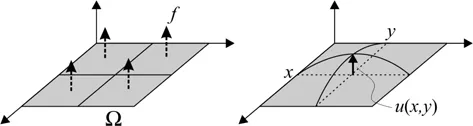
To be more specific, let us consider the approximation of the equilibrium position of an elastic membrane Ω shown in Figure 1.1, which is fixed at its boundary Ω and is under a vertical load f.
Figure 1.1
Figure 1.1An elastic membrane under a vertical load: (Left) Undeformed configuration Ω and the load f (dashed arrows); (Right) The vertical displacement u(x,y) at the point (x,y).

Governing Equations

The laws of physics imply that the vertical displacement u of the membrane Ω satisfies the boundary value problem
{Δu=f, in Ω,u=0, on Ω,
1.1
where Δ is the Laplacian, i.e. Δu=xxu+yyu. This governing equation is also called Poisson’s equation.

Weak Forms

The equation (1.1) is called the strong form of the governing equation. To solve the strong form, one should find a function which is at least twice differentiable and satisfies (1.1). Usually, it is hard to directly find such a function. Alternatively, it may be easier to find a suitable solution candidate first and then showing that the solution candidate is a real solution by establishing its differentiability.
...

Table of contents

  1. Cover
  2. Half Title
  3. Title
  4. Copyright
  5. Dedication
  6. Contents
  7. Preface
  8. Chapter 1 Overview
  9. Chapter 2 Mathematical Preliminaries
  10. Chapter 3 Finite Element Interpolation
  11. Chapter 4 Conforming Finite Element Methods for PDEs
  12. Chapter 5 Applications
  13. Appendix A FEniCS Installation
  14. Appendix B Introduction to Python
  15. References
  16. Index