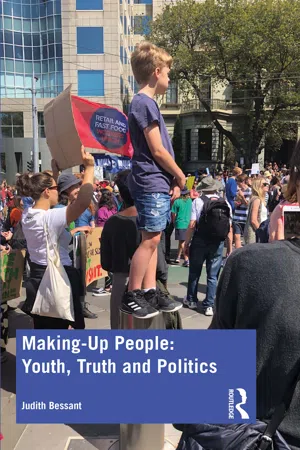
This book is about modern politics and young people. Judith Bessant revises some long-standing myths about children and young people's politics. She highlights the huge gap between the many ways young people and politics are talked about and how they have long been politically active.
Bessant draws on a relational historical sociology to show how since the nineteenth century certain historical dynamics, political interests and social imaginaries have enabled social scientists, writers, political leaders and policymakers to imagine and 'make up' different kinds of young people. Given these representations of childhood, adolescence and youth, everyone knows that young people are cognitively immature, inexperienced, morally under-developed and lack good judgement. For these reasons they cannot possibly be allowed to engage in the serious, grown-up business of politics. Yet in just one of the many contradictions, young people are criticised by many of their elders for being politically apathetic and disengaged from politics.
Many think recent global warming movements largely led by quite young people are a novel phenomenon. Yet young people have been at the forefront of political movements of all kinds since the French Revolution. Since the 1960s, children and young people increasingly played a major, if sometimes obscured, role in civil rights, anti-war, anti-globalisation, anti-austerity and global-warming movements. This accessible book is rich in theoretical and historical insight that is sure to appeal to sociologists, historians, youth studies scholars and political scientists, as well as to the general reader.
Trusted by 375,005 students
Access to over 1.5 million titles for a fair monthly price.
A common lament amongst many academics and researchers is about the difficulty they experience in defining concepts that are central to their work. In the social sciences, sociology and youth studies in particular, many writers observe how concepts vital to their field of study, like ‘youth’ or ‘adolescence’, have been contested, and the difficulty they experience in defining ‘its’ precise nature. As Steven Threadgold notes, one reason for this is that we have many different ‘figures of youth’, that include ‘stereotypes, clichés, memes, targets, scapegoats, folk devils, stigma, discourses and signifiers’ (Threadgold 2019:3).
Given this, it may seem reasonable to ask: why can’t common sense prevail? Surely, it cannot be that hard. Why don’t we just look and see what is in front of us, and identify certain people ‘as they are’ as ‘children’ or ‘young people’? While this may sound sensible, it is not so easy for reasons explored in this chapter. Clearly, there are children and young people ‘out there’, but how and what we know of them is not so straightforward. If, e.g., we assume that everyone including scientists and statisticians all see the world in the same way, we might expect everyone to use the same words to describe the same things and thus we could have unanimous agreement. That however is something we cannot assume as most words have multiple meanings and there is considerable disagreement about what is happening in the world.
Why then are there so many different ways of seeing, knowing and representing concepts that are central to our lives and work. It was this question that led Christine Griffin in 1993 to publish a widely cited and well-received book called Representations of Youth: The Study of Youth and Adolescence in Britain and America.
This book begins with the observation that while children and young people do sometimes get to talk for and about themselves, most of the dominant, powerful and enduring representations about them are produced by experts, academics and media workers.1 Griffin describes how young people have been talked about or ‘represented’ by academics and various experts in British and North American research through the twentieth century. As she says, her interest was in ‘the ideological role played by youth research in the construction and reproduction of academic common sense about young people’ (Griffin 1993:2). She said her aim was to ‘throw a conceptual spanner into the workings of … youth research by examining the discursive processes through which “youth” and “adolescence” were represented in the 1980s’ (Griffin 1993:214). Griffin also observed the tendency to represent young people as ‘problems’. Her focus was on young people represented as potentially ‘troubled’ and subject to ‘disorders of consumption and transition’.
This representation, she argued, relied heavily on G. Stanley Hall’s account of adolescence as an inherently troubled and turbulent period in the ‘life-cycle’ (Hall 1904). According to Hall that turbulence was due to a conflict between biological urges and the need for social restraint. With puberty he argued came the release of sexual hormones. This produced hyper-sexualised adolescents seeking sexual release, but who needed to control their impulses until they could legitimate sex with people of the opposite sex – and form their own family. This became the dominant model or representation of adolescence as a physiologically driven period of ‘storm and stress’. Griffin demonstrated how experts addressed a series of ‘crises’ about young people in relation to unemployment, crime and delinquency, their sexuality, including ‘teenage pregnancy’ and leisure.
Without detracting from Griffin’s achievement and the many qualities of the book, there are one or two conceptual problems in her work. In what follows, I highlight those as they relate specifically to the question of representations. The main problem is that Griffin did not say how she understood representations. This is a curious omission given that Serge Moscovici, a major figure in Griffin’s own discipline of social psychology, produced a body of work on social representations. Rather than representations, Griffin considered other categories, namely discourses and ideologies, which it seems she saw as synonymous with representations. Griffin, e.g., described a ‘representation’ as a kind of ‘discourse’ or ‘discursive configuration’, which in ‘treatment regimes’ is used to ‘construct’ and manage ‘troubled teens’. This might lead one to think a discourse analysis was going to be offered (Fairclough 1989, 1992). However, what Griffin provided was a discussion of ‘ideologies’. In what follows, I discuss the concepts ‘ideology’, ‘discourses’ and ‘representations’, beginning with discourse and ideology.
Discourse and ideology
Griffin’s work is reflective of the time in which she wrote. In the 1980s and 1990s, many academics developed and applied ‘discourse theories’ and ‘discourse analysis’ – typically under the aegis of Foucault and Derrida. In Griffin’s book however Foucault makes a fleeting appearance – and Derrida not at all. Griffin seems more interested in the traditional idea of ‘ideology’ than discourse. It was a preference that created certain difficulties for her. Griffin’s decision to talk about discourse and ideology also seems to have distracted her from focusing on representations.
For Griffin, discourses are ‘constructions’ of the ‘age stage of youth’ or ‘adolescence’ that involve making ‘distinctions between “normal” and “deviant” forms of adolescent behaviour itself…’ (Griffin 1993). Moreover, these ‘constructions’ are the product of:
…complex interactions between research funding agencies, academic career moves, research designs and techniques, publication of research results -and the practices of young people and other adult groups with whom they are involved.
The idea that these ‘constructions’ or ‘discourses’ are produced through interactions with ‘the practices of young people’ creates a problem because Griffin also says ‘constructions’ or ‘discourses’ are produced by experts with – or without – any relation with or connection to young people.
The mixed messages are amplified when Griffin says drawing on the work of Ian Parker that:
I have viewed discourse as ‘a system of statements which constructs an object. This fictive object can then be reproduced in the various texts written or spoken within the domain of discourses (that is within the expressive order of society).
This interpretation of discourse includes a number of different ideas. One is that ‘discourses’ about young people reflect ‘the practices of young people’. Yet Griffin also says there are naturally occurring ‘objects’ like the ‘practices of young people’. Moreover, ‘discourses’ are said to ‘construct fictive objects’. The claim that discourse ‘invents an object’ (even if a ‘fictive object’) implies that some kind of world-making exercise is happening.
Thus, it seems Griffin thinks discourses about young people are simultaneously ‘fictive objects’ and ‘real objects’ (i.e., ‘reflections of real practices’). She does not however say how such a distinction might be made. Here Griffin falls into a formulation that begs a number of questions. On the one hand, the idea that discourse ‘invents an object’ implies there is an ontological world-making exercise taking place. Contrarily, it also implies there is a distinction between ‘fictive objects’ and ‘real objects’ but without identifying what that distinction is.
There is also a question about Griffin’s reference to ‘the expressive order of society’ and what that means. It seems Griffin saw (like Durkheim or Parsons) society as an ‘objective’ entity that can be understood as a single, unitary symbolic order that is independent, unitary and separate from any individual. However, no modern society exists that exhibits such unity. All such societies are characterised by major economic, political, religious, moral and sexual differences. These are evident in important moral disagreements, in political conflicts, major inequalities in people’s access to cultural and economic resources – all this framed by differences apparent in categories such as class, gender, religion, ability, status, ethnicity and age. Given these differences, it is not possible to say we have a single or unitary expressive order.
Besides overlooking those differences, such an understanding of society also creates a difficulty for someone (like Griffin) who claims a Marxist provenance when thinking about ideology. Talking about a society as a unitary entity while also using a Marxist framing of ideology that presumes major class differences is bound to cause some problems.
In short, while Griffin declares a commitment to using the category of ‘discourse’, at the same time, she also uses the Marxist idea of ‘ideology’:
I have retained what may seem (to some) an unfashionable use of concepts such as ideology and hegemony alongside an examination of discourses … I have tried to show how specific discourses operate in the ideological domain.
The problem with doing this is that talking about ‘ideology’ means acknowledging that societies are not unitary. It means recognising how they are characterised by major inequalities, conflicts, differences of experience and diverse cultures and do not constitute a singular ‘expressive order’ (Parker 1989:62).2
Those working in the classical Marxist tradition see ideologies as false ideas or forms of false consciousness.3 The Marxist idea of ‘ideology’ refers to belief-systems designed to persuade particular groups such as ‘working-class people’ or ‘women’ that they should not complain about their place in what is actually an unequal social order. This may involve claims that this is a natural and timeless order that benefits everyone, or that it is a society which is committed to equal opportunity, etc. Indeed, ‘workers’ or ‘women’, etc. believing these ideas to be true assist in their continuation and in the reproduction of the social status quo (Eco 1995:17). As Žižek argues, ideologies are used to secure the voluntary consent of people about contestable political policies or social arrangements. Typically, this is done by representing those arrangements as natural and so unchangeable (Žižek 1989).
Using this Marxist framing, Griffin says she demonstrates why various representations of ‘youth’ are ideological and perform the social function of binding young people to a hegemonic capitalist culture of consumption. As she explained earlier:
How are we to understand these contemporary constructions of young people, and especially young women, in texts from all parts of the political spectrum? … For many young women (and young men), dominant representations of ‘normal’ family life appear as pervasive if increasingly distant images, strongly associated with a particular set of consumer goods – including a VCR and a CD player … What if the bait (steady job, nice things, lovely home/car/baby/husband) fails to materialize at all?
Griffin also did not say how she understood the ‘representations of youth’ as a political practice.
Having said that, a failure to explicitly discuss the concept of ‘politics’ is both common and hardly unique to Griffin. Many researchers in sociology and political science don’t define politics perhaps because we all assume we agree on what we are talking about. When pressed, the default position usually is that the political is synonymous with the exercise of power. This may be why, when Griffin does touch on the subject of the political, she refers to power but does not go on to develop that idea.
She does however, at the start of her book, briefly refer to power differences between young people and the academics researching them, noting that most research participants have minimal ‘material, cultural or ideological power’, while their voices are frequently pathologised, criminalised, muted or silenced altogether (Griffin 1993:2). Moreover, academic researchers also possess and deploy their privileged ‘intellectual expert status about other people’s lives’ (Griffin 1993:2). This is why Griffin says she pays attention to ‘power relations’ because power is an element ...
Table of contents
Cover
Half Title
Title Page
Copyright Page
Dedication
Table of Contents
List of figures
Acknowledgements
Introduction
1 Thinking about social representations
2 A minor omission: children, young people and politics
3 ‘The past is a Foreign country…’: young people in the eighteenth century
4 Civilising little savages: children and the dangerous classes
5 Girls politics and delinquency in the 1950s
6 Representing student politics in the 1960s
7 The great transformation: the young precariat and young entrepreneur
8 Making the waves: contemporary youth action
9 Answering back and the politics of recognition
Conclusion
Bibliography
Index
Frequently asked questions
Yes, you can cancel anytime from the Subscription tab in your account settings on the Perlego website. Your subscription will stay active until the end of your current billing period. Learn how to cancel your subscription
No, books cannot be downloaded as external files, such as PDFs, for use outside of Perlego. However, you can download books within the Perlego app for offline reading on mobile or tablet. Learn how to download books offline
Perlego offers two plans: Essential and Complete
Essential is ideal for learners and professionals who enjoy exploring a wide range of subjects. Access the Essential Library with 800,000+ trusted titles and best-sellers across business, personal growth, and the humanities. Includes unlimited reading time and Standard Read Aloud voice.
Complete: Perfect for advanced learners and researchers needing full, unrestricted access. Unlock 1.5M+ books across hundreds of subjects, including academic and specialized titles. The Complete Plan also includes advanced features like Premium Read Aloud and Research Assistant.
Both plans are available with monthly, semester, or annual billing cycles.
We are an online textbook subscription service, where you can get access to an entire online library for less than the price of a single book per month. With over 1.5 million books across 990+ topics, we’ve got you covered! Learn about our mission
Look out for the read-aloud symbol on your next book to see if you can listen to it. The read-aloud tool reads text aloud for you, highlighting the text as it is being read. You can pause it, speed it up and slow it down. Learn more about Read Aloud
Yes! You can use the Perlego app on both iOS and Android devices to read anytime, anywhere — even offline. Perfect for commutes or when you’re on the go. Please note we cannot support devices running on iOS 13 and Android 7 or earlier. Learn more about using the app
Yes, you can access Making-Up People: Youth, Truth and Politics by Judith Bessant in PDF and/or ePUB format, as well as other popular books in Politics & International Relations & Social History. We have over 1.5 million books available in our catalogue for you to explore.