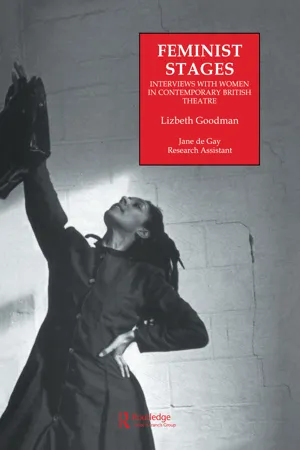
This volume is a collection of interviews that spans feminist views from 1968 to the 1990s. Including over eight years of research. Part of the Comtemporary Theatre Studies series, it will be of special interest to everyone involved in theatre and useful to students and those who oare interested in women's theatre.
eBook - ePub
Feminist Stages
Interviews with Women in Contemporary British Theatre
- 348 pages
- English
- ePUB (mobile friendly)
- Available on iOS & Android
eBook - ePub
About this book
Trusted by 375,005 students
Access to over 1.5 million titles for a fair monthly price.
Study more efficiently using our study tools.
Information
Subtopic
Art GeneralPART I
FEMINIST STAGES
FROM 1968 INTO THE 1970s
‘Feminist theatre’ in Britain came into its own in the late 1960s. Theatre censorship was abolished by Act of Parliament in 1968, and the first British National Women’s Liberation Conference was held in Oxford in 1969. Such cultural, political and social changes influenced the formation of what is now often called the ‘second wave’ of modern feminism, with the development of consciousness raising groups, and feminist activism in the form of political protests for women’s rights. This same period saw the formation of women’s theatre companies dedicated to producing work by women, or to dealing with issues of particular importance to women’s lives. The rise of the women’s movement in this period influenced the first specifically gender-oriented political demonstrations since the era of the suffragists. Important demonstrations against the Miss World and Miss America Pageants were staged in 1969–71; these questioned long-accepted stereotypes of women as sexual objects by denouncing such forms of representation on both personal and political grounds. Early feminist activists discovered the effectiveness of public performance as a form of political communication and persuasion. So, many feminist protests were staged as theatre performances, on the streets and on (and in) many different stages.
Demonstrations such as the beauty pageant protests can be seen, in retrospect, as the first stage in a clear progression from early feminist consciousness to organized feminist theatre. The next stage in this development was the emergence of early feminist agitprop groups such as The Women’s Street Theatre Group. The development of feminist theatre from street demonstration to ‘theatrical production’ was contingent upon the development of ‘fringe’ theatre. The emergence in 1968 and after of fringe theatre companies allowed for the subsequent development of splinter groups with particular allegiance to women’s issues. For instance, fringe companies such as Portable Theatre, The Pip Simmons Group, The Warehouse Company, The Brighton Combination, Welfare State International, and Incubus Theatre were instrumental to the development of The Women’s Street Theatre Group (which sometimes performed in theatre spaces), Monstrous Regiment and Mrs. Worthington’s Daughters.
Red Ladder produced Strike While the Iron is Hot in 1972, and Women’s Theatre Group produced their first show, My Mother Says I Never Should, in 1974. Playwrights including Ann Jellicoe, Jane Arden, Margaretta D’Arcy, Shelagh Delaney and Doris Lessing, who were among the first women to write for the British stage in the 1950s and 1960s, were followed in the late sixties and seventies by a second generation of feminist playwrights including Caryl Churchill, Maureen Duffy, Pam Gems and Louise Page. Ann Jellicoe’s early plays for the Royal Court are, perhaps, what earned her reputation as one of the UK’s leading playwrights, but her recent work in community theatre is also important. As her interview in this book reveals, the role of women in contemporary community drama — as in contemporary communities — throws a new light on the subject of ‘women in theatre’.
Funding was also a factor in the development of women’s work in the theatre. Women’s Theatre Group was funded by the Arts Council of Great Britain, but The Women’s Company was not. Monstrous Regiment of Women received some funding, as did Gay Sweatshop (a mixed company of lesbians and gay men), but Siren (an explicitly lesbian theatre company) struggled to find financial support. The women interviewed in these pages give a personal account of the impact of arts funding on the development of women’s theatre work.
The Conference of Women Theatre Directors and Administrators (CWTDA) was founded in this period. Sue Parrish, Sue Dunderdale and Sarah Daniels, among many others, published important articles in CWTDA’s papers. (See Contemporary Feminist Theatres for details).
Perhaps most importantly, some — though only a precious few — of the companies founded in the 1970s are still producing feminist theatre today. The women who give voice to this crucial period in feminist theatre ‘history’ are also leading lights in contemporary (1990s) theatre practice.
Lizbeth Goodman
During her long and varied career in the theatre Ann Jellicoe has been actress, stage-manager, director, producer, literary manager (Royal Court Theatre)and teacher (Central School of Speech and Drama, RADA, etc.). But, she is probably best known as a playwright and as the innovator of community plays. Her plays include: The Sport of My Mad Mother (1958), Shelley; or The Idealist (1965) and The Knack (1961). Translations include Rosmersholm (1959) and The Seagull (1964) and an opera Der Freischiitz (1964). She has also written plays for children. Since the late 1970s, she has concentrated on producing, and in most cases writing and directing, community plays — fourteen in all — from The Reckoning (Lyme Regis, 1978) to Changing Places (Woking, Surrey, 1992).
Are you aware that the position of women in the theatre has changed during the time that you have been in the profession?
When I started at the Royal Court in 1956, it was still very unusual for women to work there. You weren’t even a token woman; they didn’t think in terms of token women. You were expected to think of yourself as ‘privileged’ to be there. There was no thought for women’s issues or women’s place. The curious thing is that, at the time, one just accepted that: it was absolutely bred into one. It’s very hard to imagine now. In the 1970s, I went back to the Royal Court as Literary Manager. I was the first woman Literary Manager, although I don’t think they thought of me as a woman: they knew my work very well, and so they probably regarded me as an ‘honorary man’.
By the 1970s, I could see the balance changing. I remember going to a woman’s theatre season at the Round House in 1970–1, and seeing a play by Pam Gems, and I suddenly felt that something had changed, the balance had tipped. For one thing, I almost always used to go to the theatre alone. Theatre-going was not a social event to me, but part of my job. I always felt that there was a certain frisson about a woman being there on her own. But when I went to that season, I felt that I had a perfect right to be there. It didn’t matter that I was alone, that as a woman I was in my right place.
Of course since then there have been so many women directors in the provincial theatre, that it’s no longer possible for men to say they can’t appoint a woman director for the National Theatre because women haven’t got any experience. Women directors are clocking up experience like mad. And it’s the provincial theatres which have done it. Jane Howell, at Exeter, was one of the first, then there were Annie Castledine, Clare Venables, and more recently Jude Kelly to name a few, coming up through provincial theatres1. Not through the Royal Court. Not through the National. But we’ve now got women in the position where they can seriously be considered as possible directors of the National Theatre.
Why did that change happen first in the provincial theatre?
Because there is less money, less power, fewer resources, it’s not so important and not so enviable. I’m awfully conscious that men are aggressive. I’ve noticed that in any group or workshop, if you call for volunteers, the men rush forward pushing women aside. So until now, women have always had to work with less money, less power. The interesting thing is: Jude Kelly was appointed specifically to work in tandem with the (male) administrator (just as Elisabeth Esteve-Coll was appointed to the V & A because she was willing to play by rules set by the Governors — whose Chair, Sir Robert ‘Economical with the Truth’ Armstrong, was Mrs Thatcher’s Cabinet Secretary). These arrangements have apparently proved satisfactory. Clearly men think that women are more biddable, more easily managed, more practical and realistic as to where power lies and what is actually possible. The men may well be right. But I wonder what are the implications in terms of women’s art?
When you think about the changes which you have described over the last three decades, what do you think has contributed to that process: have changes within or outside the theatre been more important in shifting the balance?
Changes outside the theatre have been most important: political education and political awareness. That’s what happened to me: one realises that one may have been brought up to accept things in a certain way, but that’s not necessarily how things need to be.
I’d always wanted to be in the theatre ever since I can remember. I just floated along: I started out as an actress, director, even playwright of sorts. Then I taught at drama school, then I became a ‘real’ playwright. For a long time, I was politically blind. Looking back, I realize that people patronized me, but it’s only when you’re politically aware that you realise what’s happening.
I sometimes wonder if being a woman held me back and I’m pretty certain it did, but I wasn’t aware of it at the time. I was the woman who had broken through — people produced my plays (there were plenty of women novelists but not many women playwrights in the fifties and sixties). I never consciously sought to gain power. It came without my noticing it.
_______________
1 Betty Caplan discusses the importance of regional theatres, page 183.
Did the feminist movement ever become important to your work?
Hardly. I’m very much aware of women’s interests, women’s points of view, but I have never engaged in the struggle, it’s not in my nature to be aggressive in that way.
Would you say that you were a feminist?
I fight my own way. I write some plays about women but they are hardly political plays except insofar as everything we do is political.
Thinking about the development of theatre over this period, do you think that feminism has had an impact? You say that people have become more politically aware: do you think that feminism has been an important element?
Oh yes, incredibly important, because it has aroused people like me who are not particularly political. In a sense we owe them a great debt. They made me politically aware of the issues, of what was going on, aware of the arguments. They educated me, made me aware that I was being patronized, that men take all the big jobs and block the road.
When you write plays about women, are you conscious of writing as a woman, from a woman’s perspective?
I have written two kinds of plays: community plays and ‘ordinary’ plays. In the community plays women’s interest is forced on you because there are always more women than men who are interested in being in the play. So you are always looking for a story which is based on women — to which women are fundamentally important and not peripheral. So that naturally means you take women’s stories. In my other plays, the women are always, I hope, interesting, but the plays aren’t specifically about women, though they are about the relationships between men and women.
Do you think that the theatre can affect social change?
Yes. For example — John Osborne’s Look Back in Anger. I was brought up in the North of England and I thought that nothing ever happened there, that nobody was interested in the accent or wanted to see a play about the area. Look Back in Anger re-started the movement which Annie Horniman had begun with the Manchester Rep by transforming public opinion of provincial plays. However, theatre is not as powerful as television, which can speak to more people.
What about your community plays — can they affect social change? Do you find that people can be changed by participating or by watching?
Oh yes. I’ve said a lot about this in my book, Community Plays, (Methuen, 1987). One example that springs to mind is a housewife in Dorchester, who had little confidence and a part-time job as a school secretary. That woman, after two plays, is now chairman of the Dorset Arts Group which is a big organization with its own premises. Other women may say to me ‘I lost my husband just before I joined in the show, but through this everybody has been so nice to me and looked after me and I’ve made so many friends’. These experiences are duplicated literally hundreds of times. Astonishing things happen to people.
I suppose that ties in with what you were saying about Look Back in Anger making the northern character more acceptable in the theatre. Do you think that maybe community theatre similarly elevates peoples local characteristics and interests?
Yes, but the two processes are different. Look Back in Anger was a conventional play which struck a public nerve. Whereas community plays involve many individual experiences through which people may change and develop and at the same time, through local audiences, a validation and celebration of a particular place or community.
Do you get many local political issues being raised?
This is the great controversy about community plays. There is a tremendous debate: should we take the burning political issues either in the town or nationally, and reveal the differences in the community? I work the other way: I don’t go for political issues because they’re divisive. I believe it is possible to make friends across the political divide and so help close the divide. Community theatre is riven by this controversy as to whether to be political or ...
Table of contents
- Cover
- Half Title
- Title Page
- Copyright Page
- Dedication
- Table of Contents
- Introduction to the Series
- List of Illustrations
- Acknowledgements
- Feminist Stages: An Introduction
- Part I: Feminist Stages from 1968 into the 1970s
- Part II: Feminist Stages of the 1980s
- Part III: Feminist Stages of the 1990s
- Conclusion: An Interviewer Talks Back
- Afterword: ‘Guerillas in the Mist’: Sightings of, and Observations on Feminists in British Theatre
- Select Chronology of Plays by Women: 1958 to the present
- Index
Frequently asked questions
Yes, you can cancel anytime from the Subscription tab in your account settings on the Perlego website. Your subscription will stay active until the end of your current billing period. Learn how to cancel your subscription
No, books cannot be downloaded as external files, such as PDFs, for use outside of Perlego. However, you can download books within the Perlego app for offline reading on mobile or tablet. Learn how to download books offline
Perlego offers two plans: Essential and Complete
- Essential is ideal for learners and professionals who enjoy exploring a wide range of subjects. Access the Essential Library with 800,000+ trusted titles and best-sellers across business, personal growth, and the humanities. Includes unlimited reading time and Standard Read Aloud voice.
- Complete: Perfect for advanced learners and researchers needing full, unrestricted access. Unlock 1.5M+ books across hundreds of subjects, including academic and specialized titles. The Complete Plan also includes advanced features like Premium Read Aloud and Research Assistant.
We are an online textbook subscription service, where you can get access to an entire online library for less than the price of a single book per month. With over 1.5 million books across 990+ topics, we’ve got you covered! Learn about our mission
Look out for the read-aloud symbol on your next book to see if you can listen to it. The read-aloud tool reads text aloud for you, highlighting the text as it is being read. You can pause it, speed it up and slow it down. Learn more about Read Aloud
Yes! You can use the Perlego app on both iOS and Android devices to read anytime, anywhere — even offline. Perfect for commutes or when you’re on the go.
Please note we cannot support devices running on iOS 13 and Android 7 or earlier. Learn more about using the app
Please note we cannot support devices running on iOS 13 and Android 7 or earlier. Learn more about using the app
Yes, you can access Feminist Stages by Lizbeth Goodman,Jane de Gay in PDF and/or ePUB format, as well as other popular books in Media & Performing Arts & Art General. We have over 1.5 million books available in our catalogue for you to explore.