- 290 pages
- English
- ePUB (mobile friendly)
- Available on iOS & Android
eBook - ePub
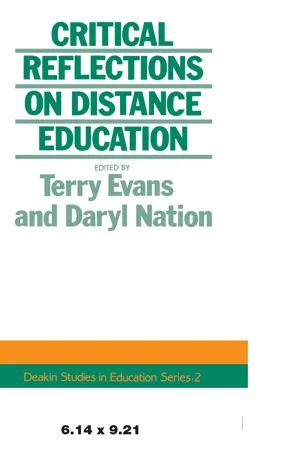
Critical Reflections On Dist.
About this book
This book suggests that apparently unrelated vignettes of Mikhail Gorbachev, Robert Mugabe, and Harold Wilson are closely connected and illustrates that the concept of distance education may be seen as one of those innovations which was forged on the frontier of European expansion overseas.
Information
PART 1
THE PROJECT
Overture
What do Mikhaii Gorbachev, Robert Mugabe and Harold Wilson have in common? Despite their manifest political differences, each has stood under a banner branded socialism. In varying degrees they have played important roles in Southern African politics. Doubtless there are many other interests and activities in which these powerful men have shared. Distance education has played an important part in the political career of each: as students for Gorbachev and Mugabe and as a political instigator for Wilson.
In 1962, at the age of 31, Mikhail Gorbachev's career moved sideways and upwards; he had begun the relatively rapid rise to ultimate power in the Soviet Union. During the previous seven years he had worked his way up within the Komsomol organization in his native region of Stavropol, almost 1600 kilometres from Moscow. His work was related to ideological consciousness raising among the region's youth. His long involvement with the Communist Party and his law degree from the prestigious Moscow State University had equipped him well for the work. His new position of district party organizer, in a region based economically on agriculture, demanded new skills. Thus in September 1962 Gorbachev enrolled in an agricultural economy course, as an external student, at the Stavropol Agricultural Institute. It was a broad course which covered the scientific, technical and practical aspects of plant and livestock farming, finance and management, and gave him even more education in Marxist-Leninist philosophy and economics. Upon graduating in 1967 his career prospects were enhanced considerably. It provided him with a small but significant portion of the knowledge which assisted his promotion back to Moscow in 1978 .1
After training as a teacher in his native village of Kutama in the mid-1940s, in 1945 Robert Mugabe set off to pursue a career as a rural teacher in Southern Rhodesia. In 1949 a scholarship took him to Fort Hare University in South Africa. Here he pursued a Bachelor of Arts and became involved for the first time in African Nationalist politics. Upon graduating he returned to teach in Rhodesia. He embarked upon the twin aspects of his life's work: a rigorous programme of self-education and an active interest in politics. His political activities forced him to leave his country for Zambia and Ghana in the mid- and late 1950s. His decision to return home in the early 1960s led to his periodic detention in prison from December 1964 to late 1974. Mugabe and his fellow political prisoners took the opportunity to plan their revolution from the 'inside', and education occupied a central place in their programme. Mugabe worked as both a teacher and a political leader. However, he did not neglect the opportunity to further his own academic training. Working through a correspondence course from the University of London, he obtained a law degree in eighteen months, a course which normally took three to four years to complete. According to his tutors he took independent learning to extremes.2
Britain's Opposition leader, Harold Wilson, had become interested in the possibilities of applying educational technology to higher education in his country, following a trip to the Soviet Union where he had observed the effectiveness of part-time correspondence courses in technical education and an experience with educational films through Encyclopedia Britannica. Seeking government and constantly vigilant for ideas with electoral appeal, while puffing on his pipe in his study after church one Sunday in the summer of 1963, he lit on the concept of a university of the air. Without seeking party approval he offered a version of the proposal to the British people in September of that year. After the Labour Party's election victory in October 1964 he handed the responsibility to Jennie Lee, a junior minister. The Open University was born.3 The rest is history — a history so important for contemporary distance education that we will deal with it in detail in our final chapter.
We do not wish to make a detailed case here, but we suggest that these apparently unrelated vignettes are closely connected. Indeed, they illustrate Geoffrey Bolton's observation 'that the concept of distance education may be seen as one of those innovations which was forged on the frontier of European expansion overseas; and that the history of distance education is to a considerable extent an example of the process by which ideas and techniques developed on the periphery have gradually been accepted and absorbed into the old heartland of European culture.'4 They are related also to an important theme for the project behind this book: things are not always what they seem!
Notes
1 Medvedev(1986), pp. 32-3, 56, 62-3; Morrison(1988), pp. 90-3.
2 Smith and Simpson (1981), pp. 15-20,54-7.
3 MacArthur (1974), pp. 4-6; Perry (1976), pp. 10-11.
4 Bolton (1986), p. 11.
Chapter 1
Introduction
Terry Evans and Daryl Nation
This book has two fundamental purposes: it offers nine critical reflections upon distance teaching practices in a variety of settings in Australian colleges and universities; and it argues a more general case for the adoption of approaches based upon critical reflection within research, theory and practice in distance education. In Chapter 2 we introduce critical reflection and discuss the development of the project. In the chapters in Part 2 individuals and teams critically reflect on aspects of their practice. In Part 3 we offer a more substantial critical discussion which places our approach within the context of developments of scholarship in distance education and makes links to other relevant areas of theory and research which have hitherto been neglected.
In choosing to structure our knowledge in this way, our aim has been to sketch in the essentials of our approach; and thus to enable those readers whose primary ambition is to come to grips with one or other of the chapters in Part 2 to get on with their reading and reflection. Those who cannot proceed intellectually (academically?) without a substantial dose of theory, can exercise their right to begin with Part 3. Our approach emphasizes the importance of socio-historical factors in the development of practice, research and theory in distance education. Accordingly, we now turn to a more detailed discussion of three issues relating to recent developments in the field: institutional provision for adults requiring post-secondary education, the professional organization of individuals and institutions interested in distance education and the growth of scholarship in the field. But all this presupposes some knowledge of the phenomenon itself. At this juncture some may feel it appropriate for us to launch into a definitional discussion. We prefer to move more empirically; we wish to orient you towards an understanding, or to engage your current understanding, by discussing some concrete examples associated with the issues identified.
In the last three decades there has been a world-wide development of institutions which have applied distance education to the provision of post-secondary education for part-time students. Few would quibble with the claim that the Open University (OU) of the United Kingdom is the most influential achievement in this regard. This vast institution, with over 100,000 students, captured the minds of politicians and educational administrators internationally in the 1970s. Indeed, a diverse range of institutions styled as open universities began to pop up all over the world; at the very least governments were expected to hold an enquiry into establishing one. Let us hasten to add: we are not suggesting that the OU was the single cause of this outbreak of educational development. Two very enduring trends emerged amongst ail this political and administrative activity: the open university concept was rarely adopted slavishly, generally local factors have had considerable influence; and those institutions which had pioneered distance education long before the 'open university fad' were given both recognition and resources for new development.
In Australia, for example, external studies in higher education have continued to progress on the courses charted within the pioneering institutions: the Universities of Queensland and New England. Without exception, all distance teaching colleges and universities in Australia are 'dual-mode' organizations which offer their courses to both on-campus and off-campus students. While there have been influences from research and practice overseas, the enduring influences have been very local Australian distance educators have done it their way, endeavouring to translate conventional techniques into distance teaching. By world standards the Australian distance education providers are quite small; the University of New England and Deakin University, which have the highest enrolments, had about 6000 and 4200 external students respectively in 1988.
Australia will never have an open university on the British model. History, vast spatial distances and a federal political system will guarantee that. The Australian response was to develop external studies sections with varying levels of institutional commitment in many colleges and universities. The number of institutions involved grew from six in 1970 to forty by the late 1980s, with student enrolments growing from about 8000 in the mid-1970s to over 45,000 sn the late 1980s, which is about 12 per cent of all students enrolled in higher education. From the early 1980s governments have been attempting to 'rationalize' external studies, and as we write it has been proposed to cut back the number of institutions involved to six.
While we cannot offer a detailed review of the international situation, we are confident that readers will be familiar with local versions of these developments which have occurred in many countries, on all continents, with varying degrees of intensity in the last three decades. Of course, although distance education has undergone this resurgence, in no sense has it become the dominant form of part-time post-secondary education; rather, it has moved in from the margins and established itself as one of the very attractive options for contemporary developments in this field. However, it is possible to assert that institutions practising distance education have proved their viability in a diverse range of societies, from the sparsely to the densely populated, in the economically wealthy and the very poor and with governments of various political colours. It is no longer a marginal activity!
Distance education has proved to be a mutating virus within the bodies of education systems. It has been able to rise to new challenges, to reshape itself to meet social changes and to transform itself for adoption to new contexts. In the United Kingdom the 'downstream' developments from the OU are well known: the move into continuing education, the recent reformulation into open learning, the creation of Open Tech and the Open College. Similar reforms are occurring in other parts of the world. Distance educators no longer apologize for their institutional existence; rather, they are in demand to explain a fashionable concept to eager new adherents. This trend looks set to continue. Those involved in distance education have an obligation to share their experiences with those who wish to enter the field. Our concern is to demonstrate the importance of local factors upon practice, so that experiences can be shared and reshaped for local practice. Education, like technology, has to be adapted to local circumstances.
Accompanying these institutional developments there has been an associated growth in professional organizations. The history of the International Council for Distance Education (ICDE) illustrates this well. The International Council for Correspondence Education (ICCE) was founded in 1938 at Vancouver. The ICCE was created by the pioneers of correspondence education in schools, colleges and private academies, the adult and continuing educators and the university extension movement. In the 1970s and 1980s these hardy pioneers were joined by a larger 'new crowd' from the distance education renaissance in the post-secondary institutions. As a symbolic recognition that the 'hard times' and/or the 'bad old days' were over, the organization incorporated distance education into its title in Vancouver in 1982. The broad consensus between members older and newer was that the name change recognized the rising of the sun upon a new era.
As its name suggests, the ICDE is a world-wide organization and it has offered an excellent basis for the exchange of ideas in the field. It has fostered the dissemination of knowledge based upon practice, the fruits of research and the discussion of concepts and theories. Its thrice-yearly Bulletin and its periodic World Conferences play vital roles in this regard. The ICDE has provided an international forum in which distance educators who may feel marginalized on the local or national scene can remind themselves that they are part of an educational endeavour that has world-wide significance. The organization has also been very successful in addressing the difficult problem of maintaining interest and harmony among administrators, teachers and researchers. The 1970s and 1980s have also witnessed the creation of some national and regional associations interested in the promotion of distance education. These associations have allowed the ideas and practices just discussed to flourish on these levels, particularly through the publication of newsletters.
The growth of scholarship in distance education is related to the developments in both institutions and professional associations. Until the mid-1970s most of the scholarly publication was devoted to practitioners discussing their work. Newsletters were the main vehicles for the distribution of these ideas. About that time reports on research began to appear with increasing frequency, and many people started to explore theory, particularly as it related to the notion of 'distance education as a discipline'. Indeed, much ink and paper was expended asking and answering the question: what is distance education? Clearly, theorists and researchers had been incorporated into the distance education fold.
More recently the range of research work and theoretical endeavour has increased significantly. There are now five international journals devoted to the publication of research reviews and scholarly debate. Scholars working in the field have made considerable impact upon 'neighbouring' disciplines. This applies particularly to the various areas concerned with educational technology, student learning, adult education and the administrative organization of education. At least two internationally recognized courses exist which offer an introducton to the field for practitioners.
This book emerges from a tradition of scholarship which has not been dominant in distance education. In the next chapter we offer an introduction to its claims for recognition along with a discussion of the genesis of the project. In the final chapter we will attempt to stake the claim for our approach in more detail. The chapters in between do this by example.
Chapter 2
Reflecting on the Project
Terry Evans and Daryl Nation
As a text, this book reflects several images of distance education; but these images, when seen through the eyes of you, the reader, are partly of your own making: we intend it to be this way. Much distance education seems to be based on selecting images for our students, giving them 'the' perspective and then assessing their reflective accuracy. Yet we know, through common sense if nothing else, that our students have to make sense of their course materials for themselves; they may contrive their assessment to conform to what we expect of them, but even this, within limitati...
Table of contents
- Cover
- Half Title
- Series Page
- Title Page
- Copyright Page
- Contents
- Acknowledgments
- General Editors' Introduction
- PART 1 THE PROJECT
- Overture
- PART 2 THE PRACTICES
- PART 3 A CRITIQUE
- Bibliography
- Index
Trusted by 375,005 students
Access to over 1.5 million titles for a fair monthly price.
Study more efficiently using our study tools.
Frequently asked questions
Yes, you can cancel anytime from the Subscription tab in your account settings on the Perlego website. Your subscription will stay active until the end of your current billing period. Learn how to cancel your subscription
No, books cannot be downloaded as external files, such as PDFs, for use outside of Perlego. However, you can download books within the Perlego app for offline reading on mobile or tablet. Learn how to download books offline
Perlego offers two plans: Essential and Complete
- Essential is ideal for learners and professionals who enjoy exploring a wide range of subjects. Access the Essential Library with 800,000+ trusted titles and best-sellers across business, personal growth, and the humanities. Includes unlimited reading time and Standard Read Aloud voice.
- Complete: Perfect for advanced learners and researchers needing full, unrestricted access. Unlock 1.5M+ books across hundreds of subjects, including academic and specialized titles. The Complete Plan also includes advanced features like Premium Read Aloud and Research Assistant.
We are an online textbook subscription service, where you can get access to an entire online library for less than the price of a single book per month. With over 1.5 million books across 990+ topics, we’ve got you covered! Learn about our mission
Look out for the read-aloud symbol on your next book to see if you can listen to it. The read-aloud tool reads text aloud for you, highlighting the text as it is being read. You can pause it, speed it up and slow it down. Learn more about Read Aloud
Yes! You can use the Perlego app on both iOS and Android devices to read anytime, anywhere — even offline. Perfect for commutes or when you’re on the go.
Please note we cannot support devices running on iOS 13 and Android 7 or earlier. Learn more about using the app
Please note we cannot support devices running on iOS 13 and Android 7 or earlier. Learn more about using the app
Yes, you can access Critical Reflections On Dist. by Terry Evans, Daryl Nation, Terry Evans,Daryl Nation in PDF and/or ePUB format, as well as other popular books in Education & Education General. We have over 1.5 million books available in our catalogue for you to explore.