eBook - ePub
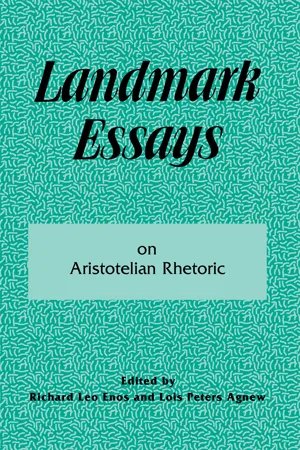
Landmark Essays on Aristotelian Rhetoric
Volume 14
- 280 pages
- English
- ePUB (mobile friendly)
- Available on iOS & Android
eBook - ePub
Landmark Essays on Aristotelian Rhetoric
Volume 14
About this book
There is little doubt that Aristotle's Rhetoric has made a major impact on rhetoric and composition studies. This impact has not only been chronicled throughout the history of rhetoric, but has more recently been contested as contemporary rhetoricians reexamine Aristotelian rhetoric and its potential for facilitating contemporary oral and written expression. This volume contains the full text of Father William Grimaldi's monograph studies in the philosophy of Aristotle's Rhetoric. The eight essays presented here are divided into three rubrics: history and philosophical orientation, theoretical perspectives, and historical impact. This collection provides teachers and students with major works on Aristotelian rhetoric that are difficult to acquire and offers readers an opportunity to become active participants in today's deliberations about the merits of Aristotelian rhetoric for contemporary teaching and research.
Trusted by 375,005 students
Access to over 1.5 million titles for a fair monthly price.
Study more efficiently using our study tools.
Information
Subtopic
Communication StudiesOrientations to Aristotle’s Rhetoric
The Lost Rhetorics of Aristotle
Keith V. Erickson
The literature of antiquity in our possession represents a fraction of the works generated by ancient authors. This is true of Aristotle's works. Numerous scholars have attempted to reconstruct the "lost" works of Aristotle and to correct extant texts.1 Philological interpretation and correction of the extant Rhetoric has clarified greatly Aristotlelian rhetorical theory,2 yet the content and philosophy of his lost rhetorics remain largely unknown. This is unfortunate as these rhetorics constitute Aristotle's earliest thinking on the subject and likely represent the nascent origins of his rhetorical theory as developed in the Rhetoric.3 The purpose of this article is to review philological research attempting to reconstruct and interpret Aristotle's lost rhetorics and to show, where possible, their influence upon his mature philosophy of rhetorical discourse.
Primary evidence confirms the ancient existence of Aristotle's "lost" rhetorics, although it is unclear why they disappeared and the Rhetoric remains.4 According to the testimony of ancient catalogers Aristotle authored numerous tracts on rhetoric. Diogenes5 lists eight titles while other catalogues list as many as nine.6 The lists of these catalogues are something of a mystery as little is known of their sources of information. Moreover, many of the entries appear spurious, their philological status ordinarily established by cross-referencing to primary sources. Modern scholarship recognizes four works from these lists as dealing with rhetoric; the extant Rhetoric, On Rhetoric or Gryllus, Synagōgē technōn, and Theodectea.
Gryllus
The Gryllus has attracted considerable scholarly attention.7 The text, however, is wholly lost (various passages of Quintilian's Institutio oratoria,8 though, are considered by Thillet and Chroust to be fragments or paraphrases of the Gryllus). Secondary sources offer a rich base of philological evidence, however. Significantly, both Diogenes and the Vita Aristotelis Hesychii consider it an authentic work. Modern critics, with the exception of Valentini Rose9 who entertained the possibility of the Rhetoric being a pseudo-Aristotelian work, likewise attribute the work to the Stagirite, with Jaeger and others10 believing it to be the first literary or exoteric publication of Aristotle, authored approximately 360-359 B.C.11
The Gryllus is philologically interesting on several counts, including its atypical title, Aristotle's motivation for composing it, and its relationship to the Rhetoric. The title of the work, it is generally agreed, emanates from Gryllus, the son of Xenophon who was killed at the battle of Man tinea in 362 B.C. Scholars suggest Aristotle dedicated this work to Gryllus, supposedly a close friend, and hence the title.12 No evidence exists, however, to suggest Aristotle was even an acquaintance of Xenophon's son, making it unlikely that he wished to honor or commemorate him. Because Diogenes mentions "Aristotle had insisted that a great many people had composed epitaphs and encomia upon Gryllus, largely for the purpose of ingratiating themselves with his father Xenophon,"13 Thillet and Solmsen believe he may have been considerably annoyed by the behavior of these orators.14 There is little doubt that much false praise was heaped upon Gryllus by people only remotely familiar with him. Aristotle no doubt was irked by the participation of prominent rhetoricians in this favor seeking display. "This is the only possible connection between the title of this dialogue and its real subject matter—between Gryllus and rhetoric."15 Thus the excesses of orators in composing false and inartistic eulogies to Gryllus prompted Aristotle's rejoinder, apparently an anti-rhetorical position, aimed at rebuking the substance and manner of their addresses. A key to interpreting this work, therefore, lies in determining whom Aristotle was charging with the inartistic employment of rhetoric. Chroust (and others) suggest the Gryllus' arguments were directed principally at Isocrates.16 Chroust reasons that Isocrates might well have written one of these eulogies—reason enough to kindle Aristotle's attack as Isocrates was a long standing competitor and antagonist of the Academy.
Thillet and Solmsen, in determining the content of the Gryllus, reason that the work was polemical rather than doctrinal, taking the position that not all forms of rhetoric constitute art. They argue that Aristotle contrasted inartistic rhetoric with true or ideal rhetoric. Evidence in support of this thesis is found in Quintilian who reviews what appear to be Aristotelian arguments (some may be those of Critolaus and Athenodorus, also mentioned by Quintilian) concerning the relationship of rhetoric to art, and it is obvious from Quintilian's remarks that he was impressed by their strength. Hill translates the passage as: "Aristotle in his Gryllus produces some tentative arguments to the contrary which are marked by characteristic ingenuity. On the other hand he also wrote three books on the art of rhetoric, in the first of which he not merely admits rhetoric is an art but treats it as a department of politics and also of logic."17 Chroust further theorizes that "Aristotle must have alleged that proper rhetoric, and not every form of rhetoric, has always been considered an art, and not merely a natural faculty or talent; that no one had ever seriously disputed this; and that the several arguments which attempted to denythat true rhetoric was an art, despite their acumen, may not be taken seriously in that they were purely dialectical performances or devices without any real merit—an intellectual veneer invented to enliven and dramatize the whole discussion."18 Chroust implies by his remarks that Aristotle, the youthful Platonist, distinguished true from sophistic rhetoric as envisioned in the Phaedrus. However, in concert with the majority of scholars, Chroust sees the Gorgias as the source of Aristotle's arguments. This is an intriguing issue as Plato's attack upon the sophists not only would have served Aristotle's purposes but would have reflected the Master as well: "Hence, it is not surprising that Aristotle, the disciple of Plato, should object to such contemptible practices as well as to the ultimate philosophic outlook underlying them. In rejecting and denouncing this type of rhetoric, Aristotle acts in full accordance with the spirit and tenets of Plato's basic philosophic teachings."19
The Gryllus, therefore, Platonically railed against the value of rhetoric as interpreted by Isocrates and his associates rather than explicating its techniques.
Quintilian's remark that Aristotle advanced many arguments of his own making in the Gryllus led modern critics to theorize that he tested a new form of dialogue. Jaeger sees the Gryllus imitating the Gorgias in an "expository" rather than "dramatic" format,20 although little philological evidence supports such speculation. Moreover, the Gryllus was to launch Aristotle's career, as here was the perfect opportunity for him to attack a long standing enemy of the Academy, employ his mentor's work, and to simultaneously advance and test arguments of his own making. In so doing, he likely secured the support of the enemies of Isocrates, made himself known to Plato, and tested his own powers of intellect. Chroust sees Aristotle's opportunity to teach rhetoric arising directly from the strength of this work. He argues that the Gryllus probably became the occasion for Aristotle being permitted to offer this course in the Academy, since in this dialogue he seems to have demonstrated not only his qualifications as a teacher of rhetoric, but also his ability to stand up to Isocrates, a man much disliked by the members of the Academy.21
The Gryllus represents the young Aristotle responsive primarily to the philosophical considerations of Platonism, while the Rhetoric evidences the genetically developed thinking of a mature philosopher. Although the Rhetoric develops the rhetorical method, the Gryllus may have influenced the Rhetoric. As an apparently anti-rhetorical work in the tradition of the Gorgias, the Gryllus probably argued that inartistic rhetoric arouses the emotions and passions. "This argument loosely resembles Socrates' proof that it is not an art because it can give no rational account of using the pathe of the hearers. The idea that there can be no techne of using the pathe clearly dictated the standard of Rhetoric I i, which banishes them from among the artistic proof."22 Further, this passage suggests that the criticism of Isocrates enunciated in the Gryllus was considered by Aristotle still viable some thirty years later upon the "publication" of the Rhetoric. "It would mean that in the preparatory period for the first stage of the Rhetoric, Aristotle's thought was dominated by the quarrel with Isocrates."23 Kennedy observes, however, that several passages citing Isocrates are mellow, if not complimentary.24 This inconsistency, one among many, highlights the fact that Aristotle did not have a single theory of rhetoric. Aristotle, for example, had two theories of artistic and inartistic rhetorical devices, as Hill suggests "they were products of different environments, and they were never completely knit together."25 Moreover, though, subject specific content of the Gryllus probably did not find its way into our Rhetoric, although early drafts may have evidenced its reasoning. I. Düring, for instance, believes that major portions of the Rhetoric belong to the late fifties of the fourth century, or shortly after the Gryllus' appearance.
Synagōgē technōn
Little is known of the actual content and thrust of the Synagōgē technōn, thought to be composed between 360 and 355 B.C. Spengel attempted to reconstruct portions of the work,26 but much of his evidence is secondary and his conclusions speculative. Cicero is our chief source of evidence having cited and described briefly its contents in three of his works.27 He tells us: "I read. . . that book of his, setting forth the rhetorical theories of all his forerunners, and those other works containing sundry observations of his own on the same art. . ."28 Primary sources, passages thought to be fragments of the lost work, are evident in Dionysius of Halicarnassus and Cicero.29 Basically, the work constituted a history of rhetoric and rhetoricians as found in early rhetorical handbooks. Prior to Aristotle, efforts to preserve these handbooks were minimal, and following his treatment of them in the Synagōgē technōn, few survived beyond the fourth century. Aristotle openly belittles the shallowness of these handbooks in the Rhetoric (1354al2-15); can we infer, then, that he collected these works not for their historical value but for research or teaching purposes? This, of course, would be in keeping with Aristotle's tradition of observing and cataloging relevant data when investigating a topic. "Presumably he was gathering material in preparation for his own works on rhetoric in the way that he gathered information on constitutions as part of his study of politics."30
Aristotle began the compendium with Corax and Tisias and brought it forward to Plato and Isocrates' Technē.31 The work may have resembled an anthology suitable for lecturing on rhetoric. Whether Aristotle employed it when he lectured on rhetoric in the Academy or much later in the Lyceum is uncertain. In any event, the theories of ancient and contemporary rhetoricians apparently were outlined in detail. The De inventione informs us that:
Aristotle collected the early books on rhetoric, even going back as far as Tisias, well known as the originator and inventor of the art; he made a careful examination of the rules of each author and wrote them out in plain language, giving the author's name, and finally gave a painstaking explanation of the difficult parts. And he so surpassed the original authorities in charm and brevity that no one becomes acquainted with their ideas from their own books, but everyone who wishes to know what their doctrines are, turns to Aristotle, believing him to give a much more convenient exposition32.
Douglas, contrar...
Table of contents
- Cover
- Half Title
- Title Page
- Copyright Page
- Dedication Page
- About the Editors
- Acknowledgments
- Contents
- Introduction
- Orientations to Aristotle's Rhetoric:
- Theoretical Issues:
- Historical Perspectives:
Frequently asked questions
Yes, you can cancel anytime from the Subscription tab in your account settings on the Perlego website. Your subscription will stay active until the end of your current billing period. Learn how to cancel your subscription
No, books cannot be downloaded as external files, such as PDFs, for use outside of Perlego. However, you can download books within the Perlego app for offline reading on mobile or tablet. Learn how to download books offline
Perlego offers two plans: Essential and Complete
- Essential is ideal for learners and professionals who enjoy exploring a wide range of subjects. Access the Essential Library with 800,000+ trusted titles and best-sellers across business, personal growth, and the humanities. Includes unlimited reading time and Standard Read Aloud voice.
- Complete: Perfect for advanced learners and researchers needing full, unrestricted access. Unlock 1.5M+ books across hundreds of subjects, including academic and specialized titles. The Complete Plan also includes advanced features like Premium Read Aloud and Research Assistant.
We are an online textbook subscription service, where you can get access to an entire online library for less than the price of a single book per month. With over 1.5 million books across 990+ topics, we’ve got you covered! Learn about our mission
Look out for the read-aloud symbol on your next book to see if you can listen to it. The read-aloud tool reads text aloud for you, highlighting the text as it is being read. You can pause it, speed it up and slow it down. Learn more about Read Aloud
Yes! You can use the Perlego app on both iOS and Android devices to read anytime, anywhere — even offline. Perfect for commutes or when you’re on the go.
Please note we cannot support devices running on iOS 13 and Android 7 or earlier. Learn more about using the app
Please note we cannot support devices running on iOS 13 and Android 7 or earlier. Learn more about using the app
Yes, you can access Landmark Essays on Aristotelian Rhetoric by Richard L. Enos,Lois P. Agnew,Richard Leo Enos,Lois Peters Agnew in PDF and/or ePUB format, as well as other popular books in Languages & Linguistics & Communication Studies. We have over 1.5 million books available in our catalogue for you to explore.