This book details the key concepts, objectives and processes relating to the professional accreditation of engineering bachelor (honours) degrees. The contemporary context of accreditation is examined in terms of the globalised nature of both the engineering profession and higher education. Examples of the processes relating to single and dual accreditation are provided, with examination of the Washington Accord and the requirements of the European Network for Accreditation of Engineering Education. Details are also provided as to how learning outcomes can be structured to demonstrate compliance with accreditation criteria. The final chapters deal briefly with quality assurance processes used in education and the current international quality ranking systems which exist.
This book will provide the reader with a detailed examination of outcome based education within the context of Bachelor of Engineering (honours) degrees. A key feature of this book is the side-by-side comparison of different accreditation criteria and a thorough discussion of the relatively new phenomenon of dual accreditation.
The book seeks to provide a very clear explanation and exploration of accreditation within the context of engineering education and will benefit those practitioners involved in the accreditation process.
Engineering education, economic development and global mobility
1.1 Transnational nature of engineering
The application of the principles of mathematics and science to turn new ideas into solutions for complex problems is called engineering. Using innovation, creativity and knowledge, engineering professionals are making a profound impact on the world. Technically skilled people are driving rapid change in our world, resulting in faster development across all nations. Engineering professionals (graduate engineers, technologists and technicians) are creative, curious and capable of dealing with all aspects of their society and the world. Engineering has no bounds, and those in this profession work tirelessly for the common goal of building a sustainable world. Today, every aspect of engineering is multi-disciplinary in nature. Hence, the amalgamated knowledge from all the engineering disciplines and sub-disciplines, as well as from finance/commerce, the environment and ecology, is required to exploit resources for peaceful, environmentally sustainable and healthy living.
Engineering professionals use the knowledge within a specific industry in order to make things work. In fact, engineering is behind everything: computers, the internet, mobile phones, satellites, make-up, cars, buses, ships, aircraft, spacecraft, trains, shoes, buildings, bridges, roads and tracks, manufacturing and production, destructive equipment and machinery, power generation, transmission and distribution, resources extraction and processing, household appliances, CT scanners, MRI, medical transplants, and much more. The dramatic improvement of healthcare and life expectancy is only possible due to the development of diagnostic equipment, disease cure/management equipment and pharmaceutical products. In our rapidly changing world, new engineering tasks and challenges are constantly emerging alongside new and innovative technologies. Engineering has had, is having and will have a direct and vital impact on the quality of life for all people and our planet. The famous scientist, Albert Einstein, said, “Scientists investigate that which already is; Engineers create that which has never been” [1]. Hence, it is “Science” which discovers the electromagnetic radiation but it is “Engineering” which uses electromagnetic radiation to make a smart TV. All the so-called “wonders of modern Science” are really wonders of modern engineering.
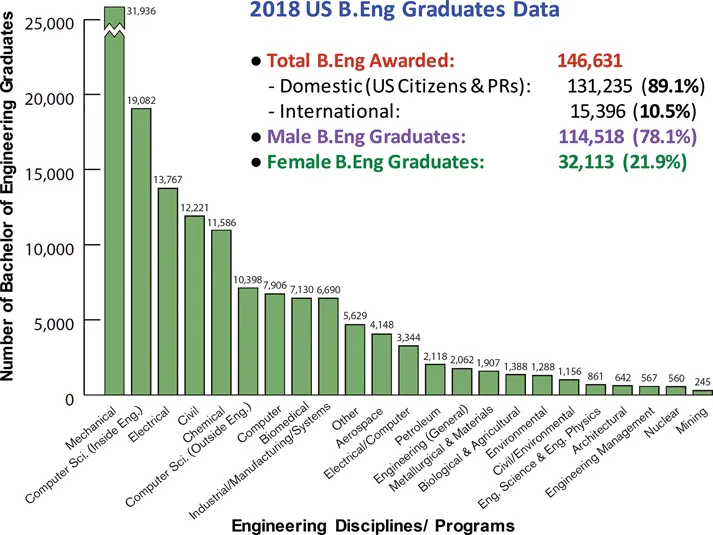
Engineering is one of the most diverse professions in terms of disciplines, types, levels and qualifications [2, 3 and 4]. An example of engineering degrees offered in various engineering disciplines by the USA higher education institutions in 2018 is shown in Figure 1.1. The nature of engineering employment varies notably both locally and globally. A simple definition of engineering activity is the production and application of knowledge, patents and technology. Globalisation has been transforming engineering industries by creating international markets for products, raw materials, human resources, ideas and innovations. In addition, new technologies are penetrating the engineering industry and changing modes of practice, habits and education.
Figure 1.1 Bachelor degrees offered in engineering disciplines in the USA in 2018. (Adapted from Ref. [5].)
1.2 Global movement of engineers
Globalisation is occurring in all engineering activities, from the standardisation of technology across national borders to the development of niche technology, resulting in either the temporary or permanent movement of engineers, technologists and technicians around the world. The increase in technological innovation accelerates the movement of qualified engineers even further.
Dobbs et al. [6] have reported that by 2020, there will be a global shortage of medium- and high-skilled workers and a global surplus of low-skilled workers. The bulk of the required technologically skilled people will be needed in developing countries due to the rapid economic growth, and unless these developing nations invest in appropriate post-secondary education, with an emphasis on engineering and science, and/or encourage their emigrant graduates to return home after an overseas education, the need for skilled human resources will be very difficult to meet. In addition, addressing this shortfall by bringing skilled people from developed nations to developing nations is costly and in most cases unaffordable. This means that by 2030, there will be an acute shortage of technically skilled human resources in populous developing nations such as China, India, Bangladesh, Indonesia, Pakistan, the Philippines, Nigeria, and Brazil.
1.2.1 Global demand for engineering graduates
The engineering profession is well-respected by the global community because the profession’s contribution has a significant impact on everyday life, society and the environment. A recent survey for views on a range of engineering issues conducted by Create the Future [7] among 10,000 people across ten countries from Europe, North America, Asia and Africa revealed that engineers are trusted to make the world a better place. The diverse nature of current global challenges means that engineering is now regarded as being more important to the world than ever before.
A report, “Skills Gap Study 2018”, by Deloitte and the US Manufacturing Institute revealed that 2.4 million jobs would be unfilled over the next decade in the USA. By 2028, the continued shortage will cause a potential loss of $454 billion in USA’s economic output – a massive 17% of the forecasted manufacturing Gross Domestic Product (GDP). The report also stated that there would be another $2.5 trillion economic output loss over the next decade due to engineering skills shortage in the USA [8]. The engineering skills shortage is not just a buzzword. Its impact is both global and local. The need to tackle this challenge is not dependent upon revenue size, organisational demographics or reach of any nation; it will affect the whole world.
In Western nations, there are many issues which have created this skills shortage, and the most significant being a restricted global mobility/labour market, poor investment in science, technology, engineering and mathematics (STEM) education, less interest in STEM careers among young people, birth rate decreases and industrialisation in traditionally populous nations (South Asia, North Asia), an aging population and mass...
Table of contents
Cover
Half Title
Title Page
Copyright Page
Table of Contents
Preface
1 Engineering education, economic development and global mobility
2 Outcome-based education
3 International accreditation framework
4 Cross-border higher education quality assurance and dual accreditation
5 Education qualifications frameworks
6 International quality rankings of higher education institutions
7 Academic (internal) quality assurance
Appendix A: Sample program guide for B.Eng. (Mechanical Engineering)
Appendix B: Example of a typical course/unit/subject/module guides
Appendix C: Sample submission table of contents for bachelor of engineering program accreditation
Appendix D: Sample dual accreditation program submission table of contents to the host country’s accreditation organisation
References
Trusted by 375,005 students
Access to over 1.5 million titles for a fair monthly price.
Study more efficiently using our study tools.
Frequently asked questions
Yes, you can cancel anytime from the Subscription tab in your account settings on the Perlego website. Your subscription will stay active until the end of your current billing period. Learn how to cancel your subscription
No, books cannot be downloaded as external files, such as PDFs, for use outside of Perlego. However, you can download books within the Perlego app for offline reading on mobile or tablet. Learn how to download books offline
Perlego offers two plans: Essential and Complete
Essential is ideal for learners and professionals who enjoy exploring a wide range of subjects. Access the Essential Library with 800,000+ trusted titles and best-sellers across business, personal growth, and the humanities. Includes unlimited reading time and Standard Read Aloud voice.
Complete: Perfect for advanced learners and researchers needing full, unrestricted access. Unlock 1.5M+ books across hundreds of subjects, including academic and specialized titles. The Complete Plan also includes advanced features like Premium Read Aloud and Research Assistant.
Both plans are available with monthly, semester, or annual billing cycles.
We are an online textbook subscription service, where you can get access to an entire online library for less than the price of a single book per month. With over 1.5 million books across 990+ topics, we’ve got you covered! Learn about our mission
Look out for the read-aloud symbol on your next book to see if you can listen to it. The read-aloud tool reads text aloud for you, highlighting the text as it is being read. You can pause it, speed it up and slow it down. Learn more about Read Aloud
Yes! You can use the Perlego app on both iOS and Android devices to read anytime, anywhere — even offline. Perfect for commutes or when you’re on the go. Please note we cannot support devices running on iOS 13 and Android 7 or earlier. Learn more about using the app
Yes, you can access Engineering Education by Firoz Alam,Alexandra Kootsookos in PDF and/or ePUB format, as well as other popular books in Education & Government & Business. We have over 1.5 million books available in our catalogue for you to explore.