Connected and Autonomous Vehicles in Smart Cities
- 500 pages
- English
- ePUB (mobile friendly)
- Available on iOS & Android
Connected and Autonomous Vehicles in Smart Cities
About this book
This book presents a comprehensive coverage of the five fundamental yet intertwined pillars paving the road towards the future of connected autonomous electric vehicles and smart cities. The connectivity pillar covers all the latest advancements and various technologies on vehicle-to-everything (V2X) communications/networking and vehicular cloud computing, with special emphasis on their role towards vehicle autonomy and smart cities applications. On the other hand, the autonomy track focuses on the different efforts to improve vehicle spatiotemporal perception of its surroundings using multiple sensors and different perception technologies. Since most of CAVs are expected to run on electric power, studies on their electrification technologies, satisfaction of their charging demands, interactions with the grid, and the reliance of these components on their connectivity and autonomy, is the third pillar that this book covers.
On the smart services side, the book highlights the game-changing roles CAV will play in future mobility services and intelligent transportation systems. The book also details the ground-breaking directions exploiting CAVs in broad spectrum of smart cities applications. Example of such revolutionary applications are autonomous mobility on-demand services with integration to public transit, smart homes, and buildings. The fifth and final pillar involves the illustration of security mechanisms, innovative business models, market opportunities, and societal/economic impacts resulting from the soon-to-be-deployed CAVs.
This book contains an archival collection of top quality, cutting-edge and multidisciplinary research on connected autonomous electric vehicles and smart cities. The book is an authoritative reference for smart city decision makers, automotive manufacturers, utility operators, smart-mobility service providers, telecom operators, communications engineers, power engineers, vehicle charging providers, university professors, researchers, and students who would like to learn more about the advances in CAEVs connectivity, autonomy, electrification, security, and integration into smart cities and intelligent transportation systems.
Frequently asked questions
- Essential is ideal for learners and professionals who enjoy exploring a wide range of subjects. Access the Essential Library with 800,000+ trusted titles and best-sellers across business, personal growth, and the humanities. Includes unlimited reading time and Standard Read Aloud voice.
- Complete: Perfect for advanced learners and researchers needing full, unrestricted access. Unlock 1.4M+ books across hundreds of subjects, including academic and specialized titles. The Complete Plan also includes advanced features like Premium Read Aloud and Research Assistant.
Please note we cannot support devices running on iOS 13 and Android 7 or earlier. Learn more about using the app.
Information
1 Connected and Autonomous Electric Vehicle Charging Infrastructure Integration to Microgrids in Future Smart Cities
1.1 Introduction
1.1.1 Smart Cities
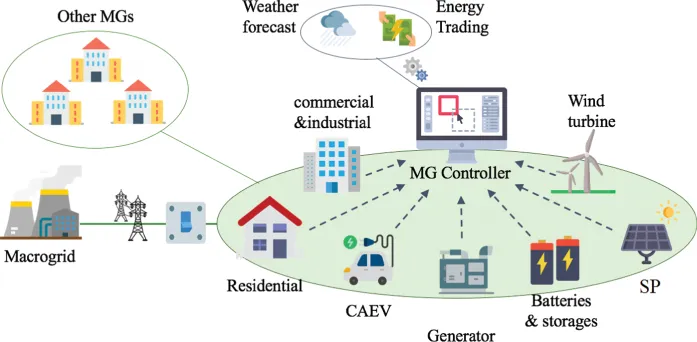
1.1.2 Microgrids

1.1.3 Renewable Energy Generation Resources
- low carbon emission
- less dependence on fossil fuels
- longer lifespan comparing to conventional resources
- noise-free in the case of solar panels (SP)
- low operational cost
Table of contents
- Cover
- Half Title
- Title Page
- Copyright Page
- Table of Contents
- Preface
- Editors
- Contributors
- Chapter 1 Connected and Autonomous Electric Vehicle Charging Infrastructure Integration to Microgrids in Future Smart Cities
- Chapter 2 A Hierarchical Management Framework for Autonomous Electric Mobility-on-Demand Services
- Chapter 3 Multifaceted Synthesis of Autonomous Vehicles’ Emerging Landscape
- Chapter 4 Machine Learning Methodologies for Electric-Vehicle Energy Management Strategies: A Comprehensive Survey
- Chapter 5 Dynamic Road Management in the Era of CAV
- Chapter 6 VANET Communication and Mobility Sustainability: Interactions and Mutual Impacts in Vehicular Environment
- Chapter 7 Message Dissemination in Connected Vehicles
- Chapter 8 Exploring Cloud Virtualization over Vehicular Networks with Mobility Support
- Chapter 9 Data Offloading Approaches for Vehicle-to-Everything (V2X) Communications in 5G and Beyond
- Chapter 10 Connected Unmanned Aerial Vehicles for Flexible Coverage, Data Gathering and Emergency Scenarios
- Chapter 11 Localization for Vehicular Ad Hoc Network and Autonomous Vehicles, Are We Done Yet?
- Chapter 12 Automotive Radar Signal Analysis
- Chapter 13 Multisensor Precise Positioning for Automated and Connected Vehicles
- Chapter 14 Deploying Wireless Charging Systems for Connected and Autonomous Electric Vehicles
- Chapter 15 Dynamic Wireless Charging of Electric Vehicles
- Chapter 16 Wirelessly Powered Unmanned Aerial Vehicles (UAVs) in Smart City
- Chapter 17 Cyber Security Considerations for Automated Electro-Mobility Services in Smart Cities
- Chapter 18 Incentivized and Secure Blockchain-based Firmware Update and Dissemination for Autonomous Vehicles
- Index