eBook - ePub
American Nations
Encounters in Indian Country, 1850 to the Present
- 520 pages
- English
- ePUB (mobile friendly)
- Available on iOS & Android
eBook - ePub
American Nations
Encounters in Indian Country, 1850 to the Present
About this book
This volume brings together an impressive collection of important works covering nearly every aspect of early Native American history, from contact and exchange to diplomacy, religion, warfare, and disease.
I AGENCY AMID CONQUEST, 1850-1900
Reel upon reel of Hollywood movies offer a powerful, almost indelible image of the West during the era of the “Indian wars,” an image of warriors and bluecoats, buffalos and battles, defeat and death. The three chapters in this section examine this place and time in a different light. Visiting the Navajos in the Southwest, the Sioux and their allies on the northern Plains, and Indians living near Puget Sound in Washington, the authors explore how Natives coped with conquest. Each story is different, but several themes run through all of them. One theme is cultural continuity; as they came to terms with American power, Indian people abandoned neither their loyalties nor their traditions. A second theme is modes of combat; there were many sorts of battlefields in these years, and not all of them looked like Little Big Horn. On reservations and in courtrooms, it turns out, Indians found ways to resist without firing a shot. A third, more implicit message broadcast by this section is that there were, as historians such as Patricia Nelson Limerick and Richard White have pointed out, many “Wests,” and most of them bore no resemblance to Hollywood’s.
1 THE NAVAJO AT BOSQUE REDONDO: COOPERATION, RESISTANCE, AND INITIATIVE, 1864-1868
While Abraham Lincoln’s administration was committing the Union’s resources to conquering the Confederacy, one part of the federal government was fighting a different sort of war. Brigadier General James H. Carleton, the commander of the military department of New Mexico (lands that became part of the United States in 1848 when the Treaty of Guadalupe Hidalgo ended the war with Mexico), decided that the time had come to make the Navajos and Mescalero Apaches five according to the rules of the American nation. Since these peoples had been defeated on the field of battle, Carleton assumed that the government would encounter no resistance to its plans to change their ways. He thus ordered the Indians moved to a reservation known as Bosque Redondo in southeastern New Mexico, a place he thought suitable for the Natives’ reeducation.
Once they arrived there, the Indians discovered that Bosque Redondo was hardly an ideal place to live. The harsh environment made it difficult to grow enough food, yet the government routinely provided inadequate rations. The water supply was so alkaline that dysentery, a potentially lethal intestinal illness, was constant, and other diseases in the area, including malaria and measles, took a terrible toll. Small wonder, then, that Navajos who relocated to Bosque Redondo found life difficult.
Small wonder, too, that they resisted any government official trying to tell them how to live. As Katherine M. B. Osburn notes in this article which combines government reports and oral traditions, Navajos refused to follow every order that Carleton and his subordinates issued. While many were interested in learning a trade, few wanted to go to school. And though many did work hard at farming, as the government wanted, they still could not grow enough food. In order to get by, some Navajo women became prostitutes, though this violated both Navajo precepts and reservation rules. Other Navajos responded in more traditional fashion, finding solace and sustenance in Native ceremonies. They adopted the Chiricahua Windway, an Apache curative ritual; they also practiced their own customary rites, including the Squaw Dance and the Coyote Way. Through such means, Navajos managed to maintain some control over their lives even amid the reservations squalor and desperation. Still, given the terrible circumstances (which included rape as well as forced relocation and starvation), this early experiment in reservation life held powerful lessons for Natives, whose future demanded adapting to the government and its plans for Indian Country. It also contained instructive lessons for those federal policymakers. Later chapters in this volume will reveal whether those officials had learned from the mistakes at Bosque Redondo.
Katherine M. B. Osburn
DESPITE THE TRATRAUMATIC EXPERIENCE of military defeat and incarceration in a strange and hostile environment, the Navajo at the Bosque Redondo, 1864-68, did not respond passively to the reservation experience. Rather, they devised active adaptive strategies using a pattern of cooperation, resistance, and initiative. While Navajo religion furnished the Indians with a means of devising their own responses to many problems they faced, it also acted as a basis for solidarity in an experience potentially devastating to the Navajo’s cultural survival. Since Indian behavior worked against the military’s purposes and functioning at the Bosque Redondo, Indians were a variable in the reservation’s demise, actively participating in its failure—not merely observing its collapse. Thus, while administrative and military aspects of the Bosque are important, the Navajo’s behavior warrants equal consideration.
As a result of the Kit Carson campaign of 1863-64, Brig. Gen. James H. Carleton, commander of the military department of New Mexico, moved the Navajo to a plot in southeastern New Mexico known as Bosque Redondo.1 There he had established a military post, Fort Sumner, and a reservation, where he planned to transform the Mescalero Apache and the Navajo into peaceful, Christian Americans.2 The Navajo who arrived at the Bosque Redondo were starving and impoverished, and over the next four years, their miserable condition did not improve greatly. Shortages of food and fuel were continual, and the alkaline water caused dysentery. Other illnesses at the reservation included malaria, pneumonia, rheumatic fever, measles, and venereal disease. The Indians reported that sometimes military personnel beat them and that Navajo women were raped. Further, the Navajo were raided by other Indian tribes.3
Despite this evidence, Carleton interpreted the Navajo’s degraded condition as an indication that they were now passive and dependent. “It is a mockery,” he wrote, “to hold councils with a people who ... have only to await our decisions. [We should] care for them as children until they can care for themselves.”4 In his view, the Navajo were his to transform. The Indians initially proved cooperative. As a condition of their surrender, the Indians agreed, as former Indian Superintendent James L. Collins noted in 1864, “to abandon their nomadic, marauding way of life, to settle on a reservation away from their cherished mountain homes, and to devote themselves to the pursuit of industry as their means of support.”5
SOURCE: New Mexico Historical Review, v. 60, n. 4 (October 1985), pp. 399-413.
Observers at the Bosque Redondo generally commented on how industriously the Indians worked. In 1865, the Indians testified before the Doolittle Commission, a Senate investigative committee, that they were more than willing to farm despite the problems involved. In addition, Michael Steck, superintendent of Indian Affairs in 1864, commented that “the tribe has for three centuries been engaged in planting and they are also far in advance of all other wild tribes in various fabricks such as blankets, baskets, ropes, saddles and bridle bits.”6 Thus it appeared, to individuals who visited the reservation in the early years, that the experiment had tremendous potential and that the Indians were hard-working and cooperative.
Indian cooperation was, however, more complex than it first appeared. Although the Navajo recognized that farming was a necessity—because the rations provided by the United States government were inadequate—the Indians had more choice in this area than is initially apparent. In 1868, for instance, they staunchly refused to plant any crops, explaining, “We have done all that we could possibly do, but we found it to be labor in vain and have therefore quit it; for this reason we have not planted or tried to do anything this year.”7 Thus, cooperation, though mandated by hunger, was also a choice, for the Indians did refuse to farm. In this act they demonstrated their ability to decide for or against cooperation, regardless of the circumstances.
Similarly, the Navajo considered the benefits of the education programs at the Bosque and chose to accept training in carpentry, leatherworking, and blacksmithing. Delgadito, the Navajo headman, realized his people’s need to repair their newly acquired farm implements and also concluded that they would now have to learn how to make a living. The Navajo also perceived that the trades provided them with such an opportunity.8 Accommodation in this realm, then, was a strategy born of immediate needs and of an understanding of the new economic realities facing the Indians.
While the Navajo appreciated instruction in the trades, they were much more reticent about the benefits of other types of education. For example, although General Carleton established a school at the Bosque Redondo in 1865, the Indians rarely utilized it.9 Apparently, they were more interested in receiving the ration coupons that the school distributed than in procuring an education for their children. As post surgeon Dr. George Gwynther noted: “I do not think that the juvenile savages shared either love of or aptitude for the alphabet, nor rightly appreciated the treasure to which it was the key; inasmuch as they often stipulated for additional bread rations as a condition of longer attendance at school.”10
The Navajo’s resistance to the reservation school was a serious blow to Carleton’s plans for acculturation. Yet the Indians claimed they were not opposed to education; they were simply more absorbed with the immediate concerns of daily survival and considered the benefits of education to be peripheral to more urgent matters such as obtaining enough food to fend off starvation.11 Their attempt to procure money and extra ration coupons for sending their children to school demonstrates the Indians’ shrewd survival strategy.
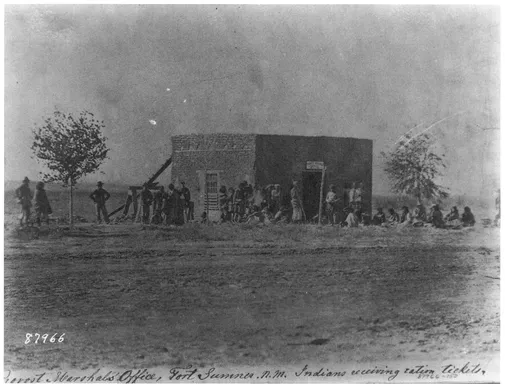
Navajos receiving ration tickets, Fort Sumner, N. Mex. Courtesy National Archives, photo no. lll-SC-87966.
The Navajo gave top priority to procuring more food. They often tried pleading for larger rations. While officers struggled to find a solution, sometimes increasing the size of the ration, other times shifting its frequency, the Indians acted to meet their needs by their own methods. They stole any available food and also produced some three thousand extra ration coupons.12 By forging metal coupons, the Navajos were utilizing an old skill to meet a new need. In addition, since the number of forged tickets increased from January to May of 1865, the number of Indians who benefitted from this practice probably increased.13 Apparently, however, this strategy profited some Indians at the expense of others.
Another method of obtaining extra food was prostitution, which was not a standard practice under less stressful conditions. Navajo women were generally considered to be modest and decent, before and after the Bosque Redondo years. Indeed, the Navajo moral code discourages promiscuity, and Navajo religion had a ritual designed for “the removal of prostitution or mania,” called The Prostitution Way.14 While the Navajo recognized the degradation of prostitution at Fort Sumner, they also indicated that the women were compelled to set aside their moral prescriptions because of poverty and hunger.15
Although some Navajo disregarded the moral injunctions of their culture against prostitution, the taboos governing residence were generally upheld. Carleton had originally planned to house the Navajo in neatly ordered barracks similar to the type of housing found in Pueblo villages.16 The Navajo, however, found this scheme unacceptable because their traditional housing was widely dispersed. Furthermore, they rejected the notion of permanent homes because of their beliefs about departed souls. “The custom of our tribe,” the chiefs claimed, “is never to enter a house where a person has died, but abandon it.” Consequently, they settled “in scattered and extended camps, unorganized by bands or otherwise.”17
The Navajo’s refusal to adhere to Carleton’s plans for their housing represents another assertion of their autonomy. Instead of conforming to the military’s plans, the Navajo forced the military to restructure their administration procedures. As Nelson H. Davis complained, the dispersed Indians were difficult to control, and his troops were severely taxed in their efforts to round up Indians for work.18 Thus, the defiance of the Indians allowed them to continue their traditional settlement patterns in spite of their captivity and to exert some control over the decisions that affec...
Table of contents
- Cover
- Half Title
- Title Page
- Copyright Page
- Dedication
- Contents
- Introduction
- Chronology
- PART I: AGENCY AMID CONQUEST, 1850-1900
- PART II: RESERVATION CULTURES, 1880-1930
- PART III: GENDER AND CULTURE CHANGE
- PART IV: RELIGIOUS INNOVATION AND SURVIVAL
- PART V: CULTURAL AND POLITICAL TRANSFORMATIONS, 1900-1950
- PART VI: INDIAN ACTIVISM AND CULTURAL RESURGENCE
- PART VII: PERSPECTIVES ON NATIVE AMERICA, 2000
- Further Reading
- Notes on Contributors
- Permissions Acknowledgments
- Index
Trusted by 375,005 students
Access to over 1.5 million titles for a fair monthly price.
Study more efficiently using our study tools.
Frequently asked questions
Yes, you can cancel anytime from the Subscription tab in your account settings on the Perlego website. Your subscription will stay active until the end of your current billing period. Learn how to cancel your subscription
No, books cannot be downloaded as external files, such as PDFs, for use outside of Perlego. However, you can download books within the Perlego app for offline reading on mobile or tablet. Learn how to download books offline
Perlego offers two plans: Essential and Complete
- Essential is ideal for learners and professionals who enjoy exploring a wide range of subjects. Access the Essential Library with 800,000+ trusted titles and best-sellers across business, personal growth, and the humanities. Includes unlimited reading time and Standard Read Aloud voice.
- Complete: Perfect for advanced learners and researchers needing full, unrestricted access. Unlock 1.5M+ books across hundreds of subjects, including academic and specialized titles. The Complete Plan also includes advanced features like Premium Read Aloud and Research Assistant.
We are an online textbook subscription service, where you can get access to an entire online library for less than the price of a single book per month. With over 1.5 million books across 990+ topics, we’ve got you covered! Learn about our mission
Look out for the read-aloud symbol on your next book to see if you can listen to it. The read-aloud tool reads text aloud for you, highlighting the text as it is being read. You can pause it, speed it up and slow it down. Learn more about Read Aloud
Yes! You can use the Perlego app on both iOS and Android devices to read anytime, anywhere — even offline. Perfect for commutes or when you’re on the go.
Please note we cannot support devices running on iOS 13 and Android 7 or earlier. Learn more about using the app
Please note we cannot support devices running on iOS 13 and Android 7 or earlier. Learn more about using the app
Yes, you can access American Nations by Frederick Hoxie,Peter Mancall,James Merrell in PDF and/or ePUB format, as well as other popular books in History & Indian & South Asian History. We have over 1.5 million books available in our catalogue for you to explore.