The purpose of this edited book is to present and showcase the basic fundamentals, applications, and integration of both IoT and Blockchain. The trend of applying Blockchain to IoT is rapidly growing because it helps to overcome various challenges faced by IoT, from smart manufacturing to unmanned aerial vehicles.
Thise book aims to showcase the basics of both IoT and Blockchain as well as the integration and challenges for existing practitioners. Thise book initiates conversations among technologists, engineers, scientists, and clinicians to synergize their efforts in producing low-cost, high-performance, highly efficient, deployable IoT systems.
Thise book is theory-based and is useful for engineers from various disciplines, including industrial engineering, computer science, electronics, telecommunications, electrical, agricultural, and cybersecurity, along with researchers, professionals, and students.
Trusted by 375,005 students
Access to over 1.5 million titles for a fair monthly price.
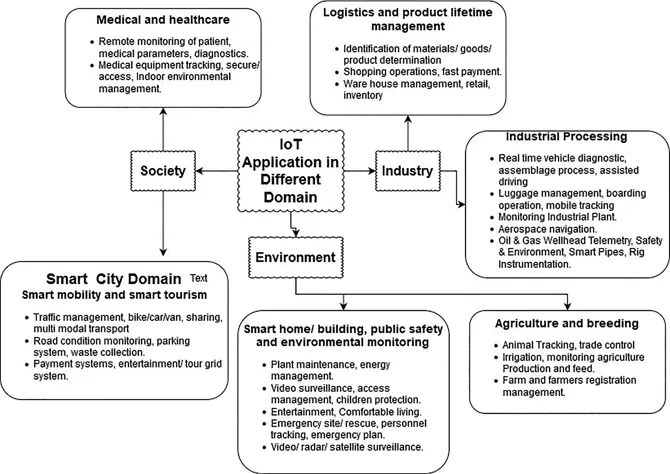
Internet of Things (IoT) is a paradigm that links real items to the Internet, enabling issues to gather, progress, and talk informatively with no human intervention. The perspective of IoT is to create a better society for people where items (referring to actual physical things; the condition of objects, devices, entities, and elements are utilized interchangeably) around us can fully grasp our likeness and personal preferences to act appropriately with no explicit directions [1, 2]. The quick advancements in inexpensive sensor production, correspondence protocols, lodged programs, actuators, and hardware miniaturization have contributed to the exponential development of the IoT. Physical items belonging in the real world are lodged with the solutions to produce them intelligently. The performance of intelligent products can be abstracted by a programmer, and IoT software can function by merging innovative products with solutions that help deal with issues of daily tasks. The various uses of IoT can be categorized in three different domains: society, business, and environment, as illustrated in Figure 1.1. When the overall culture is transitioning toward IoT, the number of sensors deployed close to the planet is growing at an immediate rate, and the receptors consistently generate a substantial amount of information [3].
FIGURE 1.1 Utilization of IoT in various domains.
Nevertheless, not all this information offers strategies that aid in creating procedures. Employing the unit search function supplied by an IoT program, the size and range of data gathered can be lowered. Therefore, a vital system is one that enables to look properly for smart devices according to the real-world attributes collected by the receptors. The benefits of the search engines and find functionalities in IoT have been emphasized. Nevertheless, because of a wide variety of free receptors to choose from and the source limits of an IoT program, developing the search engine program is tough [4].
1.1.1 Motivation of Study/Major Contribution
In the last 2 years, technological innovation has progressed significantly, particularly in terms of interconnections of computer systems, products, items, and personals. In doing so, Internet has matured with substantial improvements. The very best instance of this progression is the creation of virtually the most amazing system, the Internet. Instead we look for those breakthroughs that will truly change how we live and work with computing group [5]. Some technologies are mailed out computing, power method estimations, cloud bases computing services, and ubiquitous computing. The improvisation and extemporization of technologies and computing strategies drive the planet toward another unexpected paradigm, IoT.
According to the International Telecommunication Union (ITU) [6], IoT is essential with respect to five projecting and noticeable investigative domains, including mobile computing, wireless sensor networks, pervasive computing, IoT, cyber-physical methods. IoT is an upcoming field that is moving upwards and surrounding the entire society under its umbrella. This particular effort describes the condition of IoT in the long-term situation. While heading through the creation of IoT, we now present a few definitions in the field of IoT.
1.1.2 Definition of IoT
Based on ITU [7], the IoT is “a worldwide infrastructure with the info culture which allows innovative services by interconnecting (virtual and physical) issues based on existing and evolving interoperable info and communication technologies.” In regards to connectivity, ITU-T realized IoT as a system with anyplace and anytime connectivity for anything or anyone.
Based on ITU [8] report, “IoT is going to connect the world’s items in an intelligent and sensory way by integrating technical advancements in product identification (tagging things), wireless sensor networks and sensors (feeling things), embedded methods (thinking things nanotechnology and shrinking things)”.
Section 1.2 discusses the growth and origin of IoT, Section 1.3 presents the different technical challenges and a comprehensive survey of several issues along with the suggested answers within IoT. Section 1.4 deals with environmental and societal concerns. Future challenges of IoT are discussed in Section 1.5. An extensive conclusion of method domains of IoT discussed in this chapter is presented in Section 1.6.
1.2 Origin and Growth of IoT
Retreat is observed but largely restricted to small communities or carried out for community information. These two phrases are not disjointed as they are glued collectively through the user interface and are fused collectively via the linkage of the Internet. This particular linkage is directed toward the genesis of its paradigm.
The development and evolution of IoT depend on the creation of new solutions and strengthening pre-existing ones. The solutions varied in terms of infrastructure, infrastructure less, ad-hoc networks, RFIDs, nanotechnology, ubiquitous computing, and correspondence protocols [9]. In the evolution of IoT, the focus is on producing a novel worldwide network; this paradigm utilizes the web as the main wedge. In a layered Internet in which a particular computing unit can communicate with an opposite computing unit with free energy generation, IoT evolves [5]. IoT backlinks every item and transforms them into an intelligent thing. This transformation of the original item into an intelligent item, for example, a home appliance into an intelligent home appliance, is attainable by embedding computing, transmitting, and sensing features into them.
The two outstanding, meaningful, and contradictory assertions supplied from 2006 to 2009 are [10] as follows:
With the development of Internet (the 1990s) and movable Internet (the 2000s), we are currently proceeding on to the third even likely nearly all disruptive stages of the Internet revolution – the IoT.
The IoT is capable of altering the planet as the Internet did when it evolved, and it might be a great deal more.
IoT is an unruly stage of engineering. IoT is capable of generating a conclusion PC handler capable of using vulnerable info. On the other side, competence and possibility of technological implementation is successful in all the cases [11].
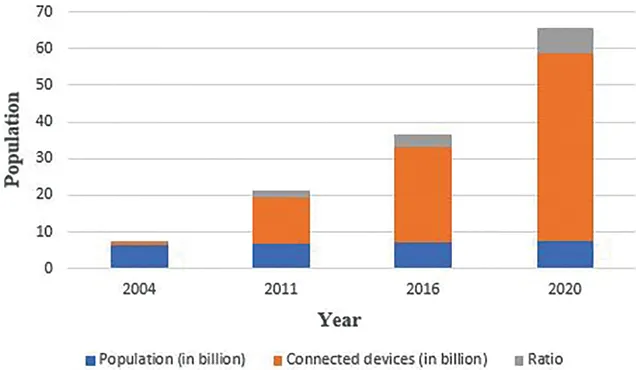
Individual device can connect to digital networks and the Internet with such as smartphones and computers in order to share information. In 2003, the global population was projected to remain 6.3 billion, while the attached products were only 5 billion. By 2010, 6.8 billion people had 12.5 connected products. By 2015, the population grew to 7.2 billion, while the attached unit matter hit 25 billion. By 2020, the population is expected to reach 7.7 billion, and the connected products could reach 50 billion [10] (Figure 1.2).
FIGURE 1.2 Comparison between connected devices and population.
Within this particular background, the evolution of IoT is considered. The development of IoT might be reflected as simple variations in profound technologies with time. At first, the computing community had merely standalone devices. After the arrival of social media, there was a need to achieve the demand to share and post information and materials. Interconnection of computing systems has led to the growth of nearly all attractions and the Internet, that is, prosperous networks. The web is made of intranets, organizations and unique computing systems, that offers limited infrastructure technologies to the users for communication. Creation of infrastructure-less communication in addition to the miniaturization of computing systems guides us toward portable systems [12].
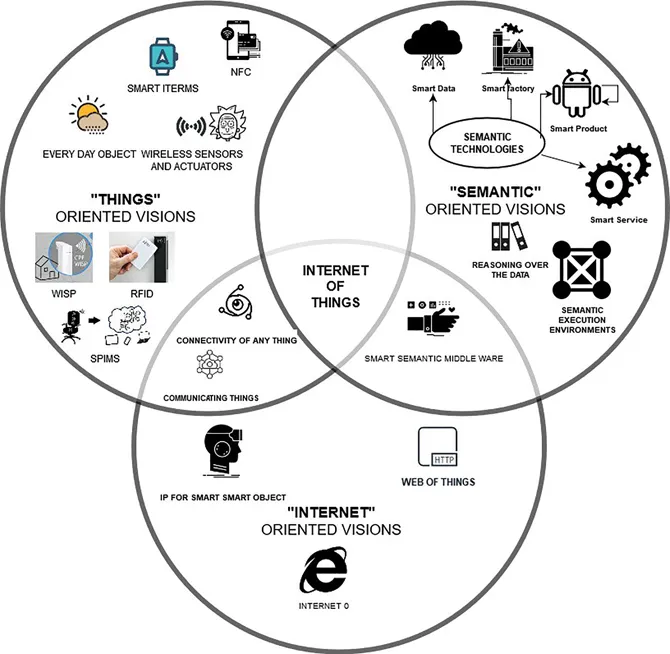
Accessing the solutions together with electric gear as receptors and actuators led us to the current stage of technologies, in which each item is assumed to become sensed and possess several computing abilities, finally leading to the era of IoT. This development is presented pictorially in Figure 1.3.
FIGURE 1.3 Evaluation of IoT.
The mass-scale deployment of homogenous IoT devices, the ability of some devices to automatically connect to other devices, the possibility to find out, identity, guide and the likelihood of fielding these devices in unsecure environments. In the future, the universe is going to appear as an interconnected net or perhaps linkage of each one of the pre-existing entities. The current initiatives are indulging computing power together with the potential to connect to just about everything [13]. IoT is not merely driven by the innovative developments in marketing communications and technologies, it has added features that are combined in a different way into daily everyday living. These issues might be intangible or tangible, invisible or visible, computing unit or perhaps a non-computing body [14]. Problems might belong to personal business or maybe a public organization. These issues might differ using things that are as basic as clothes, food material, and furniture to advanced units such as cellular cell phones, TV, and other electric home appliances. These item...
Table of contents
Cover
Half Title
Series Page
Title Page
Copyright Page
Table of Contents
Preface
Editors
Contributors
Chapter 1 IoT: Fundamentals and Challenges
Chapter 2 Internet of Things Development in Polish Enterprises
Chapter 3 Information Security of Weather Monitoring System with Elements of Internet Things
Chapter 4 IoT-Enabled Surveillance System to Provide Secured Gait Signatures Using Deep Learning
Chapter 5 IoT-Based Advanced Neonatal Incubator
Chapter 6 Malware Threat Analysis of IoT Devices Using Deep Learning Neural Network Methodologies
Chapter 7 Data Encryption for IoT Applications Based on Two-Parameter Fuss–Catalan Numbers
Chapter 8 Fog-Based Framework for Improving IoT/IoV Security and Privacy
Chapter 9 An Overview of Blockchain and its Applications in the Modern Digital Age
Chapter 10 Blockchain as a Lifesaver of IoT: Applications, Security, and Privacy Services and Challenges
Chapter 11 Business Operations and Service Management within Blockchain in the Internet of Things
Chapter 12 IoT-Based Healthcare: Personalized Health Monitoring Using Machine Learning and Blockchain for Security of Data
Chapter 13 Blockchain-Based Regenerative E-Voting System
Chapter 14 Blockchain Application of IoT for Water Industry and Its Security
Index
Frequently asked questions
Yes, you can cancel anytime from the Subscription tab in your account settings on the Perlego website. Your subscription will stay active until the end of your current billing period. Learn how to cancel your subscription
No, books cannot be downloaded as external files, such as PDFs, for use outside of Perlego. However, you can download books within the Perlego app for offline reading on mobile or tablet. Learn how to download books offline
Perlego offers two plans: Essential and Complete
Essential is ideal for learners and professionals who enjoy exploring a wide range of subjects. Access the Essential Library with 800,000+ trusted titles and best-sellers across business, personal growth, and the humanities. Includes unlimited reading time and Standard Read Aloud voice.
Complete: Perfect for advanced learners and researchers needing full, unrestricted access. Unlock 1.5M+ books across hundreds of subjects, including academic and specialized titles. The Complete Plan also includes advanced features like Premium Read Aloud and Research Assistant.
Both plans are available with monthly, semester, or annual billing cycles.
We are an online textbook subscription service, where you can get access to an entire online library for less than the price of a single book per month. With over 1.5 million books across 990+ topics, we’ve got you covered! Learn about our mission
Look out for the read-aloud symbol on your next book to see if you can listen to it. The read-aloud tool reads text aloud for you, highlighting the text as it is being read. You can pause it, speed it up and slow it down. Learn more about Read Aloud
Yes! You can use the Perlego app on both iOS and Android devices to read anytime, anywhere — even offline. Perfect for commutes or when you’re on the go. Please note we cannot support devices running on iOS 13 and Android 7 or earlier. Learn more about using the app
Yes, you can access Security and Trust Issues in Internet of Things by Sudhir Kumar Sharma, Bharat Bhushan, Bhuvan Unhelkar, Sudhir Kumar Sharma,Bharat Bhushan,Bhuvan Unhelkar in PDF and/or ePUB format, as well as other popular books in Technology & Engineering & Artificial Intelligence (AI) & Semantics. We have over 1.5 million books available in our catalogue for you to explore.