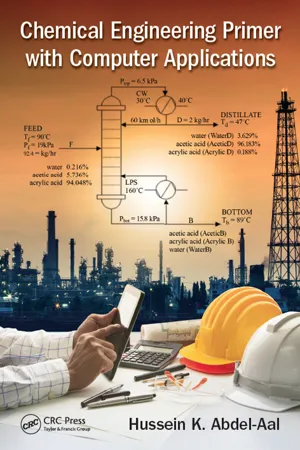
Chemical Engineering Primer with Computer Applications
eBook - ePub

Chemical Engineering Primer with Computer Applications

  1. 260 pages
  2. English
  3. ePUB (mobile friendly)
  4. Available on iOS & Android
eBook - ePub

Chemical Engineering Primer with Computer Applications

About this book

Taking a highly pragmatic approach to presenting the principles and applications of chemical engineering, this companion text for students and working professionals offers an easily accessible guide to solving problems using computers. The primer covers the core concepts of chemical engineering, from conservation laws all the way up to chemical kinetics, without heavy stress on theory and is designed to accompany traditional larger core texts. The book presents the basic principles and techniques of chemical engineering processes and helps readers identify typical problems and how to solve them. Focus is on the use of systematic algorithms that employ numerical methods to solve different chemical engineering problems by describing and transforming the information. Problems are assigned for each chapter, ranging from simple to difficult, allowing readers to gradually build their skills and tackle a broad range of problems. MATLAB and ExcelĀ® are used to solve many examples and the more than 70 real examples throughout the book include computer or hand solutions, or in many cases both. The book also includes a variety of case studies to illustrate the concepts and a downloadable file containing fully worked solutions to the book's problems on the publisher's website.

  • Introduces the reader to chemical engineering computation without the distractions caused by the contents found in many texts.
  • Provides the principles underlying all of the major processes a chemical engineer may encounter as well as offers insight into their analysis, which is essential for design calculations.
  • Shows how to solve chemical engineering problems using computers that require numerical methods using standard algorithms, such as MATLABĀ® and ExcelĀ®.
  • Contains selective solved examples of many problems within the chemical process industry to demonstrate how to solve them using the techniques presented in the text.
  • Includes a variety of case studies to illustrate the concepts and a downloadable file containing fully worked solutions to problems on the publisher's website.
  • Offers non-chemical engineers who are expected to work with chemical engineers on projects, scale-ups and process evaluations a solid understanding of basic concepts of chemical engineering analysis, design, and calculations.
Frequently asked questions

Yes, you can cancel anytime from the Subscription tab in your account settings on the Perlego website. Your subscription will stay active until the end of your current billing period. Learn how to cancel your subscription.
No, books cannot be downloaded as external files, such as PDFs, for use outside of Perlego. However, you can download books within the Perlego app for offline reading on mobile or tablet. Learn more here.
Perlego offers two plans: Essential and Complete
  • Essential is ideal for learners and professionals who enjoy exploring a wide range of subjects. Access the Essential Library with 800,000+ trusted titles and best-sellers across business, personal growth, and the humanities. Includes unlimited reading time and Standard Read Aloud voice.
  • Complete: Perfect for advanced learners and researchers needing full, unrestricted access. Unlock 1.4M+ books across hundreds of subjects, including academic and specialized titles. The Complete Plan also includes advanced features like Premium Read Aloud and Research Assistant.
Both plans are available with monthly, semester, or annual billing cycles.
We are an online textbook subscription service, where you can get access to an entire online library for less than the price of a single book per month. With over 1 million books across 1000+ topics, we’ve got you covered! Learn more here.
Look out for the read-aloud symbol on your next book to see if you can listen to it. The read-aloud tool reads text aloud for you, highlighting the text as it is being read. You can pause it, speed it up and slow it down. Learn more here.
Yes! You can use the Perlego app on both iOS or Android devices to read anytime, anywhere — even offline. Perfect for commutes or when you’re on the go.
Please note we cannot support devices running on iOS 13 and Android 7 or earlier. Learn more about using the app.
Yes, you can access Chemical Engineering Primer with Computer Applications by Hussein K. Abdel-Aal in PDF and/or ePUB format, as well as other popular books in Physical Sciences & Industrial & Technical Chemistry. We have over one million books available in our catalogue for you to explore.
Section III
Backbone Materials
As stated in the ā€œIntroductionā€, a handy collective source of basic principles and techniques in chemical engineering organized in a summary manner is a prime feature of this text. Having presented—in Sections I and II—the basic concepts and principles as introduction to calculations and described how to device and evaluate numerical techniques to solve problems through standard algorithm, we turn next to Section III.
Section III consists of Chapters 5 through 10. They represent what may be named ā€œThe Backbone Materials of Chemical Engineering.ā€ Each chapter in this section, except Chapter 10, will encompass two sections: one includes the theoretical principles in a condensed format, the other presents a set of numerically solved problems using interactive numerical software packages (Excel, MATLABĀ®). This way, the dual themes of presenting the fundamentals followed by computer applications are realized. Application problems for Section III are found in Appendix A.
Chapter 10 stands unique in its function. It includes six case studies covering different topics.
5
Fluid Flow and Transport of Fluids
Image
5.1 INTRODUCTION
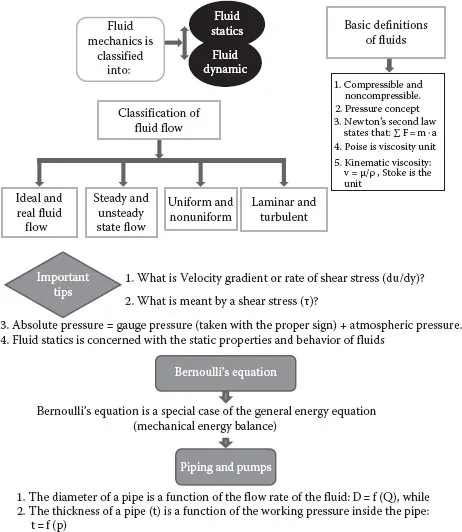
Before a formal definition of fluid is given, it is known that the three common states of matter are solid, liquid, and gas. A fluid is either a liquid or a gas. A fluid is defined as a substance that deforms continuously under the application of a shear stress.
The definition of a stress would illustrate some basic principles. A stress is defined as a force per unit area, acting on an infinitesimal surface element. Stresses have both magnitude (force per unit area) and direction, and the direction is relative to the surface on which the stress acts. Stresses are classified into two main types: normal stresses and tangential stresses. Pressure is an example of a normal stress and acts inward, toward the surface, and perpendicular to the surface; on the other hand, a shear stress is an example of a tangential stress, that is, it acts along the surface, parallel to the surface. Friction due to fluid viscosity is the primary source of shear stresses in a fluid.
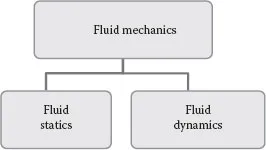
Fluid mechanics has two branches, as shown next:
Image
Fluid statics treats fluid in the equilibrium state (no motion), while fluid dynamics treats fluids when portion of the fluid are in motion (concerned with the relation between the fluid velocity and the forces acting on it).
5.2 DEFINITIONS AND TERMINOLOGY IN FLUID MECHANICS
5.2.1 COMPRESSIBLE AND NONCOMPRESSIBLE FLUIDS
A compressible fluid is identified by a fluid density sensitive to any change in temperature or pressure (including gases and vapors). On the other hand, if no change or little change in density occurs with change of pressure or temperature, the fluid is termed incompressible fluid (including liquids).
5.2.2 PRESSURE CONCEPT
The basic property of a static fluid is pressure. Pressure is familiar as a surface force exerted by a fluid against the walls of its container.
5.2.3 FORCES ACTING ON A FLUID
Any fluid may be subjected to t...

Table of contents

  1. Cover
  2. Half Title
  3. Title Page
  4. Copyright Page
  5. Table of Contents
  6. Preface
  7. Acknowledgments
  8. Author
  9. Introduction: Initial Thoughts
  10. SECTION I An Insight into Chemical Engineering
  11. SECTION II Fundamentals and Problem-Solving Profile
  12. SECTION III Backbone Materials
  13. Appendix A: Application Problems
  14. Appendix B: Mathematical Methods and Review Notes
  15. Appendix C: Conversion Tables
  16. Bibliography
  17. Index