Mapping Motivation for Top Performing Teams is the final volume in a series of books that are all linked to the author's Motivational Map toolkit. Each book builds on a different aspect of personal, team and organisational development.
This book, using the Motivational Map, the Team Motivational Map, as well as the Organisation Motivational Map, is a practical guide to understanding how team dynamics and success are hugely influenced by motivational factors, which are not usually taken into account. The book is a deeper exploration of team mapping which occurs in Chapter 6 of Mapping Motivation (2015), Chapter 6 of Mapping Motivation for Engagement (with Steve Jones, 2019), and Chapter 6 of Mapping Motivation for Leadership (with Jane Thomas, 2020). But whereas these chapters only touched on specific aspects of team dynamics, this book covers the issues more comprehensively; it also attempts to avoid replication of materials, although there are bound to be small overlaps. It covers not only how motivations affect team productivity and how this can be boosted through targeted Reward Strategies, but also how 'mapping' provides profounder insights into the four key characteristics of top performing teams: the clear remit, vital interdependency, strong belief, and real accountability. How Motivational Maps covers these areas, we believe to be original, eye-opening and effective in the management of change. Further, as always with Motivational Maps, its language and metrics raise self-awareness at an individual and team level, and so can help resolve conflicts through its common and non-judgmental language.
Managing teams is the key skill of managers: thus this book is a handbook for managers everywhere who wish to excel at management, for without bringing their teams on board (i.e. motivating their teams), they are not effectively managing.
Trusted by 375,005 students
Access to over 1 million titles for a fair monthly price.
In my book, Mapping Motivation,1 we took our first look at what a team is and how that related to Motivational Maps.2 We will not cover all that information again, but a brief re-cap is in order.
In Mapping Motivation, we contrast a team with a group and insist on the following: that groups can be classified in any number of fancy-sounding ways, but most are usually aligned with their function. So a group can be designated a department, a faculty, a unit, a branch, a board, a committee, a section and so on. It doesn’t matter whether the sales department is called the sales team or not: it may be called a sales team but be anything but a team. However, for optimum efficiency and effectiveness we need real teams, not groups. If we want, for example, a committee which is just a talking shop, then fine, a group will do; but if that committee has really got to get things done, then a team is in order and also very necessary.
Before coming on to the distinctive features of a team, let’s also keep in mind the specific limitations of a team: authorities vary as to the exact number but we think that 123 is the maximum number of members that can be in a team,4 and once that number is exceeded then the group will fragment; the team cohesion is lost. It is important to realise that simply increasing the number of people in a team does not automatically increase its productivity; in fact, the Ringelmann Effect5 suggests just the opposite.
Activity 1.1
If you have read Mapping Motivation, the earlier book, you may remember the answers to this question, but keep in mind that personnel in teams change all the time. We need to be constantly asking our groups/teams, what are the characteristics of a real, high performing team? Ask any team you work with this question, and jot down your own answers to it. Comparing your answers with those in your team can be very revealing.
My earlier book suggested that there were four distinctive characteristics that enabled a group to become a team.
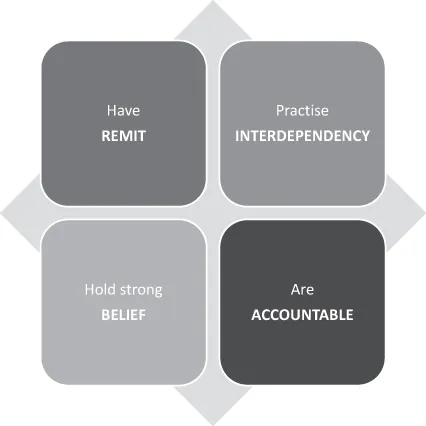
Teams have a clear remit, by which we mean a mission, a purpose, something definite that must be achieved. Teams practise interdependency, not independency and not co-dependency! By this we signify that each person’s gifts, abilities and talents are needed, are necessary, to achieve the remit or the objective. Not too many people, so there is redundancy and bloat; and not too few, so that there is under-capacity to deliver. Teams hold a strong belief. In what exactly? By this we connote a strong belief in working as a team: that it is better to co-operate – more can be achieved – than to rely on individual effort. Finally, teams are accountable. By this we suggest that team players understand that they are accountable in two ways. First, they are accountable to each other, so that they can rely on and trust each other. Second, that they are accountable to the wider organisation for their results; in other words, they practise the avoidance of creating fiefdoms, silos, autonomous units within that organisation. In this way they minimise friction, conflict, inefficiencies and ultimately ineffectiveness.
Figure 1.1 Four team characteristics
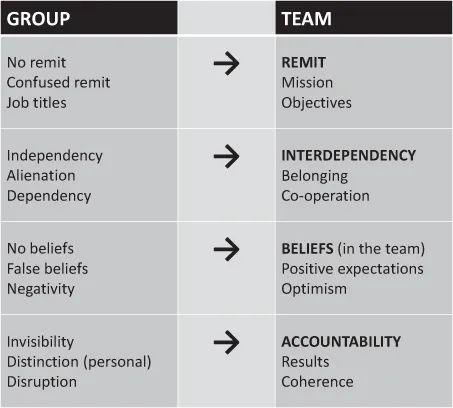
Thus, the journey from being a Group, which is more or less random, to becoming a Team, which is more or less structured and purposeful, goes something like Figure 1.2.
Figure 1.2 From Group to Team
We need, then, to encourage the shift from the group state and its attendant long- and short-term problems to the team state where high performance is possible. How do we do this and how can Motivational Maps help? An initial question which we did not deal with in Mapping Motivation, or the subsequent books, is this: can a Motivational Map help us identify a weak team, or more accurately a group, in the first instance? Put another way: remit, interdependency, belief and accountability do not on the face of it seem subject to motivational states, but are they?
Activity 1.2
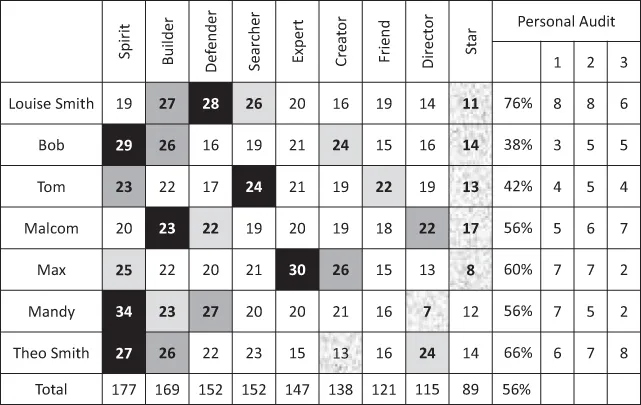
Thinking motivationally, how might a motivational profile have a bearing on whether a unit of people is a group or a team? In order to answer this question, you may wish to review the material in The Summary of Motivational Maps after the Introduction. Also, consider Figure 1.3, which is a Motivational Map for a small IT company (we will anonymise and call it Business on Line Ltd, or BoL) employing seven people, and who create webpages mainly for other businesses. What two or three pieces of information in this Map might provide a clue as to whether this is a group or a team?
Figure 1.3 Small IT company: group or team
Now we need to do two things: first, without having any further background information on this particular case, let’s see what the numbers and the configuration suggest to us. Second, if we add some more context, is there anything else the Map tells us? Keep in mind the central question: is this a group or is it a team?
As an initial assessment three things indicate that this may not be a top performing team. The most obvious fact is the motivation of the seven people averages only 56%. This puts them in the third quadrant of motivation,6 the Risk Zone. Motivation is beginning to drain away and some serious actions need to occur to reverse that; therefore, this seems highly unlikely to be a team.
Second, we do know that this is a small IT company that creates websites for other businesses; it is a B-2-B (business-to-business) type of company. Therefore, we also know that it is a professional company trading on its expertise to create value for its clients. In other words, it is not a standard shop selling common-place confectionary or ice cream! But how committed to expertise is this company? Only one person, Max Eaton, has the Expert in their top three profile, and overall Expert is only fifth. The Spirit/Builder combination of the top two motivators instead suggest a sales-driven rather than an expertise-driven company. So, are the motivators really at odds with the ostensible purpose of the company? If so, that would also suggest a group rather than a team.
Finally, we see with the Spirit as the dominant motivator, and five people with it very strongly in their profiles, plus what we call the ‘polarity reinforcement’7 of the Director motivator being so low, there is every chance that this unit has no real leadership. This point needs some careful unpacking.
So consider: we have three threads of evidence pointing to a group not a team. Put another way, a coach or consultant could without having met any of the members of this team form a reasonably accurate impression of what is going on. The motivation is low – 56% – which practically means energy levels are low, whereas energy levels are usually higher in high performing teams. The motivators of the group are almost certainly at odds with the central purpose (remit) of the organisation in terms of its service delivery to clients. In fact, one could go further: it is highly likely that clients are being ‘overcharged’ for services, since making money (the classic sales combination of Spirit and Builder) is highly motivating. And the polarity reinforcement is fascinating. Essentially, Spirit (highest motivator) and Director (second lowest) are in conflict: one seeks autonomy and the other seeks control. Thus, if an individual or team had both in their top three there would be an inner tension as one was faced with having to go for more autonomy, and so relinquish control, or take on more control (via responsibilities) and so limit further one’s autonomy, or freedom to act. But here they are spaced far apart, which in a sense doubles up the power of the dominant motivator, Spirit, for the Director motivator is not present to curtail or weaken it. This we call polarity reinforcement whereby a dominant motivator is made even stronger.
But that said, in the creation of teams Spirit is one of the more ‘difficult team motivators’.8 If we think, then, of seven people, five of whom wish to be ‘free’ and quite strongly so (consider the scores: 29, 23, 25, 34, 27 out of 40 maximum) and only two wish to direct and control, and no-one does as their top motivator, then it is apparent that in the absence of strong management, the team is not likely to function as a team – individuals will do their ‘own thing’ according to t...
Table of contents
Cover
Half Title
Series Page
Title Page
Copyright Page
Dedication
Table of Contents
List of figures
Series Editor introduction: The Complete Guide to Mapping Motivation
Preface
Acknowledgements
Introduction to Mapping Motivation for Top Performing Teams
Summary of Motivational Maps: What you need to know in a nutshell!
1 What is a team?
2 Reward Strategies
3 Getting to The Remit: Customer Focus for top performing teams
4 Getting to The Remit: What We Do
5 Getting to The Remit: Values We Insist On
6 Interdependency and motivation
7 Belief and top performing teams
8 Accountability and top performing teams
Conclusion
Resources
Index
Frequently asked questions
Yes, you can cancel anytime from the Subscription tab in your account settings on the Perlego website. Your subscription will stay active until the end of your current billing period. Learn how to cancel your subscription
No, books cannot be downloaded as external files, such as PDFs, for use outside of Perlego. However, you can download books within the Perlego app for offline reading on mobile or tablet. Learn how to download books offline
Perlego offers two plans: Essential and Complete
Essential is ideal for learners and professionals who enjoy exploring a wide range of subjects. Access the Essential Library with 800,000+ trusted titles and best-sellers across business, personal growth, and the humanities. Includes unlimited reading time and Standard Read Aloud voice.
Complete: Perfect for advanced learners and researchers needing full, unrestricted access. Unlock 1.4M+ books across hundreds of subjects, including academic and specialized titles. The Complete Plan also includes advanced features like Premium Read Aloud and Research Assistant.
Both plans are available with monthly, semester, or annual billing cycles.
We are an online textbook subscription service, where you can get access to an entire online library for less than the price of a single book per month. With over 1 million books across 990+ topics, we’ve got you covered! Learn about our mission
Look out for the read-aloud symbol on your next book to see if you can listen to it. The read-aloud tool reads text aloud for you, highlighting the text as it is being read. You can pause it, speed it up and slow it down. Learn more about Read Aloud
Yes! You can use the Perlego app on both iOS and Android devices to read anytime, anywhere — even offline. Perfect for commutes or when you’re on the go. Please note we cannot support devices running on iOS 13 and Android 7 or earlier. Learn more about using the app
Yes, you can access Mapping Motivation for Top Performing Teams by James Sale in PDF and/or ePUB format, as well as other popular books in Personal Development & Business General. We have over one million books available in our catalogue for you to explore.