eBook - ePub
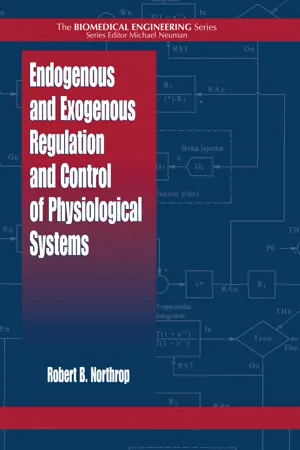
Endogenous and Exogenous Regulation and Control of Physiological Systems
- 464 pages
- English
- ePUB (mobile friendly)
- Available on iOS & Android
eBook - ePub
Endogenous and Exogenous Regulation and Control of Physiological Systems
About this book
From a biomedical engineering perspective, this book takes an analytic, quantitative approach to describing the basic components of physiological regulators and control systems (PRCs). In Endogenous and Exogenous Regulation and Control of Physiological Systems, the author provides grounding in the classical methods of designing linear and nonlinear systems. He also offers state-of-the-art material on the potential of PRCs to treat immune system ailments, most notably AIDS and cancer.
The book focuses on certain "wet" physiological regulators, such as those using endocrine hormones as parametric control substances. Endogenous and Exogenous Regulation and Control of Physiological Systems includes simulations that illustrate model validations and the putative control of cancer and HIV proliferation. It explores novel, untried immunotherapies on the cutting-edge of PRC treatment and explores the latest technologies.
Information
1 Introduction to Physiological Regulators and Control Systems
1.0 INTRODUCTION
Three major issues are addressed in this text: (1) how to accurately model and describe the dynamics of certain physiological regulators and control systems (PRCs) in order to predict their behavior when they are subject to unusual conditions caused by diseases, drugs, or physical damage; (2) how to use a validated model of a compartmental pharmacokinetic system to design a closed-loop drug administration system to maintain a desired concentration of a drug in a target organ; and (3) how to use a validated mathematical model of a compartmental pharmacokinetic system and a physiological system to design an effective closed-loop drug administration system in which the drug is used to manipulate a physiological parameter.
To accurately describe a physiological system in mathematical terms (as by a set of nonlinear ordinary differential equations), one must appreciate the enormous complexity of living systems. This complexity extends to the molecular level, where some expertise in biochemistry and cell and molecular biology is needed, as well as a knowledge of the physics of molecular diffusion and physical-chemical kinetics. In short, an interdisciplinary approach is necessary.
The horns of the dilemma created in trying to model a complex physiological system are complexity vs. reductionism. An accurate description of the behavior of a complex nonlinear system lies in its detailed parametric interactions. The inclusion of many states or parameters in a mathematical model is not as much of a challenge for today’s computers as it is for today’s bioengineers, physiologists, and biochemists. Most mathematical models of physiological systems require rate constants; many of them are unknown, as they have never been measured or, worse, are not now measurable. We are therefore forced to simplify or reduce the order and complexity of the model, thereby possibly missing interesting system behavior that is the result of nonlinear complexity.
Physiological systems are generally self-regulatory closed-loop systems. External physical or chemical factors or the presence of disease can destroy the “natural balance” of a physiological regulator, leading to a physiological parameter going out of its natural bounds. Such deviation can lead to malfunction in other PRCs or organs dependent on the out-of-bounds parameter (e.g., blood glucose in diabetes mellitus). By measuring certain critical physiological parameters, it is possible to design an external controller that will administer a drug that will allow a physiological parameter to be brought back into a “normal” range in a safe manner. As will be demonstrated, the design of closed-loop drug administration systems is made more challenging by the fact that the dynamics of how a drug is metabolized by the body and how it affects its target organ(s) change with time.
1.1 PHYSIOLOGY AND PHYSIOLOGICAL REGU...
Table of contents
- Cover
- Half Title
- Title Page
- Copyright Page
- Preface
- The Author
- Table of Contents
- Chapter 1 Introduction to Physiological Regulators and Control Systems
- Chapter 2 Physical and Chemical Factors Governing the Behavior of Physiological Regulators and Control Systems
- Chapter 3 Introduction to SISO Control Systems and Systems with Delays
- Chapter 4 Introduction to Compartmental Modeling and Pharmacokinetic Systems
- Chapter 5 Special Types of Closed-Loop Drug Input Controllers
- Chapter 6 Hormonal Regulation of Sodium, Potassium, Calcium, and Magnesium Ions
- Chapter 7 Regulation of Blood Glucose
- Chapter 8 Control of Mean Arterial Pressure by Sodium Nitroprusside Injection
- Chapter 9 Control of Postoperative Pain by Self-Administered Opioids
- Chapter 10 The Human Immune System Seen from a Biomedical Engineering Viewpoint
- Bibliography and References
- Appendix: Discussion of Simulation Languages for Physiological/Pharmacokinetic and Chemical Kinetic Systems
- Index
Trusted by 375,005 students
Access to over 1.5 million titles for a fair monthly price.
Study more efficiently using our study tools.
Frequently asked questions
Yes, you can cancel anytime from the Subscription tab in your account settings on the Perlego website. Your subscription will stay active until the end of your current billing period. Learn how to cancel your subscription
No, books cannot be downloaded as external files, such as PDFs, for use outside of Perlego. However, you can download books within the Perlego app for offline reading on mobile or tablet. Learn how to download books offline
Perlego offers two plans: Essential and Complete
- Essential is ideal for learners and professionals who enjoy exploring a wide range of subjects. Access the Essential Library with 800,000+ trusted titles and best-sellers across business, personal growth, and the humanities. Includes unlimited reading time and Standard Read Aloud voice.
- Complete: Perfect for advanced learners and researchers needing full, unrestricted access. Unlock 1.5M+ books across hundreds of subjects, including academic and specialized titles. The Complete Plan also includes advanced features like Premium Read Aloud and Research Assistant.
We are an online textbook subscription service, where you can get access to an entire online library for less than the price of a single book per month. With over 1.5 million books across 990+ topics, we’ve got you covered! Learn about our mission
Look out for the read-aloud symbol on your next book to see if you can listen to it. The read-aloud tool reads text aloud for you, highlighting the text as it is being read. You can pause it, speed it up and slow it down. Learn more about Read Aloud
Yes! You can use the Perlego app on both iOS and Android devices to read anytime, anywhere — even offline. Perfect for commutes or when you’re on the go.
Please note we cannot support devices running on iOS 13 and Android 7 or earlier. Learn more about using the app
Please note we cannot support devices running on iOS 13 and Android 7 or earlier. Learn more about using the app
Yes, you can access Endogenous and Exogenous Regulation and Control of Physiological Systems by Robert B. Northrop in PDF and/or ePUB format, as well as other popular books in Technology & Engineering & Physiology. We have over 1.5 million books available in our catalogue for you to explore.