eBook - ePub
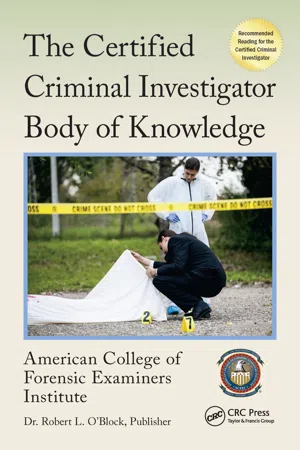
The Certified Criminal Investigator Body of Knowledge
- 581 pages
- English
- ePUB (mobile friendly)
- Available on iOS & Android
eBook - ePub
The Certified Criminal Investigator Body of Knowledge
About this book
Criminal investigators have a long list of duties. They must identify and secure a crime scene, conduct interviews of witnesses and victims, interrogate suspects, identify and properly collect evidence, and establish and maintain a chain of custody. Once an investigation is underway, the criminal investigator must demonstrate thorough knowledge of
Trusted by 375,005 students
Access to over 1.5 million titles for a fair monthly price.
Study more efficiently using our study tools.
Information
Section II
Crime Scenes and Evidence
Section II deals with proper protocol of investigating and searching crime scenes and dealing with victims, suspects, and witnesses on the scene. It also details the various types of evidence that might be present on a crime scene, such as physical evidence, trace evidence, DNA evidence, and digital evidence. Procedures for collecting each type of evidence are presented. See page 229 for questions reviewing the material in Section II.
Chapter 4: Crime Scene Investigation
Chapter 5: Evidence
Chapter 6: DNA Evidence
Chapter 7: Blood Spatter Pattern Analysis
Chapter 8: Postmortem Examination
Chapter 9: Computer/Digital Forensics
Chapter 4
Crime Scene Investigation
4.1 Types of Investigations
There are two types of investigations: complaint driven and intelligence driven.
4.1.1 Complaint-Driven Investigations
Complaint-driven investigations are reactive in nature and can be generated by either individuals or entities. Individual complainants can be victims of crimes, witnesses to crimes, informants, or perpetrators. Entity complainants include law enforcement agencies, healthcare institutions, or victims of property crimes. Victims of property crime are the most common type of complainant.
4.1.2 Intelligence-Driven Investigations
Intelligence-driven investigations are proactive in nature. It requires investigators to hunt out the individual aspects of the crime themselves. These crimes are often victimless and covert. Intelligence-driven investigations are often investigations over drugs, gangs, organized crime, vice, terrorism, or foreign counterintelligence. Investigators obtain information about such crimes through witnesses, informants, and assets.
4.2 Initial Response
This section details the investigator’s first actions when responding to a crime scene.
4.2.1 Note the Dispatch Information
The first step is to log the dispatch information. Investigators can get this information from the dispatcher, the person making the complaint, or their own observations. The following list details what needs to be noted:
- Address
- Date
- Parties involved
- Specific location (e.g., storefront, second-floor rear, mile marker)
- Time
- Type of call
- Type of scene (ongoing/dangerous scene or currently safe)
- Weapons involved
4.2.2 Watch Persons at the Crime Scene
The investigator’s initial observation of people at the crime scene can provide important clues to a case. The following list details what investigators should document:
- Investigator’s time of arrival
- Vehicles present—Know the make, model, color, condition, license plate number, and age of the vehicles. Descriptions should be vague if anything about the vehicle is unclear. For example, a black Nissan could be a dark blue Toyota, so a dark color compact car might be a better description. Investigators must note any vehicles leaving the scene.
- Individuals present—List and describe anyone at the scene. Descriptions should include the person’s height, weight, race, age, clothing, gender, and any distinguishing features.
- Direction of travel—Directions always should be described with terms such as north, south, east, and west. Left and right could be many directions depending on the viewer’s location, so investigators should avoid using them.
4.2.3 Assess the Crime Scene
Investigators approach a crime scene attentively and make careful observations. Upon arrival, they scan the entire area to thoroughly assess the scene. From this assessment, investigators note any possible secondary crime scenes. If there is activity other than in the main crime scene area, this may indicate a secondary crime scene. Finally, investigators scan the area for any vehicles or people who might be involved.
4.2.4 Approach the Scene Cautiously
Investigators approach the scene cautiously to ensure their own safety. This can begin before the investigator has even arrived. Investigators should use logic in how they approach the scene in their vehicles. Information known about the crime can help investigators decide how to approach. Crime scene personnel should always park with room around their vehicle in case they must make an emergency exit. If the crime is in progress, investigators should consider the noise their vehicles make. Measures may need to be taken to guard against the perpetrators hearing the investigators as they approach.
Upon arrival, investigators assess the scene for any ongoing dangerous activity. Using their senses, investigators watch out for downed power lines, dangerous animals, o...
Table of contents
- Taking the Exam
- Contributors
- American Board of Certified Criminal Investigators®
- Section I - Introduction to Forensic Science
- Section II - Crime Scenes and Evidence
- Section III - Criminal Investigations and Trials
- Section IV - Crime
- Section V - Injuries and Fatalities
- Section VI - The Psychological Autopsy
- Practice Test
- Answer Keys
- Bibliography
Frequently asked questions
Yes, you can cancel anytime from the Subscription tab in your account settings on the Perlego website. Your subscription will stay active until the end of your current billing period. Learn how to cancel your subscription
No, books cannot be downloaded as external files, such as PDFs, for use outside of Perlego. However, you can download books within the Perlego app for offline reading on mobile or tablet. Learn how to download books offline
Perlego offers two plans: Essential and Complete
- Essential is ideal for learners and professionals who enjoy exploring a wide range of subjects. Access the Essential Library with 800,000+ trusted titles and best-sellers across business, personal growth, and the humanities. Includes unlimited reading time and Standard Read Aloud voice.
- Complete: Perfect for advanced learners and researchers needing full, unrestricted access. Unlock 1.5M+ books across hundreds of subjects, including academic and specialized titles. The Complete Plan also includes advanced features like Premium Read Aloud and Research Assistant.
We are an online textbook subscription service, where you can get access to an entire online library for less than the price of a single book per month. With over 1.5 million books across 990+ topics, we’ve got you covered! Learn about our mission
Look out for the read-aloud symbol on your next book to see if you can listen to it. The read-aloud tool reads text aloud for you, highlighting the text as it is being read. You can pause it, speed it up and slow it down. Learn more about Read Aloud
Yes! You can use the Perlego app on both iOS and Android devices to read anytime, anywhere — even offline. Perfect for commutes or when you’re on the go.
Please note we cannot support devices running on iOS 13 and Android 7 or earlier. Learn more about using the app
Please note we cannot support devices running on iOS 13 and Android 7 or earlier. Learn more about using the app
Yes, you can access The Certified Criminal Investigator Body of Knowledge by 0 American College of Forensic Examiners Institute,American College of Forensic Examiners Institute in PDF and/or ePUB format, as well as other popular books in Social Sciences & Forensic Science. We have over 1.5 million books available in our catalogue for you to explore.