Chapter 1
Minerals and coal
Minerals and Coal are non-renewable natural resources that occur in the earth’s crust. As defined by Dana, a well known physicist, mineral is a substance having definite chemical composition and internal atomic structure and formed by the inorganic processes of nature [1].
1.1 TYPES OF MINERALS
All minerals contain one or more metals or metalloids. Minerals are broadly classified as metallic and non-metallic minerals.
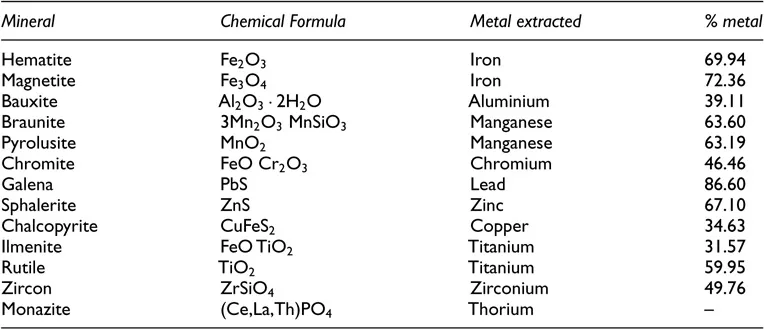
Metallic minerals are the minerals from which a metal is extracted. Bauxite (Al2O3·2H2O), Hematite (Fe2O3), Ilmenite (FeO TiO2), Pyrolusite (MnO2), and Chromite (FeO Cr2O3) are few of the important metallic minerals.
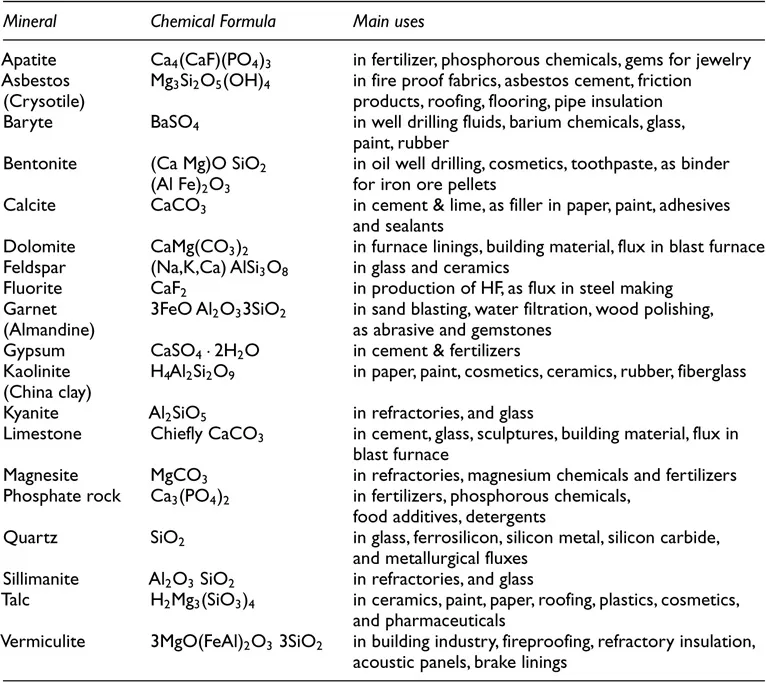
Non-metallic minerals are the minerals used for industrial purposes for making cement, refractories, glass & ceramics, insulators, fertilizers etc. These minerals are also called industrial minerals. Metals are not extracted from these minerals. Some metallic minerals are also used for industrial purposes like Bauxite, Chromite and Zircon for refractory industry, Pyrolusite for dry battery cells and Ilmenite for pigment industry etc. Table 1.1.1 shows few non-metallic minerals, their chemical formulae and chief uses.
The following are the important terms used in describing the mineral deposits.
Rock is an aggregation of several minerals as occurred in the earth’s crust. Granite, an aggregation of orthoclase, quartz and mica, is an example for the rock.
Ore is also an aggregation of several minerals from which one or more minerals can be exploited/separated at profit. Today’s rock due to unavailability of technology to use it may become tomorrow’s ore if technology is available to utilize it for our purpose. Similarly, at a place if the technology is available to separate required minerals profitably it is called ore. The same ore with the same characteristics in all respects is present in a place where it cannot be exploited at profit, it is called rock. Hence it should be understood that the term ore is used to represent its economic viability so that it can be attempted to exploit/separate for the required minerals.
Ore Minerals or Valuable Minerals (also called Economic Minerals) are those minerals of economic value and contain an economically exploitable quantity of some metal or non-metal.
Table 1.1.1 Non-metallic minerals.
Gangue Minerals are usually the non-metallic minerals associated with ore minerals which are worthless as a source for that metal or otherwise. These are usually unwanted or waste or useless minerals. These gangue minerals occasionally may find use as source of by-products. For example, pyrite present in Lead and Zinc ores is a gangue mineral but it is separated as by-product for extraction of sulphur after lead and zinc minerals are separated.
Ore Deposits are the natural deposits of ore minerals. These are also called economic mineral deposits.
Ore is an aggregation of valuable and gangue minerals.
Simple Ore is one from which a single metal can be extracted. For example, only Iron is extracted from Iron ore, Aluminium is extracted from Aluminium ore, Chromium is extracted from Chrome ore, etc. Such ores are called simple ores.
Complex Ore is one from which two or more metals can be extracted. Lead and zinc metals are extracted from lead zinc ore; Lead, Zinc and Copper metals are extracted from Lead-Zinc-Copper Ore. Such ores are called complex ores.
Table 1.1.2 Metallic minerals.
Metal Content of a mineral is generally expressed in percent of metal present in the mineral. It is calculated by taking ...