- 1,000 pages
- English
- ePUB (mobile friendly)
- Available on iOS & Android
eBook - ePub
Electrical Power Equipment Maintenance and Testing
About this book
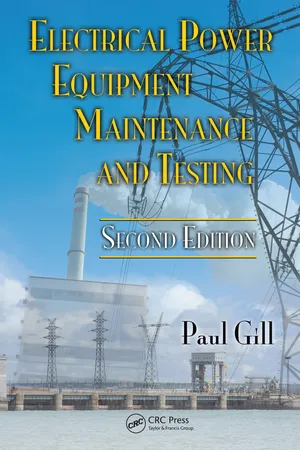
The second edition of a bestseller, this definitive text covers all aspects of testing and maintenance of the equipment found in electrical power systems serving industrial, commercial, utility substations, and generating plants. It addresses practical aspects of routing testing and maintenance and presents both the methodologies and engineering basics needed to carry out these tasks. It is an essential reference for engineers and technicians responsible for the operation, maintenance, and testing of power system equipment. Comprehensive coverage includes dielectric theory, dissolved gas analysis, cable fault locating, ground resistance measurements, and power factor, dissipation factor, DC, breaker, and relay testing methods.
Information
1
Maintenance Strategies, Dielectric Theory, Insulating Materials, Failure Modes, and Maintenance Impact on Arc-Flash Hazards
1.1 Introduction
The deterioration of electrical equipment is normal, and this process begins as soon as the equipment is installed. If deterioration is not checked, it can cause electrical failures and malfunctions. In addition, load changes or circuit alterations may be made without overall design coordination, which can result in improper selection of equipment, or settings of protective devices, or wrong trip devices installed in the circuits. The purpose of an electrical preventive maintenance (EPM) and testing program should be to recognize these factors and provide means for correcting them. With an EPM and testing program, potential hazards that can cause failure of equipment or interruption of electrical service can be discovered and corrected. Also, the EPM program will minimize the hazards to life and equipment that can result from failure of equipment when it is not properly maintained. Properly maintained equipment reduces downtime by minimizing catastrophic failures. To carry out the successful operation of electrical equipment and apparatus, it is essential to set up an effective maintenance and testing program. This program can be implemented by setting up a maintenance department or by contracting the work to a private company engaged in this practice.
The EPM program should consist of conducting routine inspections, tests, repairs, and service of electrical power system apparatus such as transformers, cables, circuit breakers, switchgear assemblies, and the like, along with associated equipment comprised of control wiring, protective devices and relays, supervisory equipment, and indicating and metering instruments.
1.2 Why Maintain and Test
A well-organized and implemented program minimizes accidents, reduces unplanned shutdowns, and lengthens the mean time between failures (MTBF) of electrical equipment. Benefits of EPM can be categorized as direct and indirect. Direct benefits are derived from reduced cost of repairs, reduced downtime of equipment, and improved safety of personnel and property. Indirect benefits can be related to improved morale of employees, better workmanship, increased productivity, and the discovery of deficiencies in the system that were either designed into the original system or caused by later changes made in the system.
1.3 Overview of Electrical Maintenance and Testing Strategies
Much of the essence of effective electrical equipment preventive maintenance (PM) can be summarized by four rules:
• Keep it dry.
• Keep it clean.
• Keep it cool.
• Keep it tight.
More specifically, most electrical power and control equipment is susceptible to a relatively small number of mechanisms of degradation, and the purpose of most EPM activities is to prevent them, retard them, or mitigate their effects. There are number of traditional philosophical approaches to electrical maintenance, such as run-to-failure (RTF), maintain as necessary, perform maintenance on fixed time schedules, and predictive maintenance, which are briefly summarized in the following sections. The reliability-centered maintenance (RCM) program is gaining favor because it combines the strengths of reactive, preventive, predictive, and proactive maintenance strategies. The RCM approach to electrical equipment is discussed in a greater detail than other maintenance strategies because it is becoming a maintenance program of choice. However, most power utilities, manufacturing firms, and owners of plant facilities utilize a combination of these programs. The decision as to which approach to adopt is largely dependent on the scope of system and equipment, as well as a function of how management views the cost and benefits of maintenance.
RTF
In this approach, EPM per se is not performed at all. Degraded equipment is only repaired or replaced when the effect of degradation on process output becomes unacceptable. (For most types of electric power equipment, this coincides with catastrophic failure.) No explicit attempt is made to monitor performance or to avert failure, and the risks associated with ultimate failure are accepted. Because of the generally high reliability of electric power equipment installed in a benign environment, the RTF approach often provides satisfactory power reliability and availability in noncritical applications. Small organizations which lack dedicated maintenance staffs often utilize this approach by default, and larger and more sophisticated organizations in the manufacturing sector also frequently apply it to noncritical equipment and systems. This maintenance strategy is also referred to as reactive maintenance.
Inspect and service as necessary
This approach is an advance beyond RTF wherein plant operating or maintenance personnel inspect electrical equipment on a more or less regular schedule (often during regular rounds of the plant). Under this approach, incipient failures are usually corrected before they become catastrophic, especially if the impact of a failure is considered unacceptable, and there is often some informal monitoring of performance to predict future failures. Many industrial manufacturing plants use this approach and find it satisfactory.
Time-based maintenance
The time-based maintenance (TBM) strategy is also known as scheduled PM. In this approach, established EPM activities are performed at fixed intervals of calendar time, operating hours, or operating cycles. Both procedures and schedules are usually based on manufacturers’ recommendations or industry standards. While the scheduled EPM approach ensures that equipment gets periodic attention, it does not necessarily prioritize EPM according to safety or productivity significance, nor does it optimize the application of limited EPM resources or take advantage of lessons learned from plant and industry experience. Scheduled EPM currently is the predominant approach among relatively sophisticated operators of plants where productivity and safety is a serious concern.
Condition-based maintenance
The condition-based maintenance (CBM) strategy is also called predictive maintenance. It is an extension of the TBM strategy and uses nonintrusive testing techniques to assess equipment condition. It uses planned maintenance tasks that are based on equipment’s previous operating history, and trending of the maintenance data. It is most effective when combined with a PM program because it prioritizes EPM based on criticality of equipment, productivity, resources, or lessons learned from experience.
RCM
It is a maintenance strategy where equipment condition, criticality, failure history, and life cycle cost are integrated to develop logically the most effective maintenance methods for each system, subsystem, and components. RCM capitalizes on the respective strengths of reactive, preventive, predictive, and proactive maintenance methods to maximize equipment reliability and availability. It is an ongoing process that continuously refines and redefines each maintenance activity.
The RCM process reduces the uncertainty inherently associated with the operational reliability of equipment by managing the risk through the periodic assessment of equipment condition. By using the proper instrumentation, the ability to determine the current equipment condition, changes from the baseline, and margin to failure, limits are readily determined. This allows the maintenance and operations staff to quantify the risk associated with continued operation or maintenance deferment, and to identify the most probable cause of the problem to the component level. In the majority of cases, condition testing is nonintrusive, allowing equipment condition assessments to be performed with the equipment operating under normal, loaded conditions.
The concept of RCM has evolved considerably over time when one applies it to facility maintenance. Historically, there was an intuitive belief that because mechanical parts wear out over time, equipment reliability is directly related to operating age. The belief was that the more frequently that equipment was overhauled, the better protected it would be against failure. Industry increased PM to include nearly everything.
In the 1970s, the airline industry found that many types of failure could not be prevented regardless of the intensity of maintenance. Actuarial analysis of failure data suggested that PM was ineffective by itself in controlling failure rates. And for many items, failure rates did not increase with increased operational use. In the 1980s, early forms of condition monitoring devices came on the market and coincided with microprocessors and a new computer literacy. RCM theory was refined and adopted by the US Navy’s submarine fleet. It was shown that in many cases, scheduled overhaul increases the overall failure rate by introducing new infant mortality probability into an otherwise stable system.
What has evolved is a complementary program—rigorous and streamlined—that has its most appropriate applications based on the consequences of failure, the probability of failure, historical data, and the amount of risk willing to be tolerated.
Rigorous RCM in its original concept involves a heavy reliance on detailed failure modes and effects analyses; math-calculated probabilities of failure; model development and accumulation of historical data. It provides the most detailed knowledge on a specific system and component and provides the most detailed documentation. Because of the detail involved, it is highly labor intensive, time-consuming, and comparatively expensive. The most appropriate applications of RCM are when the consequences of failure would result in a catastrophic risk to personal safety and health, to the environment, or could result in complete economic failure of an organization.
Plant managers adopted a streamlined RCM approach recognizing its benefits while realizing that few building mechanical and electrical systems carry the catastrophic risk addressed in the rigorous RCM process. Lower intensity more in line with the scale of a facility’s infrastructure also meant lower costs. Streamlined RCM targets systems and components in order of criticality. It relies heavily on condition-based tasks and eliminates low-value maintenance tasks altogether based on maintenance and operations staff input and historical data. It minimizes extensive analysis in favor of finding the most obvious, costly problems early-on, capitalizes on the early successes, and then expands outward in a continuous fashion. Streamlined RCM requires a thorough understanding of condition monitoring technologies as well as analytical techniques, including root cause failure analysis (RCFA), trend analysis, and failure modes and effe...
Table of contents
- Cover
- Title Page
- Copyright Page
- Dedication
- Table of Contents
- Series Introduction
- Foreword
- Preface
- Acknowledgments
- Chapter 1 Maintenance Strategies, Dielectric Theory, Insulating Materials, Failure Modes, and Maintenance Impact on Arc-Flash Hazards
- Chapter 2 Direct-Current Voltage Testing of Electrical Equipment
- Chapter 3 Power Factor and Dissipation Factor Testing Methods
- Chapter 4 Insulating Oils, Fluids, and Gases
- Chapter 5 Transformers
- Chapter 6 Cables and Accessories
- Chapter 7 Medium-Voltage Switchgear and Circuit Breakers
- Chapter 8 Low-Voltage Switchgear and Circuit Breakers
- Chapter 9 Testing and Commissioning of Protective Relays and Instrument Transformers
- Chapter 10 Motors and Generators
- Chapter 11 Electrical Power System Grounding and Ground Resistance Measurements
- Chapter 12 Power Quality, Harmonics, and Predictive Maintenance
- Chapter 13 Electrical Safety, Arc-Flash Hazard, Switching Practices, and Precautions
- Appendix A
- Appendix B
- Bibliography
- Index
Trusted by 375,005 students
Access to over 1.5 million titles for a fair monthly price.
Study more efficiently using our study tools.
Frequently asked questions
Yes, you can cancel anytime from the Subscription tab in your account settings on the Perlego website. Your subscription will stay active until the end of your current billing period. Learn how to cancel your subscription
No, books cannot be downloaded as external files, such as PDFs, for use outside of Perlego. However, you can download books within the Perlego app for offline reading on mobile or tablet. Learn how to download books offline
Perlego offers two plans: Essential and Complete
- Essential is ideal for learners and professionals who enjoy exploring a wide range of subjects. Access the Essential Library with 800,000+ trusted titles and best-sellers across business, personal growth, and the humanities. Includes unlimited reading time and Standard Read Aloud voice.
- Complete: Perfect for advanced learners and researchers needing full, unrestricted access. Unlock 1.5M+ books across hundreds of subjects, including academic and specialized titles. The Complete Plan also includes advanced features like Premium Read Aloud and Research Assistant.
We are an online textbook subscription service, where you can get access to an entire online library for less than the price of a single book per month. With over 1.5 million books across 990+ topics, we’ve got you covered! Learn about our mission
Look out for the read-aloud symbol on your next book to see if you can listen to it. The read-aloud tool reads text aloud for you, highlighting the text as it is being read. You can pause it, speed it up and slow it down. Learn more about Read Aloud
Yes! You can use the Perlego app on both iOS and Android devices to read anytime, anywhere — even offline. Perfect for commutes or when you’re on the go.
Please note we cannot support devices running on iOS 13 and Android 7 or earlier. Learn more about using the app
Please note we cannot support devices running on iOS 13 and Android 7 or earlier. Learn more about using the app
Yes, you can access Electrical Power Equipment Maintenance and Testing by Paul Gill in PDF and/or ePUB format, as well as other popular books in Technology & Engineering & Electrical Engineering & Telecommunications. We have over 1.5 million books available in our catalogue for you to explore.