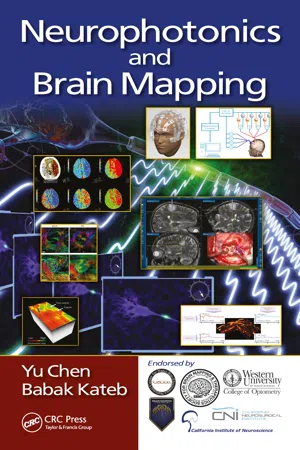
Understanding how the brain works and developing effective therapeutics are important in advancing neuroscience and improving clinical patient care. Neurophotonics and Brain Mapping covers state-of-the-art research and development in optical technologies and applications for brain mapping and therapeutics. It provides a comprehensive overview of various methods developed using light, both microscopic and macroscopic techniques. Recent developments in minimally-invasive endoscopic imaging of deep brain structure and function, as well as light-based therapy are also reviewed.
- 563 pages
- English
- ePUB (mobile friendly)
- Available on iOS & Android
eBook - ePub
Neurophotonics and Brain Mapping
About this book
Information
1
History of Brain Mapping and Neurophotonics
From Technological Discoveries to Brain Initiatives
CONTENTS
Introduction
Historical Milestones in Brain Mapping
X-Ray
Computed Tomography
Magnetic Resonance Imaging
Positron Emission Tomography
Historical Milestones in Neurophotonics
Near-Infrared Spectroscopy and Imaging
Optical Coherence Tomography
Fluorescence Spectroscopy, Imaging, and Microscopy
Optogenetics
Photodynamic Therapy
Intraoperative Brain Mapping
GE Double Donut MRI
Intraoperative Magnetic Resonance Imaging Integrated Neurosurgical Suite
Advanced Multimodality Image Guided Operating
Brain Initiative, G20 World Brain Mapping and Therapeutics Initiative, and National Photonic Initiative
SBMT-IEEE Brain Mapping Initiative
National Photonic Initiative
Conclusion
References
Introduction
According to the Society for Brain Mapping and Therapeutics (SBMT), brain mapping is defined as the study and elucidation of the anatomy and functionality of the brain and spinal cord through the use of imaging (including intraoperative, microscopic, endoscopic, molecular, and multimodality imaging), immunohistochemistry, optogenetics, stem cell and cellular biology, engineering (material, electrical, and biomedical), advanced technologies (ultrasound, photonics, etc.), neurophysiology, and nanotechnology (Kateb and Heiss, 2013). Diverse types of brain mapping exist, encompassing anatomical, structural, cellular, functional, and metabolic. Cellular maps, for instance, may comprise nanoscale imaging and may be alternately defined via genomics. This volume will endeavor to survey and articulate the latest advances in neurophotonics. These exciting technological advances will lead to the further enhancement of the diagnoses and treatments of myriad brain conditions toward improved patient outcomes globally.
Historical Milestones in Brain Mapping
The first known written instance of the word “brain,” in addition to articulations of the meninges, the cerebrospinal fluid, and various brain injuries, dates back to ~3000 BC in what is referred to as The Edwin Smith Surgical Papyrus, which is an ancient medical text that was authored by the prominent Egyptian physician Imhotep. At the time, however, the brain was thought to be an inconsequential organ in contrast to the heart, which was deemed to be its life force (Minagar et al., 2003). The Greek medical theorist and dissectionist Alcmaeon of Croton (500 BC) is thought to have been the earliest author to propose that the brain was the center of cognition and sensation. His dissection studies of the eye led him to posit that the optic nerves “came together behind the forehead” and comprised brain terminating “light bearing paths” (Lloyd, 1975). Democritus (460–370 BC) put forward that all matter in the universe was made of various constituent atoms and that the human mind was composed of the most rapidly motile atoms (Gross, 1995). Plato (~428–347 BC) expanded on these musings in his Timaeus, where he states that the brain “…is the divinest part of us and lord over all the rest” (Plato, 1959), whereas Hippocrates (460–370 BC) affirmed that mental operations were “completely undertaken by the brain.” He also conveyed his firm belief that epilepsy originated within the brain in his well-known essay “On the Sacred Disease” (Hippocrates, 1950; Gross, 1995).
Galen (AD 121–201) was among the first well-documented ancient scienti...
Table of contents
- Cover
- Halftitle Page
- Endorsements
- Title Page
- Copyright Page
- Dedication Page
- Contents
- Preface
- Contributors
- Chapter 1 History of Brain Mapping and Neurophotonics: From Technological Discoveries to Brain Initiatives
- SECTION I Optical Spectroscopy and Spectral Imaging of Brain
- SECTION II Brain Imaging and Mapping from Micro to Macroscales
- SECTION III Intraoperative Neuroimaging
- SECTION IV Image-Guided Intervention and Phototherapy
- Index
Trusted by 375,005 students
Access to over 1.5 million titles for a fair monthly price.
Study more efficiently using our study tools.
Frequently asked questions
Yes, you can cancel anytime from the Subscription tab in your account settings on the Perlego website. Your subscription will stay active until the end of your current billing period. Learn how to cancel your subscription
No, books cannot be downloaded as external files, such as PDFs, for use outside of Perlego. However, you can download books within the Perlego app for offline reading on mobile or tablet. Learn how to download books offline
Perlego offers two plans: Essential and Complete
- Essential is ideal for learners and professionals who enjoy exploring a wide range of subjects. Access the Essential Library with 800,000+ trusted titles and best-sellers across business, personal growth, and the humanities. Includes unlimited reading time and Standard Read Aloud voice.
- Complete: Perfect for advanced learners and researchers needing full, unrestricted access. Unlock 1.5M+ books across hundreds of subjects, including academic and specialized titles. The Complete Plan also includes advanced features like Premium Read Aloud and Research Assistant.
We are an online textbook subscription service, where you can get access to an entire online library for less than the price of a single book per month. With over 1.5 million books across 990+ topics, we’ve got you covered! Learn about our mission
Look out for the read-aloud symbol on your next book to see if you can listen to it. The read-aloud tool reads text aloud for you, highlighting the text as it is being read. You can pause it, speed it up and slow it down. Learn more about Read Aloud
Yes! You can use the Perlego app on both iOS and Android devices to read anytime, anywhere — even offline. Perfect for commutes or when you’re on the go.
Please note we cannot support devices running on iOS 13 and Android 7 or earlier. Learn more about using the app
Please note we cannot support devices running on iOS 13 and Android 7 or earlier. Learn more about using the app
Yes, you can access Neurophotonics and Brain Mapping by Yu Chen, Babak Kateb, Yu Chen,Babak Kateb in PDF and/or ePUB format, as well as other popular books in Ciencias biológicas & Neurología. We have over 1.5 million books available in our catalogue for you to explore.