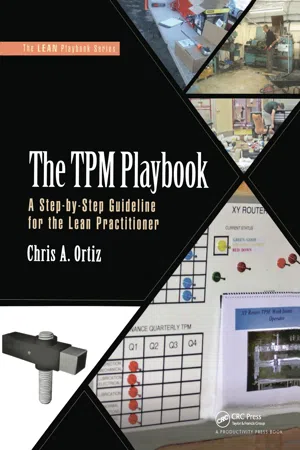
- 72 pages
- English
- ePUB (mobile friendly)
- Available on iOS & Android
eBook - ePub
About this book
This book is a guideline for implementation and it is intended for the Lean practitioner looking for a training tool and a guideline that can be used in the work area while improvements are being conducted. It describes how to effectively implement total productive maintenance.
Information
Publisher
Productivity PressYear
2016Print ISBN
9781032556499
9781138437944
Edition
1eBook ISBN
9781498782609
Chapter 1
Start with 5S
Introduction
The successful implementation of total productive maintenance (TPM) into your organization will help change the way the culture thinks and perceives the company’s important assets. Within Lean, there are tools and concepts for reducing waste. 5S is a great starting point, and the purpose of this chapter is to show you how to implement 5S in the maintenance department. If maintenance staff and operators are required to perform TPM activities, what is the state of organization in their work areas? 5S creates the foundation for continuous improvement, and TPM helps develop a sense of pride and discipline for the culture. You also want your maintenance staff to spend their time performing TPM and special projects, not searching for tools and parts in a cluttered work area.
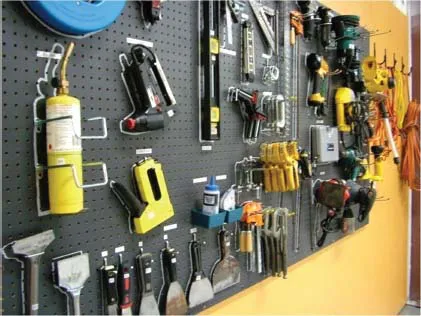
Evaluate what is needed to perform the tasks in a work area and remove anything unnecessary. It is good practice to use an identification system while conducting the sorting step. This system is called Red Tagging.
■ Parts
■ Tools
■ Workbenches
■ Garbage cans
■ Fixtures and jigs
■ Documentation
■ Supplies
■ Equipment
■ Anything that can be removed
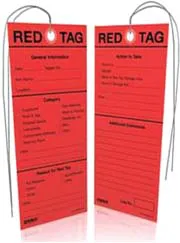
Break down the sorted items into three categories:
1. Garbage and junk (throw away or recycle). There is not much point in Red Tagging garbage, but it still needs to be removed.
2. Unneeded, never to return. This category will have most of the Red Tags. Further in this book, I provide some options of how to deal with these items.
3. Low-use Items. Low-use items are essential but not used that often, maybe once a month or in wider time frames. Red Tag these items but place them in a separate pile. Just make sure when you are setting things in order they are organized away from daily use items.
Make sure to create an inventory list of all items to be removed to help in the final disposition and removal from the company.
Red Tagging
■ Organized approach to sorting
■ Keeps track of what is being removed
■ Allows for efficient removal from facility
■ Three parts to a Red Tag event:
– Attaching Red Tags: Red Tag
– Red Tag area (temporary staging): Red Tag area
– Removal procedure
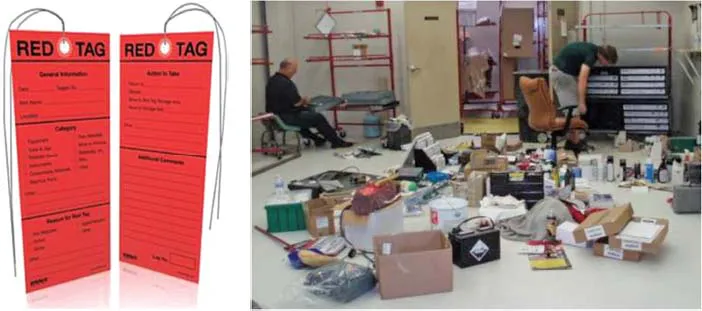
This is a Red Tag area.
Why Sort?
■ Unneeded inventory takes up space.
■ Extra parts require wasted transportation and motion.
■ Without sorting, it is tougher to find what is needed.
■ Unneeded equipment becomes obstacles.
■ It is tough to bring in new product lines.
■ It is tough to bring in new equipment.
■ The confusion that clutter creates is cleared.
■ Clarity is obtained on what is truly needed.
■ It prepares for setting things in order. (Why organize items you do not use?)
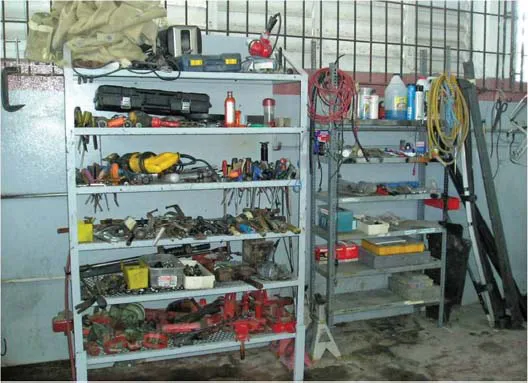
Is everything here really needed?
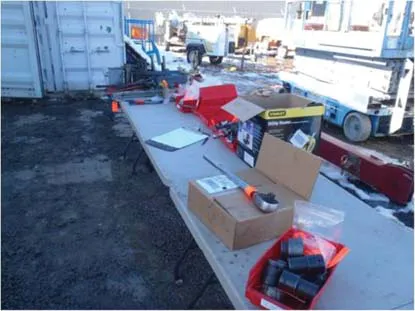
Red Tag area: service shop sorted items
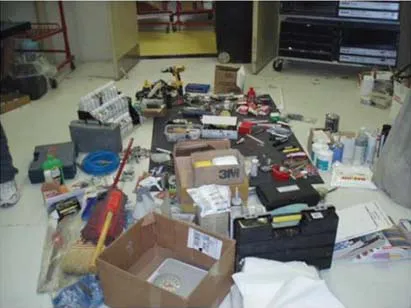
Maintenance parts room: sorted items
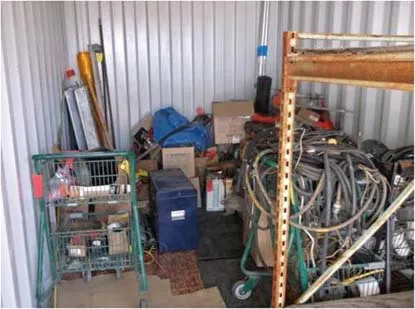
Maintenance Red Tag area: rented container
The second stage of 5S is Set in Order. Set in Order is the act of creating locations for all essential items needed in the work area. It is the act of organizing what is needed so it is easily identifiable in a designated place. During this phase, it is recommended that the implementation team work from the floor up, focusing on the layout of the maintenance department.
It is at this point in the implementation when work areas, aisleways, and floor locations are established. Once this is complete, then smaller items...
Table of contents
- Cover
- Half Title
- Title Page
- Copyright Page
- Table of Contents
- How to Use This Playbook
- Introduction
- 1 Start with 5S
- 2 Maintenance Inventory
- 3 Baseline Your Equipment
- 4 TPM Procedures
- 5 Visual TPM Boards
- 6 Conclusion
- Definition of Terms
- Index
- About the Author
Trusted by 375,005 students
Access to over 1.5 million titles for a fair monthly price.
Study more efficiently using our study tools.
Frequently asked questions
Yes, you can cancel anytime from the Subscription tab in your account settings on the Perlego website. Your subscription will stay active until the end of your current billing period. Learn how to cancel your subscription
No, books cannot be downloaded as external files, such as PDFs, for use outside of Perlego. However, you can download books within the Perlego app for offline reading on mobile or tablet. Learn how to download books offline
We are an online textbook subscription service, where you can get access to an entire online library for less than the price of a single book per month. With over 1.5 million books across 990+ topics, we’ve got you covered! Learn about our mission
Look out for the read-aloud symbol on your next book to see if you can listen to it. The read-aloud tool reads text aloud for you, highlighting the text as it is being read. You can pause it, speed it up and slow it down. Learn more about Read Aloud
Yes! You can use the Perlego app on both iOS and Android devices to read anytime, anywhere — even offline. Perfect for commutes or when you’re on the go.
Please note we cannot support devices running on iOS 13 and Android 7 or earlier. Learn more about using the app
Please note we cannot support devices running on iOS 13 and Android 7 or earlier. Learn more about using the app
Yes, you can access The TPM Playbook by Chris A. Ortiz in PDF and/or ePUB format, as well as other popular books in Business & Industrial Management. We have over 1.5 million books available in our catalogue for you to explore.