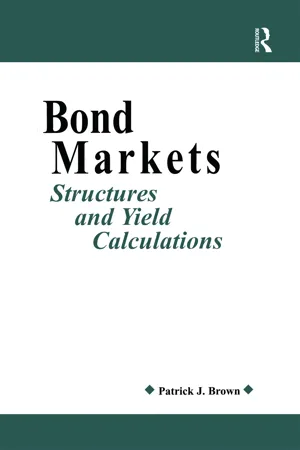
As cross-market bond trading has increased, it has become vital for international participants to understand the many different features that characterize the various international bond markets. Of particular interest to bond traders and investors are such factors as calculation of prices, accrued interest, yields, and durations. Bond Markets compares and contrasts all major bond markets with particular attention to: how different instruments are normally quoted; how much accrued interest is payable by the buyer in addition to traded price; the cost of a bond if quoted on a yield basis; normal settlement terms; rules for adjusting coupon rates; and how yields are quoted and calculated.
- 150 pages
- English
- ePUB (mobile friendly)
- Available on iOS & Android
eBook - ePub
CHAPTER 1
INTRODUCTION
The bond markets in Europe and elsewhere have developed independently with inevitably different conventions for calculating prices, yields and interest rates and settling the various instruments. With the ever increasing amount of cross-border trading it is desirable that people should be able to compare accurately the markets in one country with another and agree the cost of the transactions. The purpose of this book is to help in the process.
The practices of the individual markets are constantly changing and these changes are tending to make the markets more homogeneous - partly due to the influence of the G30 recommendations, but more significantly, due to the greatly increased amount of cross-border trading and the advent of the euro.
Examples of this are the wide acceptance of the ISMA yield methodology, which is included in the Maastricht treaty, and the standard money market yield calculation. Similarly, there has been a move to settling bond transactions internationally, in many European domestic markets and in the U.S. corporate market on a T+3 basis (i.e. 3 business days after trade date).
However, the different bond and money markets still continue to accrue interest on a variety of bases, to trade ex-coupon for different periods etc. For example, currently in France, the money markets accrue interest on a 360-day year basis, whereas the bond markets accrue on a 365/366-day year. The situation is reversed in Italy, with the money markets accruing interest on a 365-day year and the bond markets on a 360-day year.
It should be noted that, whilst every effort has been made to establish the validity of the data, the constantly changing nature of the markets inevitably creates a potential for errors and omissions, for which neither the author or publisher can accept liability.
CHAPTER 2
TRADE, VALUE AND SETTLEMENT DATES
Most markets have rules for determining the value date of a transaction. For example, the value date for a transaction in an applicable international security is governed by ISMA Rules 221-225. The rules as at January 1997 are given below:
Rule 221 Value date new issues
The value date for a transaction effected prior to the closing date shall be the closing date or the third business day following the trade date, whichever is the later.
A business day for the purpose of this rule shall be a day when Cedel, Euroclear and the cash market of the currency in which the relevant transaction is to be settled are open for business.
In case either Cedel, Euroclear or the cash market of the currency in which the relevant transaction is to be settled, are closed for business between the trade date and the value date, accrued interest shall be adjusted.
Rule 222 Normal value date
The value date for a transaction effected on or after the closing date shall be the third business day (as defined in rule 221) following the trade date.
In case either Cedel, Euroclear or the cash market of the currency in which the relevant transaction is to be settled, are closed for business between the trade date and the value date, accrued interest shall be adjusted.
Rule 223 Special value date
A special value date may be mutually agreed between the buyer and the seller at the time of dealing.
Rule 224 Value date on non-settlement day
Deleted effective June 1, 1995.
Rule 225 Value date and coupon due date
Where the due date of an interest coupon coincides with the value date of a transaction, the buyer shall not acquire such coupon and no accrued interest shall be calculated on such a contract. With the exception of floating rate notes, in the case of a transaction with a value date on the thirtieth calendar day and a coupon due date on the thirty-first calendar day of the same month, accrued interest shall correspond to the full value of the coupon.
The value date and the settlement date are normally identical. It is conventional and recommended that all calculations on securities are performed to the value date and not the settlement date if there is a discrepancy.
Similarly if a coupon or redemption falls on a non-settlement date then all calculations are performed as if the payment were to be made on that date.
The worst problem that can arise is when a bond is expected to be redeemed on a non-settlement date e.g. Taylor Woodrow 8 %% 1 December 1990 which was redeemed on a Saturday. The terms of most new international issues are now chosen so that this does not occur, however in some domestic markets, e.g. the Netherlands and Germany, it is a common occurrence, because of their coupon payment conventions.
Example ▶
If the cost of overnight money is 10% then the cost of a two day delay on the redemption payment is 10 x 2/365 = 0.0548%.
Coupons on fixed rate bonds will frequently occur at weekends and on bank holidays. However, this should not happen with floating rate notes as the issuing houses normally follow the convention below.
The interest payment date is the date falling six calendar months after the closing date and each date thereafter which falls six calendar months after the preceding interest payment date. If any interest payment date would otherwise fall on a day which is not a business day, it shall be postponed to the next business day unless it would thereby fall in the next calendar month. In the latter event, the interest payment date shall be the immediately preceding business day, and each subsequent interest payment date shall be the last business day of the sixth calendar month after the month in which the preceding interest payment date shall have fallen.
Example ▶
Consider a floating rate note which pays a monthly coupon on Tuesday, 28 January 1996. The subsequent coupon payment dates will be:
| 28 February | Friday |
| 30 March | Monday |
| 30 April | Thursday |
| 29 May | Friday |
| 30 June | Tuesday |
| 31 July | Friday |
| 28 August | Friday (assuming 31 August is not a business day) |
| 30 September | Wednesday |
CHAPTER 3
ACCRUED INTE...
Table of contents
- Cover
- Title Page
- Copyright Page
- Contents
- Preface
- Acknowledgements
- Chapter 1 Introduction
- Chapter 2 Trade, Value and Settlement Dates
- Chapter 3 Accrued Interest
- Chapter 4 Measures of Life and Associated Calculations
- Chapter 5 Yields
- Chapter 6 Floating Rate Note Calculations
- Chapter 7 Convertible Calculations
- Chapter 8 Warrants
- Chapter 9 Money Market Instruments
- Chapter 10 Miscellaneous
- Chapter 11 Bond Market Comparisons
- Appendix I The General Redemption Yield Formula
- Appendix II Compounding Frequency Adjustments
- Appendix III Index-Linked Stocks and Real Returns
Trusted by 375,005 students
Access to over 1.5 million titles for a fair monthly price.
Study more efficiently using our study tools.
Frequently asked questions
Yes, you can cancel anytime from the Subscription tab in your account settings on the Perlego website. Your subscription will stay active until the end of your current billing period. Learn how to cancel your subscription
No, books cannot be downloaded as external files, such as PDFs, for use outside of Perlego. However, you can download books within the Perlego app for offline reading on mobile or tablet. Learn how to download books offline
Perlego offers two plans: Essential and Complete
- Essential is ideal for learners and professionals who enjoy exploring a wide range of subjects. Access the Essential Library with 800,000+ trusted titles and best-sellers across business, personal growth, and the humanities. Includes unlimited reading time and Standard Read Aloud voice.
- Complete: Perfect for advanced learners and researchers needing full, unrestricted access. Unlock 1.5M+ books across hundreds of subjects, including academic and specialized titles. The Complete Plan also includes advanced features like Premium Read Aloud and Research Assistant.
We are an online textbook subscription service, where you can get access to an entire online library for less than the price of a single book per month. With over 1.5 million books across 990+ topics, we’ve got you covered! Learn about our mission
Look out for the read-aloud symbol on your next book to see if you can listen to it. The read-aloud tool reads text aloud for you, highlighting the text as it is being read. You can pause it, speed it up and slow it down. Learn more about Read Aloud
Yes! You can use the Perlego app on both iOS and Android devices to read anytime, anywhere — even offline. Perfect for commutes or when you’re on the go.
Please note we cannot support devices running on iOS 13 and Android 7 or earlier. Learn more about using the app
Please note we cannot support devices running on iOS 13 and Android 7 or earlier. Learn more about using the app
Yes, you can access Bond Markets by Patrick J. Ryan in PDF and/or ePUB format, as well as other popular books in Business & Bonds. We have over 1.5 million books available in our catalogue for you to explore.