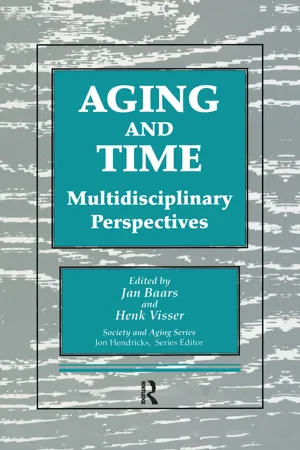
eBook - ePub
Aging and Time
Multidisciplinary Perspectives, Illustrated Edition
- 216 pages
- English
- ePUB (mobile friendly)
- Available on iOS & Android
eBook - ePub
Aging and Time
Multidisciplinary Perspectives, Illustrated Edition
About this book
The aim of this volume is to revitalise the debate about the concepts of time implicit in the study of aging. The many problems related to aging and the aged put an enormous pressure on the gerontological community to come up with practical applications and solutions. In considering research findings, we must keep in mind the basic assumptions that shape and influence even the most obvious statements about aging. In this multidisciplinary volume, the contributors take on the important task of exploring real issues concerning temporal concepts and approaches to aging; and the concepts of time that are used in thinking about aging determine to a large extent the way aging is approached. Most studies of aging still use a chronological approach to define populations for research purposes (that is, to determine which "aged" should be studied) and to establish how people's characteristics (social, economic, health and so forth) change as a function of age. This approach may lead to an accumulation of data, but does not in itself lead to explanatory knowledge. The step from chronological time to chronological age should be taken cautiously if we want to consider aging processes seriously, especially because chronological age is widely used in contemporary societies as a basis for regulating all kinds of processes, with many consequences for individuals. The arguments presented here do not deny the finitude of human life, nor do they deny that "aging" can be observed in any individual if we compare the characteristics of that person over a relatively long period. The question is how to approach these themes to get a better understanding. To achieve this, we need to understand the specific significance and relativity of chronological time and uncover unfounded deductions about time in relation to aging. This book will be of interested to students and professors of the social sciences, humanities and aging, including the methodology of aging studies; professionals working in the field of aging, including sociologists, psychologists and biologists.
Information
It is the aim of this volume to revitalize the debate about the concepts of time implicit in the study of aging. A potentially interested but already overburdened reader may wonder whether one needs or whether there is a need for such a book. Time seems such an ordinary unproblematic topic that a work devoted to it might appear to be a digression from many pressing problems of aging. Indeed, aging can lead to many problems that must be taken care of. This has put an enormous pressure on the gerontological community to provide or seek practical applications and solutions. It is not important to read this book so as to counterbalance such practically oriented work. Its importance is the exploration of real issues concerning temporal concepts and approaches to aging: whatever concepts of time are used determine to a large extent the way aging is approached.
There is a seemingly self-evident time that we read on clocks and calendars and use to determine the ages of cars, buildings and (why not?) human beings. This chronological time serves many purposes well but is actually quite problematic when it comes to aging, especially when it gets more credit than it deserves. That aging is poorly indicated by higher chronological ages may often be admitted, but this does not appear to lead to much change in research practices. The vast majority of studies of aging still use a chronological approach to define populations for research purposes (determine who the “aged” are that should be studied) and try to establish how (social, economic, health, etc.) characteristics of people change as a function of their chronological age. This may lead to an accumulation of data, but in itself not to explanatory knowledge.
The issue at stake is not whether chronological time should be abandoned; that would be to neglect the role it has to play in every empirical study, also of aging processes. There is, however, an unreflected overemphasis on chronological time that leads to problems, as if the precision of chronological time would in itself give a solid foundation to the study of aging. This idea is even more tempting as this concept of time has been institutionalized to measure and coordinate processes and actions all over the world, leading to a calendar that makes it possible to localize anybody’s birth in time and precisely determine his or her “age.” The grand ambition of gerontology still seems to be to establish how this chronological or calendar age of persons determines the characteristics of aging persons or even of all humans. This would eventually reduce gerontology to a straightforward set of simple formulas in which scientific precision and practical use would be united. Almost 50 years ago this option was already stated with much self-assurance: “Chronological age is one of the most useful single items of information about an individual if not the most useful. From this knowledge alone an amazingly large number of general statements or predictions can be made about his anatomy, physiology, psychology and social behavior” (Birren, 1959, p. 8). Although the author of these lines has later expressed serious reservations about them, a large part of the gerontological community is still under their spell.
One of the practical issues at stake is whether gerontology does not, in its search for clear links between age and characteristics, reinforce conventional generalizations about aging and the aged. Furthermore, even unfounded generalizations about categories of people with certain ages can be implemented in policies regarding, for instance, specific forms of care or housing for “the aged” and thus contribute to a reality which forces aging people to fit in, because there are no other options offered. Consequently, later research can affirm the earlier generalizations, not because they grasped the realities of aging, but because gerontological expertise has again played its unreflected role in co-constituting the realities of aging. In such cases, the analytical apparatus of gerontology runs the danger of becoming an uncritical instrument catering to all kinds of organizational contexts, in which aging people are mainly relevant as the subjects of planning procedures and average estimates. Such bureaucratic operations may be necessary, but should not dominate the way aging is approached or understood. Although aging processes can be measured chronologically, they are not regulated by chronological time. The step from chronological time to chronological age should be taken very cautiously if we want to take aging processes seriously, especially because chronological age is widely used in contemporary societies to regulate all kinds of processes with many consequences for the people concerned (see Baars, this volume). To counteract these tendencies, it is good to emphasize that the search for aging characteristics based on chronological age has established much counterevidence, testifying to the many differences in aging processes. This counterevidence comes hardly as a surprise when we try to imagine persons with the same chronological age but living in very different circumstances. Think, for instance, of 60-year-olds: one would expect enormous differences in terms of empirical data and personal experiences between, let us say, a contemporary poor African woman, a Japanese man, or a homeless American of that age; not to mention 60-year-olds in prehistoric times, in the Roman Empire, in classical China or among nineteenth-century factory workers. The fact that in Western Europe the average life expectancy for males has practically doubled in the last 150 years (Imhoff, 1981) implies that chronological age cannot by itself give any precise reference to (a phase of) aging processes.
Chronological definitions of life expectancy must presuppose more or less regular cycles of human life in specific historical contexts. But also within the same historical period, different socioeconomic and cultural contexts, gender, genetic codes, medical histories, and individual choices or fates have been shown to be statistically associated with different aging processes. Even a “cohort identity,” established by contrast with other cohorts within the same historical context, remains to a high degree an abstract construction which has to tolerate a considerable amount of internal differentiation. Major longitudinal studies like the Berlin Aging Study (Baltes & Mayer, 1999) or the Seattle Longitudinal Study (Schaie, 1996) offer many examples of these differences (cf. also Daatland & Biggs, 2004).
Because human beings with the same chronological age can show, even from a mere biological point of view, very different aging characteristics, we can no longer assume that aging processes develop in synchrony with chronological time. As organisms age at different rates and even different tissues, organs, and organ systems within an organism may age at different rates, chronological age turns out to be even a poor predictor of remaining life expectancy, leading here and there to other directions for research, such as the quest for “biomarkers” of aging (Sprott, 2002). The many faces of aging between the extremes of a teenager suffering from progeria and a vibrantly alive centenarian are mirrors in which the hidden and profoundly puzzling varieties of aging as living in time stare us in the face. Maybe the many different processes of aging all have their own dynamical properties, but these may include, to make it even more complicated, an openness to the environment. These processes must be discovered in their specificity, and in the course of this discovery chronological time can only function as an instrument and should not be extended to represent a chronological age with an implicit gerontological surplus. Chronological age is only the amount of chronological time that has passed since somebody was born.
To avoid any misunderstanding, these arguments are no denial of the finitude of human life, nor do they deny that aging can be observed in any human being, if we compare characteristics of the same person over a relatively long period of time. The question is how to approach these themes to get a better understanding. To achieve this, it is essential to understand the specific significance and relativity of chronological time and its unfounded seductions in relation to aging.
A MISTAKEN IDEA BEHIND CHRONOLOGICAL AGE: TIME WORKING AS A REGULAR CAUSE
Generalizations about people with a certain calendar age actually presuppose a causal concept of time: because time has worked for a certain duration in aged people, certain inevitable effects should be reckoned with. Moreover, the effects are assumed to develop steadily and universally according to the rhythm of the clock. However, such a causal concept of time in aging can never generate knowledge that might explain something of the differences that exist between human beings of the same age, nor allow us to understand that aging is a generalizing concept that is actually composed of many specific processes. While it is true that all causal relations are also temporal relations, or relations working “in time,” it would be wrong to identify causality with time or to reduce the process of aging to the causal effects of time. The same Jim Birren whose high expectations of the predictive power of chronological age I quoted earlier, has later dealt with time extensively and articulated a similar view: “By itself, the collection of large amounts of data showing relationships with chronological age does not help, because chronological age is not the cause of anything. Chronological age is only an index, and unrelated sets of data show correlations with chronological age that have no intrinsic or causal relationship with each other” (Birren, 1999, p. 460).
The elusive concept of time is usually made visible and calculable using spatial and numerical projections to explain what time is or how time works. A well-known example of such a spatial projection is drawing a straight line, which visualizes the time which is passing even during this action of drawing. This can easily be transformed into the “arrow of time” or into one of the axes in a diagram explaining changes as a function of time. But this visualization creates precisely the illusion that aging processes can be clearly and unequivocally related to chronological time. An important limitation of such projections is that they can clarify only those aspects that time has in common with space. But is it at all possible to concentrate on pure time as such and measure it precisely?
THE ABSTRACT RHYTHMS OF CHRONOLOGICAL TIME
Time is usually indicated by clocks, which make it possible to measure the duration of a process or locate an event (the birth of a baby, a future appointment) in time. We know that some clocks do not function well, that they are not precise. But how can we determine whether a clock really measures time as such? Usually, we establish the accuracy of a clock by comparing it with the clock of an institution with “more authority,” such as the telephone company or television. But again, how can we determine the accuracy of such an authoritative clock? To what most “authoritative clock” or most “fundamental time” are these clocks attuned? To the movement of the earth around the sun? Is that time in an ultimate sense? Or something else? Unfortunately, following this line of questioning does not lead to ultimate time or an ultimate clock. In all chronological time concepts that we know of, a specific, more or less regular process has been selected as a standard to establish what time is. In most traditions, the movements of the celestial bodies have been taken to represent time: defining years, seasons, months, day and night, hours and minutes.
But in principle, there are many processes that might be used as the basis of a chronological time concept. In fact, all rhythms could be taken into consideration. But a general time concept must be based on processes that cannot be influenced by the different processes it should measure. Therefore the movements of the earth and the moon were excellent candidates to form the basis of a general time concept, as their regular movements are clearly independent of anything happening on earth. But eventually this way of defining time resulted in many problems of measurement since these basic cosmological movements turned out to be too irregular. The elliptic form of the movement of the earth around the sun and the precession of the equinoxes caused, in the long run, a lack of precision in the Holy Calendar, which already upset the Pope toward the end of the fifteenth century and urged the Church to have the Christian calendar improved; changing it in 1582 from the Julian to the Gregorian calendar. After this, the calendar has more or less been left to itself as human beings could live very well with small, long-term irregularities; but these were increasingly regarded as intolerable to the degree that ever more precise measurements became of vital importance to further the range of effective control over nature. Therefore the search has been intensified for still more delicate regular movements that could be used as a basis for a general standard to measure all other movements.
The technical criteria that must be met have become extremely demanding. To be able to establish a natural process as a standard for measuring time, we need a periodic process with extremely short phases, which can easily be reproduced and has outcomes that are highly stable with respect to possible external disturbances. In searching for this time standard, the frequency of the periodical processes has risen to the level of the cesium atomic clock, which is based on a cycle of over nine billion vibrations during one (old) astronomical second. This has become the basis of the International Atomic Time, which is continuously broadcast from stations in Colorado (U.S.), Rugby (U.K.), and Braunsweig (BRD) and is received by the authoritative clocks referred to above. On this atomic foundation it is, in principle, possible to make chronological measurements extending from the millions of years that astrophysicists work with to the nanoseconds that are needed in other areas of physical research.
This time is indicated precisely by the clock, but this is in no way “time as such.” Its foundation is only a specific stable movement that has been selected to function as a standard for chronological measurement. It is only a very sophisticated convention that enables time to be measured by offering a precise instrument everyone can use for the abstract temporal coordination of their actions.
An important implication is that the constructed chronological concept of time, to be able to measure all possible processes (except its own), must be totally devoid of any content and be completely abstract. This abstract nature implies that of any process, only those aspects are relevant that can be measured according to this chrono-logic. All other possible aspects are neglected: the measurement of time has nothing to do with its meaning. The anthropological paradox is, however, that the chronological subject is theoretically completely detached, but practically necessarily involved in time.
That gerontology is seduced to let chronological age play such an undeserved prominent role has something to do with this paradox, which leads to specific problems of studying aging as living in time.
First, it is impossible to study processes of aging as we would study other processes because we cannot observe aging in an experimental group and compare the results with a control group that does not age. We are, like everything that exists around us, embedded in time and although (unlike stones or trees) we can be aware of this, we cannot step out of time or aging to observe it purely. Getting a clear understanding of time is hard because it is always difficult to distance ourselves from what we take for granted. Time slips away because we are living in time and cannot distance ourselves from it. This fundamental human condition, discussed in this volume by Jan Baars, leads to problems in even the most sophisticated research strategies. The notorious Age-Period-Cohort problem, which is addressed here by Warner Schaie, is just another example of the enveloping and elusive nature of time: we cannot step out of time to pinpoint it clearly. We can never find aging in a pure form: aging can only be experienced or studied in specific situations that influence and co-constitute the processes that are involved.
Second, we have no organ to perceive time like we can see objects in space. And although what we can see for ourselves may often seem self-evident but actually be self-deceiving, grasping time is even more difficult. Therefore spatial or metric figures are mostly used to represent time, but they already presuppose specific ways of dealing with it.
Every step in studying or even discussing aging already involves metaphors, images, or vague ideas about time, and they make an uneasy contribution to the results of these studies or discussions. Moreover, as aging involves many different processes at different levels, all these processes must be precisely understood in their own temporal qualities, which requires adequate theories and concepts. Because time and aging cannot be perceived directly, the dynamics of aging cannot be grasped without concepts. More clarity about concepts of time should be a major priority for gerontology because only if we can specify more precisely the nature of different aging processes will it be possible to arrive at better explanations of the variations in aging among humans of the same chronological age, which are often hidden in average scores.
A further exploration of the implicit concepts of time and aging appears not only to be important for most individual disciplines which study aging, but is certainly relevant for the interdisciplinary pretensions of the endeavor called gerontology. During the last years, there have been some important publications that have advanced the interdisciplinary theoretical debate in gerontology (e.g., Bengtson & Schaie, 1999), but it may be also fruitful to focus on a common theme such as time, which poses fundamental questions for all disc...
Table of contents
- Cover
- Title Page
- Copyright Page
- Table of Contents
- Acknowledgments
- CHAPTER 1 Introduction: Chronological Time and Chronological Age: Problems of Temporal Diversity
- CHAPTER 2 A Triple Temporality of Aging: Chronological Measurement, Personal Experience, and Narrative Articulation
- CHAPTER 3 Psychological Time: Empirical Evidence, Theories, and Aging-Related Effects
- CHAPTER 4 Temporal References in the Construction of Self-Identity: A Life-Span Approach
- CHAPTER 5 The Concept of Event Time in the Study of Adult Development
- CHAPTER 6 Time and Aging: A Physicist’s Look at Gerontology
- CHAPTER 7 Biological Time as an Emergent Property
- CHAPTER 8 Whence an Emergence of Biological Time?
- CHAPTER 9 Further Conjectures on the Nature of Time in Living Systems: Causes of Senescence
- CHAPTER 10 The Integration Problem: Toward Multilevel Explanations
- Contributors
- Index
Trusted by 375,005 students
Access to over 1.5 million titles for a fair monthly price.
Study more efficiently using our study tools.
Frequently asked questions
Yes, you can cancel anytime from the Subscription tab in your account settings on the Perlego website. Your subscription will stay active until the end of your current billing period. Learn how to cancel your subscription
No, books cannot be downloaded as external files, such as PDFs, for use outside of Perlego. However, you can download books within the Perlego app for offline reading on mobile or tablet. Learn how to download books offline
We are an online textbook subscription service, where you can get access to an entire online library for less than the price of a single book per month. With over 1.5 million books across 990+ topics, we’ve got you covered! Learn about our mission
Look out for the read-aloud symbol on your next book to see if you can listen to it. The read-aloud tool reads text aloud for you, highlighting the text as it is being read. You can pause it, speed it up and slow it down. Learn more about Read Aloud
Yes! You can use the Perlego app on both iOS and Android devices to read anytime, anywhere — even offline. Perfect for commutes or when you’re on the go.
Please note we cannot support devices running on iOS 13 and Android 7 or earlier. Learn more about using the app
Please note we cannot support devices running on iOS 13 and Android 7 or earlier. Learn more about using the app
Yes, you can access Aging and Time by Jan Baars,Henk Visser, Henk Visser,Jan Baars in PDF and/or ePUB format, as well as other popular books in Social Sciences & Developmental Psychology. We have over 1.5 million books available in our catalogue for you to explore.