
- 414 pages
- English
- ePUB (mobile friendly)
- Available on iOS & Android
eBook - ePub
Bibliopegia
About this book
A part of the history of bookbinding collection-A series of reprint volumes, original monographs, and translations relating to the history of bookbinding. This volume includes a Bibliopegia of bookbinding in two parts- The 'Books of the Ancients and History of the Art of Bookbinding'. and in part two, 'The practical art of bookbinding'. This edition includes Brassington's memoir of Hammett.
Trusted by 375,005 students
Access to over 1 million titles for a fair monthly price.
Study more efficiently using our study tools.
Information
Topic
EducationSubtopic
Inclusive EducationBIBLIOPEGIA;
OR,
BOOKBINDING:
Part I.
THE BOOKS OF THE ANCIENTS,
AND
HISTORY OF THE ART OF BOOKBINDING.
THE
BOOKS OF THE ANCIENTS,
&c.
CHAPTER I.
ON THE RECORDS AND WRITINGS OF THE EARLIEST PEOPLE; THEIR FORM, AND METHOD OF PRESERVATION.
IN the darkness of ages, the arts and sciences generally have been enveloped in obscurity :—of many, not even the record of their existence, and of others, merely the passing mention of their once general prevalence, has been handed down to us. And whilst those arts which must of necessity have first occupied the thoughts and attention of mankind, such as would contribute to their personal comfort, to the supply of their wants, or to the defence of their position and home, are scarcely known, we can little expect that anything approaching to the refinements of life, such as the records of their literature, will be met with. In the brief notices of the transactions of man soon after the creation, we find Jubal referred to as the father of all such as handle the harp and organ, and Tubal-cain as an instructor of every artificer in brass and iron. To this may be added, the knowledge the earliest people possessed of the art of wine-making, of navigation and shipbuilding, as implied in the formation of the ark of Noah, of building and architecture, in the erection of the city and tower of Babel, of the making of arms for trained fighting-men, of images, of camels1 furniture, and of chariots of war. And if we descend to the date assigned by Dr. Gooda to the Book of Job, namely, 1200 years after the flood, it is certain that at that epoch metals were extracted from the earth and used for domestic purposes, for instruments of war, and for money; that various musical instruments were known, that written characters were in common use, that astronomy was cultivated as a science, and that mankind unquestionably were not living in the simple patriarchal state, since different ranks in society are in several instances familiarly mentioned; whilst it is at the same time quite evident, that the degree of intellectual acquirement and of refinement which would allow of the composition of the work itself, could not have been low in the scale of human cultivation.b Considering these facts, and reasoning from the general improvement of society in all ages, where men have congregated together, it may be pronounced all but certain, that some degree of refinement, and a regard for learning, had been arrived at by the antediluvian world, particularly so when the general belief of the Mosaic account gives a period of 2000 years duration to the earth prior to the deluge.
Of the mode adopted in the earliest times to transmit to after generations the records of the preceding ones, an impenetrable darkness hangs around; and in attempting any description, conjecture alone can be the foundation. And if this uncertainty as to the very existence of their records is the case, how much more difficult becomes the path by which we can draw any conclusion as to the material of which they were composed, or of the manner of preserving them. That the antediluvians did arrive at a considerable degree of proficiency in many of the arts, has been shown, and we may fairly conclude that some method had been invented, by which the thoughts and opinions of the learned might be communicated in some more durable manner than oral testimony. But nothing exists to prove this to be so; we, therefore, are left to draw the inference, from what has been transmitted relative to later times, that a similar mode had been adopted, and progression made, in periods anterior to them. Taking this as our guide, and allowing that there is much on the subject we must be content to remain ignorant of, it will be necessary to ascertain what has reached us relative to the materials on, and form in, which the early inhabitants of the earth inscribed their records.
Engraving, or sculpture on stone, appears to have been the first method of writing; the great and noble actions of nations and men were cut on entire rocks and mountains.c This custom was continued for many ages, and remains still exist in Denmark, Norway, the deserts of Tartary, and Judea. The absence of rocks in many situations, or for the better keeping before the eye of youth the acts and deeds of their forefathers, doubtless suggested the pillar or column. Jesephus makes mention of two, one of stone, the other of brick, on which the children of Seth wrote their inventions and astronomical discoveries.d Porphyri also speaks of some stone pillars in Crete, on which the ceremonies of the Corybantes in their sacrifices were recorded.e Many of the obelisks brought from Egypt are of this character, and there are some ancient monuments of the same kind of writing remaining in that country, more particularly among the ruins of Persepolis.f These inscriptions commemorated events in history and discoveries in science, and to them the ancient historians, Sanchoniatho and Herodotus, acknowledge their obligations.g Mr. Drummond, however, is of opinion that the first essays in the art of writing must have been on softer materials than stones. Whether so or not, it is certain that the time and labour necessary to carve on stone, would soon lead men to consider of some more expeditious mode of recording their thoughts and discoveries; as well as to multiply their number. We find clay was early used for the purpose, and stamps made by which it was impressed, and then submitted to the action of the sun or fire to harden.h To this class the Baby* Ionian bricks belong, the inscriptions on which doubtless were intended for the propagation of science, to the inculcation of some special facts, or the record of some useful memorial.i And though the meaning of these inscriptions is unknown, the preservation of some of the bricks through a period of some thousand years, proves that the ancients rightly calculated on the mode they adopted in perpetuating their discoveries. These bricks were employed in the building of their public edifices. From them further advances were made, which ultimately led to the formation of books. This progress is shown in the following sketch of a burnt clay pillar, of about the same period as those before referred to. It also displays a considerable improvement in the formation of the characters. This pillar, with severa of the bricks, are preserved in the library of Trinity College, Cambridge.
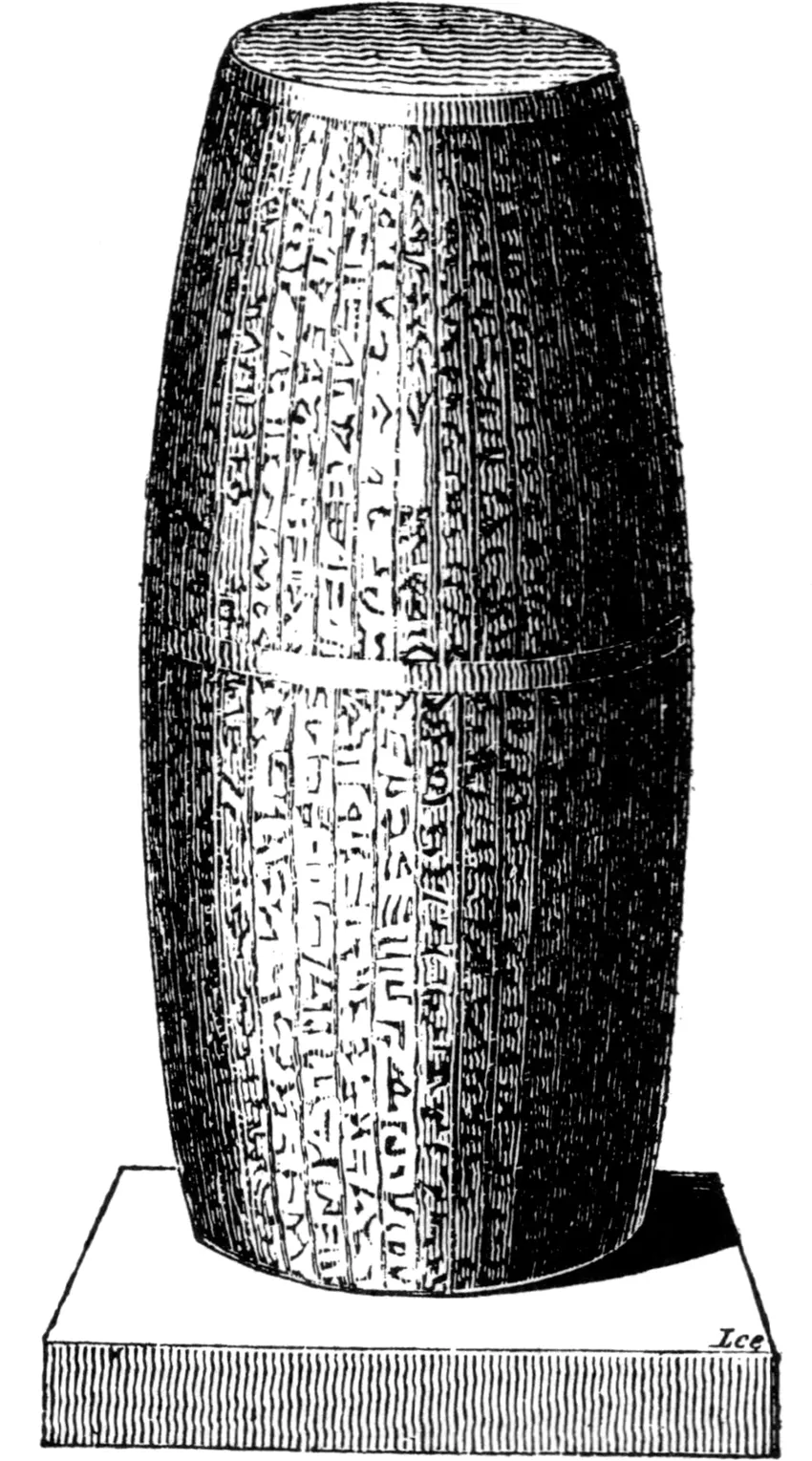
Mr. Hansard, who minutely examined this pillar, considered it a rare piece of ancient learning and art, and a work of great public importance at the time it was executed. He says: “One of these printed pieces might contain a complete subject; or a subject might occupy several of them, which altogether formed a series; each piece answering, as it were, such a purpose as the leaf of a book; one following another in regular order, from the beginning to the end of any subject, as the sheets in a volume. Front a succession of these printed miniature monuments might numerous sets be made; and thus might laws, astronomical observations, historical annals, and any other subject of interest to mankind, be recorded.”k
This opinion, there can be little doubt, is a right conclusion. And to confirm it we find, even long after the acknowledged period of the invention of letters, that engraving on similar pillars of stone and other durable substances was still adopted. Pollux and Suidas state that the pieces of brass on which the public documents in their time were written, were of a cubical form.l
The first books, then, if we may so call them, were simply in the form of pillars or tables, of which frequent mention is made in Scripture under the name of Sephir. When, however, the ancients had matters a little longer to treat of, they would adopt materials more suited to their purpose. Hence, wood, slate, horn, plates of lead and copper, leaves of trees, and other materials, according to the local circumstances of different nations, and their progress in the arts, were used to write such things upon as they were desirous to have transmitted to posterity.m
That a ready mode of writing was in general use, or at least well understood by the learned, previous to the delivery of the tables of the law, is proved by the command given to Moses, “Write this for a memorial in a book.” It is observable, that there is not the least hint to induce us to believe that writing was then newly invented: on the contrary, we may conclude, that Moses understood what was meant by writing in a book; otherwise God would have instructed him, as he had done Noah in building the ark; for he would not have been commanded to write in a book, if he had been ignorant of the art of writing: but Moses expressed no difficulty of comprehension, when he received this command.n He may have become acquainted with the art of writing in Egypt, which country, we learn from the Old Testament, was long previously acquainted with all those arts of civilization and government, and notions of property, which usually belong to nations which have been long settled and civilized.o
Slight as are the notices of the writings of the early ages of the world, little can here be stated relative to ancient bookbinding, but that some mode of preservation of documents which must have required so much care to execute, was early devised, cannot be doubted; and therefore the art may be dated as almost coeval with the science of composing books: and that both one and the other would soon follow the invention of hieroglyphic characters and letters, though it must be after the latter period to which we must look for anything that can decidedly be called bookbinding. Previous to this, the preservation of their tables, &c., was by means of cases of wood, stone, or earthenware, of which we have an example in the commandments given to Moses. But that writings in his time were of some extent, is shown in the book of Exodus (xxiv. 4—7), where we find that Moses wrote all the words and all the judgments of the Lord, contained in the twenty-first and two following chapters. What was the material, or what the form of the original book of the law, cannot be ascertained. Montfauçon believed it was written on skins; and considering that the roll is the form still adopted in all the synagogues of the Jews, we shall not be hazarding too much to state it to have been so since its first promulgation by Moses to the people. Some progress must have been made before this; and at whatever period books were first formed, a necessity would arise of uniting the several parts together, for the more ready reference, as well as their better preservation. This, however slight or rudely per...
Table of contents
- Cover
- Title Page
- Copyright Page
- Table of Contents
- Preface
- Part I The Books of the Ancients, and History of the Art of Bookbinding
- Part II The Practical Art of Bookbinding
- Appendix on Bleaching, &c
- Index to Part I
- Index to Part II
Frequently asked questions
Yes, you can cancel anytime from the Subscription tab in your account settings on the Perlego website. Your subscription will stay active until the end of your current billing period. Learn how to cancel your subscription
No, books cannot be downloaded as external files, such as PDFs, for use outside of Perlego. However, you can download books within the Perlego app for offline reading on mobile or tablet. Learn how to download books offline
Perlego offers two plans: Essential and Complete
- Essential is ideal for learners and professionals who enjoy exploring a wide range of subjects. Access the Essential Library with 800,000+ trusted titles and best-sellers across business, personal growth, and the humanities. Includes unlimited reading time and Standard Read Aloud voice.
- Complete: Perfect for advanced learners and researchers needing full, unrestricted access. Unlock 1.4M+ books across hundreds of subjects, including academic and specialized titles. The Complete Plan also includes advanced features like Premium Read Aloud and Research Assistant.
We are an online textbook subscription service, where you can get access to an entire online library for less than the price of a single book per month. With over 1 million books across 990+ topics, we’ve got you covered! Learn about our mission
Look out for the read-aloud symbol on your next book to see if you can listen to it. The read-aloud tool reads text aloud for you, highlighting the text as it is being read. You can pause it, speed it up and slow it down. Learn more about Read Aloud
Yes! You can use the Perlego app on both iOS and Android devices to read anytime, anywhere — even offline. Perfect for commutes or when you’re on the go.
Please note we cannot support devices running on iOS 13 and Android 7 or earlier. Learn more about using the app
Please note we cannot support devices running on iOS 13 and Android 7 or earlier. Learn more about using the app
Yes, you can access Bibliopegia by John Hannett,W. S. Brassington in PDF and/or ePUB format, as well as other popular books in Education & Inclusive Education. We have over one million books available in our catalogue for you to explore.