The Longman Anthology of Old English, Old Icelandic and Anglo-Norman Literatures provides a scholarly and accessible introduction to the literature which was the inspiration for many of the heroes of modern popular culture, from The Lord of the Rings to The Chronicles of Narnia, and which set the foundations of the English language and its literature as we know it today.
Edited, translated and annotated by the editors of Beowulf and Other Stories, the anthology introduces readers to the rich and varied literature of Britain, Scandinavia and France of the period in and around the Viking Age. Ranging from the Old English epic Beowulf through to the Anglo-Norman texts which heralded the transition Middle English, thematically organised chapters present elegies, eulogies, laments and followed by material on the Viking Wars in the Anglo-Saxon Chronicle, Vikings gods and Icelandic sagas, and a final chapter on early chivalry introduces the new themes and forms which led to Middle English literature, including Arthurian Romances and Chaucer's Canterbury Tales.
Laying out in parallel text format selections from the most important Old English, Old Icelandic and Anglo-Norman works, this anthology presents translated and annotated texts with useful bibliographic references, prefaced by a headnote providing useful background and explanation.
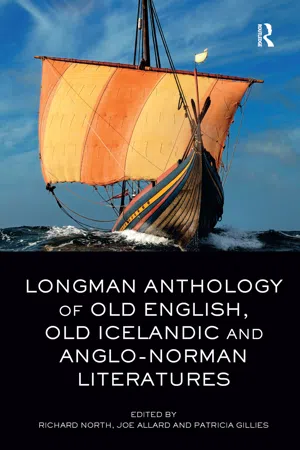
eBook - ePub
Longman Anthology of Old English, Old Icelandic, and Anglo-Norman Literatures
- English
- ePUB (mobile friendly)
- Available on iOS & Android
eBook - ePub
Longman Anthology of Old English, Old Icelandic, and Anglo-Norman Literatures
About this book
Information
HEROIC POEMS
* * *
HEROIC POEMS
* * *
The flagship of this section is Beowulf, from which as many as 15 passages may be read (more in the Custom Version) here as a means of getting to know this eventually tragic poem. The shorter heroic poems follow: catalogues, mysterious squibs and fragments in the case of Old English, Old High German and Icelandic; extracts from longer works and sometimes whole lays in the case of the relevant Welsh, Irish and other Icelandic literature. By reading these poems one may make comparisons. Hildegyth for example helps her lover escape from a tyrant in Waldere, rather as Deirdre does her lover in The Exile of the Sons of Uisliu. There again, we might wonder how these women compare with Hildr in Bragi’s Eulogy on Ragnarr, whose response to her father’s pursuit of herself and her lover is to cast a spell that sets the two armies fighting each other in an endless battle. Does this myth make a comment on male as opposed to female heroics? The men in the Finnsburh Episode, or in Freawaru’s Danish Heathobard marriage, will go on fighting whatever the cost, even when this destroys family life. Does the poet of Beowulf deplore this tendency as well as admire it, or is he more in the world of Aneirin on the glory of Gododdin against overwhelming odds in Catterick, or the Fragment on Hnæf’s stout defence in Finnsburh?
The ethos of this wide range of poetry is broadly heroic, but there are differences worthy of study. Where the ethics of these poets are based on religion, it can be seen that the Christianity of many of these poems sets the struggles and achievements of their heroes and heroines in a context of God or destiny which determines the individual’s fate. The selection ends with a Norwegian poem, however, The Lay of Attila, where this rule does not apply. Here there is no power but the will of King Gunnarr to shape his own end, and that of his sister Guðrún to avenge him, in ways so terrible that it is clear that aesthetics rather than morals governed this heathen poet’s understanding of heroic conduct. Whereas Beowulf honours one God, sacrificing himself in order to save and enrich his people, Gunnarr sacrifices his people in order to turn his death into a godless work of art. The difference is starker than ever, yet the need for comparison remains. Most of the works on offer in this section were composed in the same period, from the early ninth to the late tenth century, either in the British Isles or nearby in Norway. By reading them here we can compare the Christians and heathens who often traded with each other when they did not yet live side by side. For many readers, the point of mixing up the poems in this selection may be to see the larger context in which Old English heroic poems such as Beowulf were composed.
General bibliography
Baker, P. S., ‘The Old English language’, B&OS 272–300
Bjork, R. E., and J. D. Niles, ed., A Beowulf Handbook (Exeter, 1997)
Chambers, R. W., Beowulf: an Introduction to the Study of the Poem, 3rd ed., with supplement by C. L. Wrenn (Cambridge, 1959), 68–88
Dronke, U., ed., trans. and comm., The Poetic Edda, vol. I: Heroic Poems (Oxford, 1969)
Garmonsway, G. N., and J. Simpson, trans., Beowulf and its Analogues, including ‘Archaeology and Beowulf’ by H. R. Ellis Davidson (London and New York, 1968)
Hill, J., ed., Old English Minor Heroic Poems, Durham and St Andrews Medieval Texts 4 (Durham, 1983)
Larrington, C., trans., The Poetic Edda (Oxford, 1996)
Mitchell, B., and F. C. Robinson, ed., Beowulf: An Edition with Relevant Shorter Texts, including ‘Archaeology and Beowulf’, by L. Webster (Oxford, 1998)
North, R., Heathen Gods in Old English Literature, Cambridge Studies in Anglo-Saxon England 22 (Cambridge, 1997)
North, R., The Origins of ‘Beowulf’: From Vergil to Wiglaf (Oxford, 2006)
North, R., ‘Old English minor heroic poems’, B&OS 95–129
North, R., ‘Notes on the Old Norse language’, B&OS 323–9
Orchard, A., A Critical Companion to Beowulf (Woodbridge, 2003)
Orchard, A., ‘Beowulf and other battlers: an introduction to Beowulf’, B&OS 63–94
Beowulf
*
HWÆT WE GARDEna in geardagumÞeodcyninga Þrym gefrunon,hu ða æÞelingas ellen fremedon!(Beowulf, lines 1–3)We have heard of the glory of the nation-kingsof the Spear-Danes in days of yore,how those princelings carried out deeds of courage!
Beowulf is preserved in only one copy, in the Nowell Codex, which was bound to the back of another codex to make the present manuscript, ‘British Library, Cotton Vitellius A.XV’. This manuscript is dated very approximately to the year 1000. It was nearly burned but survived with staining and damaged edges in the Cotton Library fire of 1731. Luckily two brief excerpts of Beowulf had already been printed, and in 1787–9 two copies of the poem (Thorkelin A and B) were made before worse damage set in. The manuscript was rebound in 1845 in a process that caused more damage. In the Nowell Codex, Beowulf follows The Passion of St Christopher, The Wonders of the East and the Old English Alexander’s Letter to Aristotle, and is followed by the headless poem Judith. It has been suggested that the compiler wanted Beowulf because he was making a collection of monster literature. His compilation was copied by two scribes, now named ‘A’ and ‘B’, with B taking over from A at the beginning of the third line on folio 172 verso (the rear of the page), on Beowulf, line 1939. It has been suggested that Scribe B wrote in a hand of the late tenth century, Scribe A in one of the early eleventh. Not only a high number of garbled spellings, but also some likely textual lacunae in Beowulf show that both scribes were probably copying from an exemplar (a copy text) which was itself defective. The poem Beowulf, then, was probably composed some time before its manuscript.
Beowulf is divided into cantos named ‘fitts’, which are numbered in sequence beginning one fitt late, but later with corrections, and then incompletely. These textual divisions are also probably older than the manuscript. When it comes to dating this great work, all dates possible for the Anglo-Saxon period have been considered at some time, and for all kinds of reasons, and sometimes for no reason but personal conviction. The seventh century went out in favour of the eighth, the reign of Offa (757–96), when Dorothy Whitelock wrote The Audience of Beowulf (Oxford, 1951). The eighth century was gladly dropped in favour of a range of later periods in the Toronto Symposium, whose proceedings were edited by Colin Chase (Toronto, 1981). Here Roberta Frank promoted the late ninth–century Alfredian period (pp. 123–39), Walter Goffart the tenth–century Æthelstanian (pp. 83–100), Kevin Kiernan the reign of Cnut, 1016–35 (pp. 9–21 and then Beowulf and the Beowulf Manuscript, 2nd ed., Ann Arbor, MI, 1996). The pendulum swung back to the early eighth century, however, when R. D. Fulk set a (southern) Mercian metrical–morphological terminus ad quem (latest possible date) of c. 725 in A History of Old English Meter (Philadelphia, PA, 1992) and Sam Newton launched his dashing case in The Origins of Beowulf and the Pre–Viking Kingdom of East Anglia (Cambridge, 1993). Since then North has argued for 826–7 in the Mercia of King Wiglaf (827–39), in The Origins of Beowulf: From Vergil to Wiglaf (Oxford, 2006). But there will be more attempts on this question, of that there is no doubt. With this anthology, it is hoped that more readers will be able to judge for themselves.
The following excerpts give an idea of the character of Beowulf as temperamentally ambitious rather than modest or temperate, endlessly loyal to his bad–lot uncle Hygelac while less concerned with what his true friend Hrothgar has to say to him about ‘eternal rewards’ in the textual heart of Beowulf, lines 1700–84. Beowulf’s three fights with monsters show how the poet could command swift action as easily as reflect on an unknown future, lost ages or the slow pace of time. While the poet is an advocate for good heathens, he never forgets that they are probably damned and he makes this clear in the curse on the treasure which Beowulf wins from the Dragon’s hoard. The genre appears to be ‘epic’, but ‘elegy’ has always seemed nearer the mark, and in view of the moral darkness in which Beowulf leaves the world, as the emblem of not an individual’s but a culture’s heroic failure, ‘tragedy’ might come the closest of all.
Scyld Scefing’s funeral
Through Scyld Scefing at the head of the royal Danish family, the poet seems determined to construct an agrarian ideology as well as a foundation narrative for the heathen Danes. Scyld’s funeral at the end of this fitt (unnumbered but really Fitt I) also allows the poet to give his heathen subjects the saving grace of ignorance in the religion they follow. This passage has often been discussed in relation to the genealogy of King Alfred’s father, Æthelwulf, in the Anglo–Saxon Chronicle for 855, in which the old man claimed desc...
Table of contents
- Cover
- Half Title
- Title Page
- Copyright Page
- Dedication
- Table of Contents
- Preface
- Heroic Poems
- Poems on the Meaning of Life
- Poems of Devotion
- The Earliest English Prose
- Viking Wars
- Gods of the Vikings
- Sagas of Icelanders
- Writers of the Benedictine Reform
- Early Chivalry
- Contents of the Custom Version
Trusted by 375,005 students
Access to over 1.5 million titles for a fair monthly price.
Study more efficiently using our study tools.
Frequently asked questions
Yes, you can cancel anytime from the Subscription tab in your account settings on the Perlego website. Your subscription will stay active until the end of your current billing period. Learn how to cancel your subscription
No, books cannot be downloaded as external files, such as PDFs, for use outside of Perlego. However, you can download books within the Perlego app for offline reading on mobile or tablet. Learn how to download books offline
Perlego offers two plans: Essential and Complete
- Essential is ideal for learners and professionals who enjoy exploring a wide range of subjects. Access the Essential Library with 800,000+ trusted titles and best-sellers across business, personal growth, and the humanities. Includes unlimited reading time and Standard Read Aloud voice.
- Complete: Perfect for advanced learners and researchers needing full, unrestricted access. Unlock 1.5M+ books across hundreds of subjects, including academic and specialized titles. The Complete Plan also includes advanced features like Premium Read Aloud and Research Assistant.
We are an online textbook subscription service, where you can get access to an entire online library for less than the price of a single book per month. With over 1.5 million books across 990+ topics, we’ve got you covered! Learn about our mission
Look out for the read-aloud symbol on your next book to see if you can listen to it. The read-aloud tool reads text aloud for you, highlighting the text as it is being read. You can pause it, speed it up and slow it down. Learn more about Read Aloud
Yes! You can use the Perlego app on both iOS and Android devices to read anytime, anywhere — even offline. Perfect for commutes or when you’re on the go.
Please note we cannot support devices running on iOS 13 and Android 7 or earlier. Learn more about using the app
Please note we cannot support devices running on iOS 13 and Android 7 or earlier. Learn more about using the app
Yes, you can access Longman Anthology of Old English, Old Icelandic, and Anglo-Norman Literatures by Richard North, Joe Allard, Patricia Gillies, Richard North,Joe Allard,Patricia Gillies in PDF and/or ePUB format, as well as other popular books in Literature & European Literary Collections. We have over 1.5 million books available in our catalogue for you to explore.