Groundwater Geochemistry: Fundamentals and Applications to Contamination examines the integral role geochemistry play s in groundwater monitoring and remediation programs, and presents it at a level understandable to a wide audience. Readers of all backgrounds can gain a better understanding of geochemical processes and how they apply to groundwater systems.
The text begins with an explanation of fundamental geochemical processes, followed by a description of the methods and tools used to understand and simulate them. The book then explains how geochemistry applies to contaminant mobility, discusses remediation system design, sampling program development, and the modeling of geochemical interactions. This clearly written guide concludes with specific applications of geochemistry to contaminated sites.
This is an ideal choice for readers who do not have an extensive technical background in aqueous chemistry, geochemistry, or geochemical modeling. The only prerequisite is a desire to better understand natural processes through groundwater geochemistry.
Water present below the land surface takes on some of the characteristics of that environment. Rainfall and snowmelt percolating through the soil zone and unsaturated material chemically react with the gases, minerals, and organic compounds that occur naturally in the subsurface. These reactions continue below the water table as the water flows through the aquifer. The result is that the characteristics and composition of the water evolve as it flows through the ground in response to the types of solid and gas phases that the solution encounters and the geochemical reactions that occur between these phases. Part I of this book describes the fundamentals of groundwater geochemistry. Chapter 1 discusses characterization of the water/rock system, and Chapters 2 and 3 discuss solution/gas and water/rock reaction processes. The development of geochemical models to simulate the natural system is described in Chapter 4, while Chapter 5 provides a discussion of the computer codes commonly used to model groundwater geochemical reactions.
1 The Groundwater Geochemical System
Groundwater supplies drinking water to over half the population of the United States and provides an even greater percentage of the amount of water used for irrigation and industrial purposes.1 Thirty years ago the main use of geochemistry to groundwater was as an aid in differentiating water types in aquifers to help identify and quantify water resources. Today, geochemistry plays a much larger role in groundwater studies because of its importance in characterizing the natural system, understanding contaminant migration, and designing remediation programs. Neglecting the geochemistry component of groundwater contamination may tremendously oversimplify the situation and lead to erroneous conclusions regarding the impact of contamination on the environment and the amount of effort required to remediate the aquifer.
The area of geochemistry that we are interested in is low temperature, aqueous geochemistry that focuses on water/rock interactions in the unsaturated zone and below the water table in the aquifer(s) present at a site. These water/rock interactions are the geochemical processes that soil scientists have studied for decades to optimize plant growth and that groundwater scientists/engineers are now using to better understand the chemical facet of subsurface conditions. Along with the physical and biological processes active in the subsurface, geochemistry plays a major role in controlling groundwater composition and the movement of dissolved constituents.
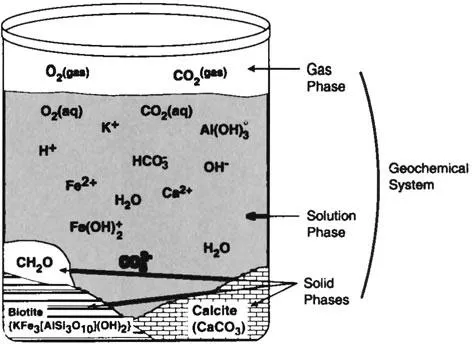
The subsurface can be thought of as a dynamic geochemical system consisting of (1) solid phases (minerals, amorphous [noncrystalline] solids, and organic matter), (2) a soil gas phase, and (3) an aqueous solution phase (water with its dissolved constituents). Each phase is a separate physical entity with more or less uniform chemical composition. There is commonly a single gas phase and a single solution phase, although two or more separate solution phases (such as surface and groundwater) may mix to produce a new solution phase. Each mineral type or other solid material with the same composition and properties is considered a separate phase. A system is simply an assemblage of these solid, gas, and solution phases under site-specific temperature and pressure conditions. The beaker model shown in Figure 1-1 represents a simple geochemical system. The five phases comprising this system are solution, gas, organic matter (CH2O), biotite, and calcite. Water is in contact with the gas phase and the various inorganic/organic solid phases. Some of the constituents of the solution phase may have been present as dissolved in the water when it was added to the beaker, whereas others may have dissolved into the water as a result of reactions in the beaker between the phases.
Figure 1-1 Beaker model of geochemical system.
In the natural geochemical system, fresh recharge water with few dissolved constituents and low concentrations contacts the subsurface material and interacts with the other phases of the system. Chemical reactions occur because the composition of the recharge water is not in equilibrium with the solid phases or the soil gases. Disequilibrium drives the reactions that dissolve gases an...
Table of contents
Cover
Title Page
Copyright Page
Dedication
Author
Preface
Acknowledgments
Table of Contents
Part I: Groundwater Geochemistry Fundamentals
Part II: General Geochemical Applications
Part III: Applications of Geochemistry to Specific Types of Contaminants and Contaminated Environments
Appendix A — Solid Phases That Limit Groundwater Concentrations
Index
Trusted by 375,005 students
Access to over 1.5 million titles for a fair monthly price.
Study more efficiently using our study tools.
Frequently asked questions
Yes, you can cancel anytime from the Subscription tab in your account settings on the Perlego website. Your subscription will stay active until the end of your current billing period. Learn how to cancel your subscription
No, books cannot be downloaded as external files, such as PDFs, for use outside of Perlego. However, you can download books within the Perlego app for offline reading on mobile or tablet. Learn how to download books offline
Perlego offers two plans: Essential and Complete
Essential is ideal for learners and professionals who enjoy exploring a wide range of subjects. Access the Essential Library with 800,000+ trusted titles and best-sellers across business, personal growth, and the humanities. Includes unlimited reading time and Standard Read Aloud voice.
Complete: Perfect for advanced learners and researchers needing full, unrestricted access. Unlock 1.5M+ books across hundreds of subjects, including academic and specialized titles. The Complete Plan also includes advanced features like Premium Read Aloud and Research Assistant.
Both plans are available with monthly, semester, or annual billing cycles.
We are an online textbook subscription service, where you can get access to an entire online library for less than the price of a single book per month. With over 1.5 million books across 990+ topics, we’ve got you covered! Learn about our mission
Look out for the read-aloud symbol on your next book to see if you can listen to it. The read-aloud tool reads text aloud for you, highlighting the text as it is being read. You can pause it, speed it up and slow it down. Learn more about Read Aloud
Yes! You can use the Perlego app on both iOS and Android devices to read anytime, anywhere — even offline. Perfect for commutes or when you’re on the go. Please note we cannot support devices running on iOS 13 and Android 7 or earlier. Learn more about using the app
Yes, you can access Groundwater Geochemistry by William J. Deutsch,Randy Siegel in PDF and/or ePUB format, as well as other popular books in Physical Sciences & Environmental Science. We have over 1.5 million books available in our catalogue for you to explore.