- 336 pages
- English
- ePUB (mobile friendly)
- Available on iOS & Android
eBook - ePub
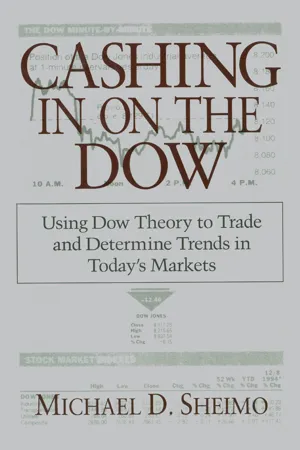
Cashing in on the Dow
About this book
Created over a hundred years ago by Wall Street Journal founder Charles H. Dow, the Dow Theory is the grandfather and foundation of all technical stock market analyses. The Theory operates on the premise that the market itself is the best predictor of future performance. By using Dow averages to explain the current condition of the market, forecast future trends, and determine investment strategy, the Dow Theory continues to be a sound technique for successful stock investing.
Cashing in on the Dow takes a contemporary look at the Dow Theory and shows investors how they can effectively --and profitably--apply the theory to today's rapidly changing market. With discussion s on origin, evolution, and core influence on other market indicators, this invaluable reference offers insights into how to understand the signals generated by stock market indicators, leading to better stock selection timing, and higher returns.
CHAPTER 1
The Dow Theory: Origin
Around 1901, articles presenting an outlook on the stock market began appearing in The Wall Street Journal. These articles contained information on how to choose stocks, how to limit risk and how to understand the movement of stocks. The ideas set forth in these articles were those of Charles H. Dow, co-founder of the Dow Jones & Company and the first editor of The Wall Street Journal.1
Charles Dow indicated that his conclusions regarding the stock market were based on more than 15 years of observation of the market and on his charting of the stock price movements. Dow considered price tracking important to an investor’s understanding of individual stocks and the stock market as a whole. In fact, stock price tracking was important enough for Dow to simplify the activity for readers of his newspaper by creating the Dow Jones Railroad Average (now called the Transportation Average)2 and the Dow Jones Industrial Average. Dow’s purpose in creating the averages was twofold: first, to create a list that would be an indicator for the entire stock market and second, to select companies that are representative of the most actively traded stocks. But in Dow’s time, the accomplishment of this purpose was not an easy task.
In the late 1800s, while it was already well-recognized that stock prices tended to move as a group, the market was not as active as it is now. Many stocks would sit for days without being bought or sold. Newspapers listed all of the daily trading prices of selected stocks, a feat which now would be impossible. Finding stocks which traded with regularity was also quite difficult. To find stocks which could be considered representative of all other stocks increased the problem.
These problems were solved by constantly reviewing and changing the lists. Now, more than 100 years later, those lists are still being changed and adjusted. On March 17, 1997, the Dow Industrial Average of 30 stocks had four replacements. Westinghouse Electric Corp., Texaco Inc., Bethlehem Corp., and Woolworth Corp. were removed and replaced with Travelers Group (TRV), Hewlett Packard (HWP), Johnson & Johnson (JNJ), and WalMart Stores Inc. Changes can occur for many reasons. A company on the list may be bought out by some other company, or the basic business of a company may change dramatically, or the stock may no longer be representative of the stock market and therefore be removed. As a result of continuous changes like these in the market, the lists of companies used in the market averages are in a constant state of revision.
In summary, Dow studied the stock market and formed a basic movement theory, then created lists of stock market averages to illustrate this theory. These lists were then adjusted and refined to be representative of the entire stock market.
THEORY REFINEMENTS
The market averages, as well as the Dow Theory, would be further refined by other editors of The Wall Street Journal (predominantly William Peter Hamilton, editor from 1908-29) and market devotees such as Robert Rhea (author of The Dow Theory: An Explanation of Its Development and an Attempt to Define Its Usefulness as an Aid in Speculation, published by Barron’s, 1932).
Throughout this study it will be important to remember that the Dow Theory can be helpful in forecasting certain trends, but it is not infallible. Any stock market indicator can be overridden by other events. A sudden, sharp change in interest rates, for example, can quickly and easily override market indicators. At times even the suggestion of higher interest rates will quash a Dow Industrials rally and send it plunging 100 points or more. However, understanding and working with the elements of the theory can be of assistance in planning and implementing an investment strategy.
PRIMARY TREND
A primary trend is a bull market, moving in a steady upward direction, or a bear market, steadily dropping. Primary trend determination is the most important concept to understanding the Dow Theory. Although it is a simple concept, trend determination can vary in complexity. For example, does the chart in Exhibit 1 represent a bull or a bear market?
At a glance, the ending level (January 31, 1995) is slightly higher than the first; therefore, it appears to be a bull trend, a small consolation to the investor who bought stock near the end of January and sold it in fear during early April 1994. Looking more closely shows a bear trend from late January to early April, with both averages declining. In April (area in box) the trend of the Dow Industrials turned upward, but the Transportation average gave only weak confirmation. The Transportation Average just couldnt seem to sustain a rally, until December of 94.
Charles Dow might have gone farther with the analysis, concluding that the bear market experienced from January through March appeared to be returning in late November, but then turned again, becoming bullish in December. He would have looked to achieving new highs in 1995, barring things unforeseeable.

William Hamilton, who followed in the path started by Dow, would have pointed out the accumulation/distribution period, where the market was forming a line, between June and November. The market tried to rally several times, but the Transportation Average (formerly the Railroad Average) failed to confirm the rallies; therefore, the industrials fell back to lower levels. Though the trend now looks positive and has the advantage of being confirmed (i.e., both averages advancing), it remains to be seen whether the confirmed December rally is the turning point for a returning to a bull market or is just a secondary up-trend in a bearish market.
A modem Dow Theory follower might reason as follows. The bull market appears to be returning in December, after the confirmed bear market of late January through March and the forming of a line through November. Support is established at the 3,600- to 3,700-point level for the Industrial Average, and 1,600 as well as the lower 1,400 for the Transportation Average. Although the two averages confirm in December, it will be an important signal of higher levels when the Transportation Average breaks through the strong resistance of 1,600, as it did in August, and the Dow Industrial Average is able to solidly break above the 3,900 resistance level, as it did back in October.
Failure to break though these resistance levels could lead to retracements to the strongest support levels. At this point (December), however, the confirmed primary trend appears to be upward. When the averages set new highs it will become a well-defined bull market primary trend
Notice that none of the preceding descriptions is precise with its forecast. All of the descriptions look to a bull market primary trend with the two averages moving upward together (confirmation). Although there are signs and signals before a market trend reverses, a reversal can happen quickly and is seldom forecast with pinpoint accuracy. Dow, Hamilton, Rhea, and many later Dow Theory followers have stressed the fact that forecasting market movement cannot be reduced to a precise mathematical formula, but rather relies on the relationship between the trends of the two averages. Too many factors and variables make any form of stock market forecast a conditional situation. Stock prices do move as a group, and the market averages tend to move in a wavelike motion. Primary trends do exist in the stock market—its advantageous to recognize the trends whether one is a short or long-term stock trader.
Determining the trend can be accomplished in a number of ways. The two basic methods are: 1) look at a chart of the market, and if the trend is not quickly apparent, look at a longer time period; and 2) compare the market trend to a flatter chart, such as a three-month or six-month moving average. The flattened, longer moving average chart is recalculated each new trading day. It looks back for a 200-day trading period and calculates the average. The average removes the confusing peaks and valleys and gives a clearer picture of the trend. Exhibit 2 adds the 200-day moving average figures to the 1994, Dow Industrials chart.
200-Day Moving Average
The 200-day moving average (Exhibit 2) shows the long-term uptrend dipping slightly near the end of 1994, caused by the Dow Industrials drop in November. The moving average then turns upward again. Although it’s possible the market is just giving an extended Santa Clause Rally (any market rally between the holidays of Thanksgiving and Christmas) at the end of a mixed year, when we compare this chart to Exhibit 1, in December, as well as most of January, both the Dow Industrials and the Dow Transportation Average are rising. The confirmation by the Transports is the main difference in December-January, as compared to earlier in 1994.

A moving average is a continuously changing line. Back in June, it looked different than it did at the end of 1995. It had a different 200-day time period as a basis on which to form its line. The confirmed rally in December is a time for cautious optimism during which to look for value in new investments.
Other Time Periods
Other moving averages (e.g., 9-day, 18-day, 21-day, 50-day, 100-day) can be consulted for a more complete picture. They can be calculated on a computer, obtained from one of many newsle...
Table of contents
- Cover
- Title Page
- Copyright Page
- Dedication
- Table of Contents
- List of Exhibits
- Preface
- About the Author
- Chapter 1 The Dow Theory: Origin
- Chapter 2 Dow Theory Concepts
- Chapter 3 Dow Evolution
- Chapter 4 Condensed Market
- Chapter 5 Market at Rest, Market in Motion
- Chapter 6 What Are the “Heavy Hitters” Doing?
- Chapter 7 Tracking the Beast: Technical Points of Support and Resistance
- Chapter 8 Market Indicators
- Chapter 9 “Quick” Market Indicators
- Chapter 10 Economic Indicators
- Chapter 11 Market Strength
- Chapter 12 A Contrarian View
- Chapter 13 Technical Trends of Stocks
- Chapter 14 Individual Stocks (Charles Dow and Warren Buffett)
- Chapter 15 Using a Computer
- Chapter 16 Putting It All Together
- Glossary
- Suggested Readings
- Index
Trusted by 375,005 students
Access to over 1.5 million titles for a fair monthly price.
Study more efficiently using our study tools.
Frequently asked questions
Yes, you can cancel anytime from the Subscription tab in your account settings on the Perlego website. Your subscription will stay active until the end of your current billing period. Learn how to cancel your subscription
No, books cannot be downloaded as external files, such as PDFs, for use outside of Perlego. However, you can download books within the Perlego app for offline reading on mobile or tablet. Learn how to download books offline
Perlego offers two plans: Essential and Complete
- Essential is ideal for learners and professionals who enjoy exploring a wide range of subjects. Access the Essential Library with 800,000+ trusted titles and best-sellers across business, personal growth, and the humanities. Includes unlimited reading time and Standard Read Aloud voice.
- Complete: Perfect for advanced learners and researchers needing full, unrestricted access. Unlock 1.5M+ books across hundreds of subjects, including academic and specialized titles. The Complete Plan also includes advanced features like Premium Read Aloud and Research Assistant.
We are an online textbook subscription service, where you can get access to an entire online library for less than the price of a single book per month. With over 1.5 million books across 990+ topics, we’ve got you covered! Learn about our mission
Look out for the read-aloud symbol on your next book to see if you can listen to it. The read-aloud tool reads text aloud for you, highlighting the text as it is being read. You can pause it, speed it up and slow it down. Learn more about Read Aloud
Yes! You can use the Perlego app on both iOS and Android devices to read anytime, anywhere — even offline. Perfect for commutes or when you’re on the go.
Please note we cannot support devices running on iOS 13 and Android 7 or earlier. Learn more about using the app
Please note we cannot support devices running on iOS 13 and Android 7 or earlier. Learn more about using the app
Yes, you can access Cashing in on the Dow by Sheimo,Michael D. Sheimo in PDF and/or ePUB format, as well as other popular books in Business & Business General. We have over 1.5 million books available in our catalogue for you to explore.