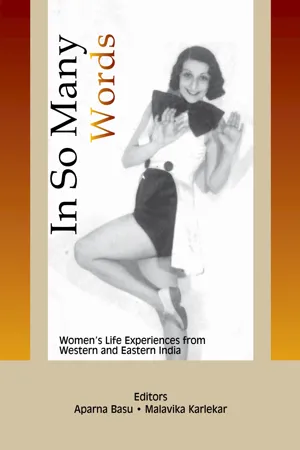
This volume will mark a new trend in dealing with women's varied experiences of life: individual introductions situate the narrator in a context – and then her voice takes over, with no intervention from the editors (except to provide footnotes wherever necessary).
The personal narrative — be it an autobiography, a letter or a diary — has come to be recognised as an acceptable data source in history and social science. Literary critics and students of literature too find considerable use in reading the personal writings of poets, fiction and crime writers. In this book, readings of personal narratives help in painting various images of lives that we can only know at second hand. The mélange includes memoirs, published articles, 'portraits from memory', a collection of essays , and an oral interview. In all, the self was the focus. The writings of Sailabala, Li Gotami, and Shakuntala go beyond a recounting of their lives and deal with spiritual and travel experiences. Three of the essays are excerpts from published autobiographies — Sarala Devi Chaudhurani's Jeevaner Jharapata (Life's Fallen Leaves), Kalpana Dutt's Reminiscences and Sailabala Das's A Look Before and After. Vidyagauri Nilkanth's writings are essays and a selection of amazingly candid letters exchanged with her husband. Anasuya Sarabahi's is an interview in Gujarati with niece Gira and Monica's a selection from an unpublished memoir. Li Gotami, whose original name was Rutty Petit, travelled to Manasarovar, and a few of the magazine articles on this amazing journey have been reproduced here.
Whichever form a woman chooses, writing about her self, is emancipatory; she may be a person who has so far received little attention from the family or the world. Or she may be one who is a well-known public figure – yet little is known about her childhood. So she writes about many selves – life is not about one coherent self but rather one of many lives and experiences. In other words,
Trusted by 375,005 students
Access to over 1.5 million titles for a fair monthly price.
Sarala Devi Chaudhurani, arguably the first woman political leader in the Indian freedom movement,1 belonged to the Hindu–Brahmo community, which had played a leading role in the nineteenth-century reform movement in Bengal. She was related to the Tagores of Jorasanko, unquestionably the most illustrious family in contemporary Bengal; her mother Swarnakumari Devi was the daughter of Maharshi Debendranath Tagore and elder sister of Rabindranath Tagore.2 Sarala’s father Janakinath Ghoshal was a nationalist, a staunch supporter of the early Indian National Congress, and as Sarala’s autobiography indicates, a man of independent will.
Her family encouraged Sarala to pursue formal education. At the age of seven she was admitted to Calcutta’s Bethune School, which was at that time the centre of learning for girls from ‘progressive’ families. Here she came in touch with other future celebrities like Lajjabati Basu, Hemaprabha Basu, Hemalata Sarkar, Kumudini Khastagir, Kamini Ray and Abala Basu.3 When she graduated with a BA Honours degree in English in 1890 from Bethune College, she was one of the first generation of Bengali women to become a graduate, the path having been broken only a few years earlier by Kadambini Ganguly and Chandramukhi Basu. She briefly took a paid job in the exclusive Maharani Girls’ School in Mysore, as she felt that ‘to know oneself’ one must be away from home, at least for some time.
Sarala Devi at around age 18. In this studio photograph, Sarala wears an elaborate blouse modelled on the upper half of a western gown with a brooch at the middle of the high neck and long sleeves that have ruffs at the end. She has draped her sari in the new style introduced by her aunt, Jnanadanandini Devi, who had revolutionised urban middle-class women’s attire enabling them to go out of the home. Until almost the middle of the nineteenth century, women from such homes wore only a sari wound around themselves so as to cover as much of their bodies as possible. Jnanadanandini introduced the bodice (angiya cachali), blouse (jama) and a short skirt-like petticoat. While the Brahmos referred to the new style of wearing the sari with blouse and chador as the ‘Thakurbarir sari’ (sari worn in the style of the Tagores), as more and more Brahmos started wearing the sari in this manner throughout India, it came to be popularly known as the ‘Brahmika sari’.
A powerful singer, Sarala made her debut in politics through the medium of music. In 1901, at the Congress session in Calcutta, she mesmerised the audience by leading a chorus of 50 women assembled from all parts of India with a deeply stirring nationalist song she had composed and set to music. Her purpose was not only to sing but to inspire a nation that she felt was in deep slumber under the yoke of foreign masters. Indeed, the key quality of her character was the desire to inspire. Wherever she turned her attention, whether it was to politics, literature or music, or the women’s question, she attempted to stimulate, to activate and to arouse. It is not commonly known that while Rabindranath created the tune of the first two lines of Bankim Chandra Chattopadhyay’s ‘Bande Mataram’, the rest was set to music by Sarala Devi. She sang this patriotic song at the Benaras session of the Congress in 1905, and contributed in no small measure to its nationwide popularity.
In order to contextualise Sarala, we have to recall that this was the time of the Swadeshi Movement in Bengal4 — a protest against Lord Curzon’s Partition of Bengal in 1905. But the anti-colonial sentiment had been gaining ground for some years, since the Indian National Congress had been founded in 1885. Evidence of Sarala’s fierce nationalism was manifest from her youth, in her school essays, her preference for Indian over European circus, her composition of nationalistic songs. She also took great pride in being Bengali. It hurt her that Bengalis were perceived as ‘effeminate’ and ‘physically weak’. Through her articles in Bharati, which she jointly edited with her mother and sister for a few years, and singly from 1899 to 1907 (and later from 1924 to 1926), she exhorted the Bengali youth to cultivate physical prowess, courage (a key issue with her) and mental strength. It was while she was editor that she came in close contact with Swami Vivekananda, who greatly admired her, and requested her to go abroad to represent Indian womanhood and spread the message of the East in the West. ‘May the Lord grant that many women like you be born in this country and devote their lives to the betterment of the motherland’, wrote Vivekananda to her.
A proud graduate. It is possible that both this photograph as well as the earlier one were taken after Sarala’s graduation (the sari and studio props appear the same). In this pose she is wearing the graduate’s gown and mortar board and of course holds a book in her right hand. Here, however, she is not engaging with the camera, but rather looking into the middle distance.
Sarala, however, did not go. Her sympathies lay with the revolutionary philosophy. She formed an akhara and a gymnasium, which also served as linkages with biplabis (revolutionaries). Her clubs were not secret organisations, but the members were asked not to talk about them, which in practical terms meant the same thing. Her autobiography describes in detail how she inspired young men to take an oath to serve the country with their entire body and mind. Along with the boys of her akhara, she introduced a Birashtami Utsav where she invited members of other clubs to participate in competitive games and, by inaugurating a Pratapaditya utsav and an Udayaditya utsav, she asked them to pay homage to the past heroes of India and, and in memory of Bengali heroes.5
Sarala’s initiative, however, had a double significance. By propagating Bengali heroes as role models for Bengali boys she was promoting a special brand of nationalism: Bengali Hindu nationalism. Second, she was actually preparing the youth for an armed struggle against colonial rulers. It would not be wrong to say that even before the emergence of the biplabi movement in Bengal, she took the initiative to prepare the stage, and was thus the first woman of Bengal to be involved in the biplabi movement. When Jatindranath Banerjee came to Calcutta to establish secret revolutionary societies, Sarala helped him and worked together till the latter left politics in 1904. She also maintained close links with the Suhrid Samiti of Mymensingh and Anushilan Samiti of Dhaka, both secret revolutionary organisations.
Sarala married late, in 1905, when she was 33, under family pressure. Her mother felt that it was high time for her to be married (rather than lead a band of young men); the family honour was at stake. Rambhuj Dutta Choudhury, a lawyer-cum-journalist and reputed nationalist in Punjab, was a widower and belonged to the Arya Samaj. The wedding took place suddenly, away from Calcutta, in a small town without any pomp or grandeur worthy of Sarala’s fame or the family’s name. Sarala had often challenged traditional norms, but in this crucial area of her life, marriage, she had to bow to her parents’ wishes. Her ‘hands and feet were tied’ — there was no space for any movement. It was perhaps not fair to Sarala — this unceremonious marriage to an elderly widower whom she had not known and who took her away to Punjab, far from her field of work where she had carved out a distinct niche for herself. There is no evidence to indicate whether the marriage was happy or not. She ends her fascinating autobiography before relating the story of her life after marriage, which makes one feel that perhaps she did not wish to highlight it.
Sarala carried on political activities in the Punjab, in cooperation with her husband, and helped him to edit the nationalist Urdu weekly, Hindustan. Here, too, she displayed characteristic courage. When the colonial government decided to cancel the licence of the weekly paper if Rambhuj remained the proprietor, Sarala stepped in and registered her name as proprietor and editor and also published an English edition of it. She spent 18 years in the Punjab, participating in major anti-colonial programmes. When the Rowlatt Act was passed and a nationwide agitation broke out against it, the government policy of repression reached its height in the Punjab leading to the Jallianwalla Bagh massacre. Sarala and her husband adopted a brave anti-British stand through their paper. Consequently, the press was confiscated and Rambhuj was arrested. The arrest of Sarala too was planned, but discarded because the arrest of a woman might lead to fresh political complications. When Gandhi came to Lahore as Sarala’s house guest, a close friendship developed between the two.6 Sarala became a follower of Gandhi and a supporter of the Non-cooperation Movement, which caused a difference of political opinion with Rambhuj who was opposed to the principle of non-violence. She returned to Bengal after Rambhuj’s death in 1923.
Sarala was a great leader of women. Her central thesis was that women were the real source of power in society and that it was necessary to bring them out of the temporary decline that had set in. The crucial task, therefore, was to make women conscious of their latent power, and rekindle it. She spoke extensively and delivered inspiring speeches to convince women that they were embodiments of the Goddess of power. ‘Women of India’ she said, ‘Wake up! Let the world know you for your true identity, in the image of Durga, wielder of power and authority.’ Simultaneously she urged women to be as ‘noble’ as the Aryan women of ancient India, borrowing the ‘Aryan woman model’ from the prevailing dominant nationalist construction of Indian womanhood.
While working among women in the Punjab, Sarala developed the idea of networking among them. In 1910, she founded the Bharat Stree Mahamandal, the first all-India women’s organisation, even before the inception of the All-India Women’s Conference (1927). She published an interesting account of the formation of the body in an article in the Modern Review. Despite the fact that her proposal for a permanent association of women had earlier been accepted by male leaders at the Indian National Social Conference, when she actually started preparing for a meeting, she faced opposition from a ‘phalanx of mere men’. ‘Surely traditions die hard’, she wrote, ‘even among social reformers of India.’ Nevertheless, with the support of some liberal men, Sarala was able to set the Mahamandal going. Its object was, in her own words, ‘the creation of an organization by means of which women of every race, creed, class, and party in India may be brought together on the basis of their common interest in the moral and material progress of the women of India’, and ultimately to work ‘for the progress of humanity through that of their own sex.’ The Mahamandal had several branches in the country, and worked chiefly for the education and vocational training of women. Its Bengal branch was looked after by Krishnabhabini Das and Priyambada Devi, while Sarala was in Punjab. On returning to Calcutta, she took up the work of the Mahamandal, and founded the girls’ school ‘Shiksha Sadan’ in 1930. She also took up the editorship of Bharati once again. And then, in 1935, she retired from active public life, turning to religion! This confirms, and a number of her articles indicate, that she had always had religious leanings and had been drawn to Hindu philosophy, and religious discourse.
Sarala in later life, perhaps after her return to Calcutta as she is dressed in widow’s weeds.
Sarala was acknowledged by contemporaries as quite an unusual woman, a pioneer, and a fascinating personality. But the brand of Bengali nationalism she advocated did not take root in Indian soil. Her strong views, her initiation of an organisation for women and led by women to focus on women’s issues (as distinct from issues of nationalism) also found little favour with those who had supported her role in the nationalist movement. Even uncle Rabindranath was unsympathetic. ‘You know how women missionaries are,’ he wrote to Pramatha Chaudhuri, ‘And Sarala is no ordinary missionary’. Sarala’s Mahamandal did not last long either. Its importance as the first all-India women’s organisation was overshadowed by that of the All-India Women’s Conference and latter-day women’s associations.
The achievements of this outstanding woman are almost forgotten now.
Notes
1. For an analysis of her role in the freedom movement see Ray (2002: 8–14, 98).
2. Swarnakumari, one of Bengal’s earliest successful women writers, wrote numerous poems, essays and novels, and edited the progressive journal Bharati for several years. She also founded Sakhi Samiti (1886), the first women’s organisation in Bengal to be set up by a woman; became the President of the women’s branch of the Theosophical Society in Bengal; and shared with Kadambini Ganguli the distinction of becoming the first woman delegate to the Indian National Congress.
3. For short biographical sketches of these women see Ray (2002: 140, 144, 146–48).
4. The Swadeshi movement, although initiated as a protest against a political move, was motivated by the urge of the aspiring Bengali middle class to break British control over the Indian economy and to create new opportunities for their own participation in the commercial and industrial fields. The two major planks of the movement were the boycott of foreign goods and promotion of indigenous products. Interestingly, this socio-economic struggle against the British was subtly converted into a worship of the motherland (deshpuja). Nationalism therefore assumed a religious form. For details, see Sarkar (1973); and for the women’s role in the movement, see Ray (1995: 174–218).
5. Sarala Devi initiated the Pratapaditya utsav in 1903 with a view to inspiring the youth of Bengal with ideals of heroism. The celebration was in memory of Pratapaditya, the last independent Bengali Hindu zamindar of Jessore, who had ventured to resist Mughal arms, and so was, according to Sarala, Bengal’s own hero. Soon she started the Udayaditya utsav, named after Udayaditya, who died in the field of battle while fighting against the Mughals. Unfortunately, the Pratapaditya utsav created a rift with her uncle Rabindranath, who had portrayed Pratapaditya in an uncomplimentary role in one of his novels. Sarala argued that a man, who though a small zamindar, had the courage to defy the powerful Mughal emperor Akbar, was certainly worthy of being recognised as a heroic personality. Historically speaking, however, Sarala made the same mistake as the other Swadeshi leaders who appealed only to Hindu religious heritage and the Hindu concept of Bharat Mata (‘Mother India’), as popularised by Abanindranath Tagore. Had she turned, for heroes, to the Mughal emperor Akbar or Mir Qasim (the Bengali Muslim nobleman who fought against the British), she would have succeeded in reaching out to the Muslim youth as well.
6. For interesting observations on the Sarala–Gandhi relationship, see Gandhi (2006).
References
Gandhi, Rajmohan. 2006. Mohandas: A True Story of a Man, His People and an Empire. New Delhi: Viking.
Ray, Bharati. 1995. ‘The Freedom Movement and Feminist Consciousness in Bengal, 1905–1929’, in idem (ed.), From the Seams of History: Essays on Indian Women. Delhi: Oxford University Press, pp. 174–218.
____________ . 2002. Early Feminists of Colonial India: Sarala Devi Chaudhurani and Rokeya Sakhawat Hosain. Delhi: Oxford University Press.
Sarkar, Sumit. 1973. The Swadeshi Movement in Bengal, 1903–1908. Delhi: People’s Publishing House.
Jeevaner Jharapata*
Sarala Devi Chaudhurani
Birth and Childhood
On a day in the month of Bhadra — it happened to be the seventh day of the New Moon — another female grandchild of the Maharshi, daughter of a daughter, was born — me. I saw the light of the day in the usually set aside lying-in-room, used for all births in the family. It was an isolated room, located on the second floor of the huge mansion, constructed mainly of timber, now weather-beaten and with many cracks from long exposure to the sun. My birth was not greeted with any particular response or notice; new born babies were, after all, a regular event in this large and extended family. Nevertheless, the conventional ceremonies were all ritually observed; certain other rites newly evolved for the followers of the Brahmo faith including special prayers were also performed. The old custom of celebrating the eighth day of the birth was also not ignored when sweets and other delicacies were distributed to the children, whose loud cheers welcomed the newborn.
Each day, following the age-old practice, the new baby was anointed all over its body with mustard o...
Table of contents
Cover
Half Title
Title Page
Copyright Page
Dedication
Contents
Preface and Acknowledgements
Introduction by Aparna Basu and Malavika Karlekar
1. Sarala Devi Chaudhurani
2. Sailabala Das
3. Vidyagauri Neelkanth
4. Anasuya Sarabhai
5. Li Gotami
6. Shakuntala Paranjpye
7. Monica Gupta (Chanda)
8. Kalpana Dutt (Joshi)
About the Contributors
About the Editors
Frequently asked questions
Yes, you can cancel anytime from the Subscription tab in your account settings on the Perlego website. Your subscription will stay active until the end of your current billing period. Learn how to cancel your subscription
No, books cannot be downloaded as external files, such as PDFs, for use outside of Perlego. However, you can download books within the Perlego app for offline reading on mobile or tablet. Learn how to download books offline
Perlego offers two plans: Essential and Complete
Essential is ideal for learners and professionals who enjoy exploring a wide range of subjects. Access the Essential Library with 800,000+ trusted titles and best-sellers across business, personal growth, and the humanities. Includes unlimited reading time and Standard Read Aloud voice.
Complete: Perfect for advanced learners and researchers needing full, unrestricted access. Unlock 1.5M+ books across hundreds of subjects, including academic and specialized titles. The Complete Plan also includes advanced features like Premium Read Aloud and Research Assistant.
Both plans are available with monthly, semester, or annual billing cycles.
We are an online textbook subscription service, where you can get access to an entire online library for less than the price of a single book per month. With over 1.5 million books across 990+ topics, we’ve got you covered! Learn about our mission
Look out for the read-aloud symbol on your next book to see if you can listen to it. The read-aloud tool reads text aloud for you, highlighting the text as it is being read. You can pause it, speed it up and slow it down. Learn more about Read Aloud
Yes! You can use the Perlego app on both iOS and Android devices to read anytime, anywhere — even offline. Perfect for commutes or when you’re on the go. Please note we cannot support devices running on iOS 13 and Android 7 or earlier. Learn more about using the app
Yes, you can access In So Many Words by Aparna Basu,Malavika Karlekar in PDF and/or ePUB format, as well as other popular books in Social Sciences & Gender Studies. We have over 1.5 million books available in our catalogue for you to explore.