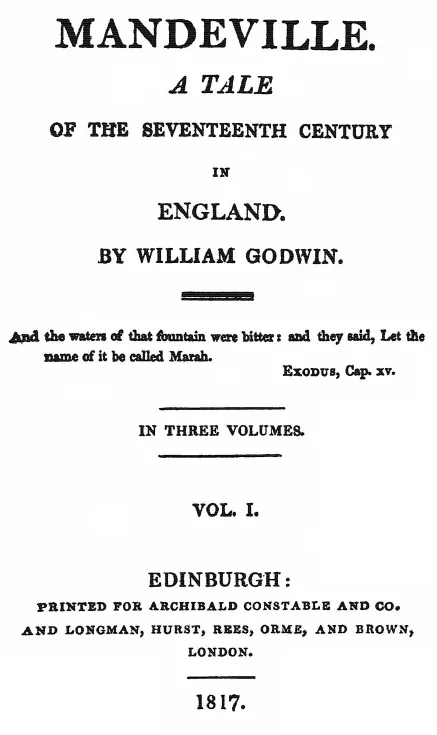
![]()
![]()
[DEDICATION]
To the memory of the sincerest friend I ever had, the late John Philpot Curran, (who a few days since quitted this mortal stage) I affectionately inscribe these volumes.
[William Godwin,] October 25, 1817.
![]()
PREFACE1
Approaching, as I now very rapidly do, to the period when I must bid the world an everlasting farewel, I am not unwilling to make up my accounts with it, as far as relates to this lighter species of composition. On this occasion, I am contented to talk, to that small portion of the world whose eye is ever likely to light upon these prefatory pages, with the communicativeness of an intimate friend.
Eight years ago I began a novel.2 The thought I adopted as the germ of my work, was taken from the story of the Seven Sleepers in the records of the first centuries of Christianity,3 or rather from the Sleeping Beauty in the Wood, in Perrault’s Tales of Ma Mere L’Oie.4 I supposed a hero who should have this faculty, or this infirmity, of falling asleep unexpectedly, and should sleep twenty, thirty, or a hundred years at a time, at the pleasure of myself, his creator. I knew that such a canvas would naturally admit a vast variety of figures, actions, and surprises.
When my respectable friend, the publisher of the present work,5 found means to put in activity the suspended faculty of fiction within me, I resolved to return to the tale which, eight years before, I had laid aside. But the nearer I looked at it, the more I was frightened at the task. Such a work must be made up of a variety of successive tales, having for their main point of connection, the impression which the events brought forward should produce on my sleeping-waking principal personage. I should therefore have had at least a dozen times to set myself to the task of invention, as it were, de novo.6 I judged it more prudent, particularly regarding certain disadvantages under which I found myself, to choose a story that should be more strictly one, and should so have a greater degree of momentum, tending to carry me forward, after the first impulse given, by one incessant motion, from the commencement to the conclusion. Such was my motive for rejecting my former subject, and adopting that which is here treated.
Every author, at least for the last two thousand years, takes his hint from some suggestion afforded by an author that has gone before him, as Sterne has very humorously observed;7 and I do not pretend to be an exception to this rule. The impression, that first led me to look with an eye of favour upon the subject here treated, was derived from a story-book, called Wieland, written by a person, certainly of distinguished genius, who I believe was born and died in the province of Pennsylvania in the United States of North America, and who calls himself C.B. Brown.8 This impression was further improved from some hints in De Montfort, a tragedy, by Joanna Baillie.9 Having signed these bills against me, I hold myself for the present occasion discharged from all claims of my literary creditors, except such as are purely transient and incidental.
To proceed in the same style of confession and unreserve. I am not aware that, in my capacity as an author, I owe any considerable thanks to the kindness of my contemporaries; yet I part from them without the slightest tinge of ill-humour. If ever they have received my productions with welcome, it has been because the same public impression, or the same tone of moral feeling, had been previously generated in the minds of a considerable portion of my species, and in my own. When I have written merely from a private sentiment, and thought to try whether, as Marmontel says, they valued me for myself,10 (which I did in the Essay on Sepulchres, and the Lives of the Nephews of Milton)11 my reception has been such, as might be well calculated to cure me, if I had been constitutionally liable to the intoxications of vanity. Yet I have never truckled to the world. I have never published any thing with the slightest purpose to take advantage of the caprice of the day, to approach the public on its weak side, or to pamper its frailties. What I have produced, was written merely in obedience to that spirit, unshackled and independent, whatever were its other qualities, that commanded me to take up my pen.
There are two or three things, which I still meditate to perform in my character of an author. But whether life, and health, and leisure will be granted me sufficient for the execution of what I design, is among the secrets of “time not yet in existence.” In either event I feel myself altogether satisfied and resigned.
![]()
CHAPTER I
I was born in the year 1638. The place of my birth was the borough of Charlemont,1 in the north of Ireland. My great uncle passed over to that country in the train of the Earl of Essex, in his famous and unfortunate expedition thither undertaken forty years before.2 The military reputation of my great-uncle was considerable, and he died full of years and of honour, under the pacific administration of Sir Arthur Chichester.3 My father, who, as well as my great-uncle, was a younger brother, was bred to the same profession, was sent over to Ireland for the advantage of being under his uncle’s eye, and was at this time an officer in the garrison of Charlemont under William Lord Caulfield, a brave officer, now grown old in the service of his sovereign.4
Ireland was a country that had been for ages in a state of disturbance and violence. No people were ever more proud of their ancestry and their independence than the Irish, or more wedded to their old habits of living;—and the policy of the English administration had not been such as to wean them in any degree from the partialities to which they were prone. The latter years of Elizabeth however had conduced much to the enfeebling of their military strength; and the pacific system of James seemed, for a long time, to be no where attended with so much success as in this island.5 His system in Ireland, was that of colonization,6 of placing large bodies of civilized strangers in every great station through the country, and undertaking, by a variety of means, to reclaim the wild Irish from what might almost be called their savage state. The government of his lieutenants and deputies was not exactly that of benignity;—it was characterized by many forfeitures, and by a vexatious inquiry, in every direction successively, into the titles by which the Irish chieftains held their estates; but it was so equally tempered with severity and firmness, as to produce the spectacle, scarcely before known, of a profound peace in the island for almost forty years.
It was towards the close of this period that Thomas Lord Strafford was appointed, by Charles I, to the office of Lord-Lieutenant.7 In his government there was a greater proportion of sternness than in that of his predecessors; his character was in the highest degree arrogant and imperious, but there was a steadiness in his measures, and his proceedings were stamped with the features of intellect and ability,—so as to appear well calculated to impress a people like the Irish with awe and respect. They hated him, but you could scarcely see that they hated him. They did not, even to their own thoughts, fully analyze and confess their passions; they felt towards him the sensations inspired by a sort of superior nature,—the core of their thoughts was dread and aversion; but their gestures were paralyzed; the expression of these sentiments died away upon their tongue; the public language that followed him was that of approbation and honour. Ireland was substantially less tranquillized than under Sir Arthur Chichester, and the other predecessors of their present austere ruler; but it exhibited every external indication of tranquillity and submission.
Strafford was finally withdrawn from the government of Ireland in the beginning of the year 1640. His absence was intended to be short; but the growing convulsions of his native country detained him, and he never returned. This produced a very new state of things in the country where he had presided. His successors were not of a character to impress either respect or terror upon the people they governed, and the Irish began to reflect in an independent spirit upon their condition. An unexpected view of things opened upon their thoughts. They had contemplated the ascendancy of the English government as a detested thing; but, at the same time, as an evil that it was as much in vain to struggle against, as the laws of nature, or the convulsions of the elements. The other subjects of this government had, for some time, been under different impressions. The people of North Britain, offended with the injudicious and narrow-minded efforts that had been employed to impose upon them episcopacy and a liturgy, had risen in open resistance against the tyranny, and had quelled the oppressor.8 The English, who had long despised the naked and unvarnished despotism that had been attempted over them, were now ripe for the combined and irresistible assertion of their rights. The Long Parliament assembled towards the close of 1640;9 and they began their operations with an open attack on the confidential ministers of Charles I. Strafford in particular was the object of their unrelenting prosecution, and he was put to death by the sentence of the highest court of judicature, in the spring of the following year.10
All this was greatly encouraging to the Irish. The period was favourable; and if they neglected to improve it, they would deserve to be slaves.11 They had both example and opportunity to animate their efforts. What they had suffered before, they now ventured to shape into thoughts; and what they thought, they dared to speak. Their murmurs were audible; and the stream of the population was agitated, like ocean before a storm.
The discontents of Ireland were first published through the constitutional medium, her parliament. This assembly sent over her commissioners, to assist the English legislature with additional charges against Strafford. They called loudly for the redress of some of the most oppressive grievances that had been imposed by the stern lord-lieutenant. They demanded the establishment of certain graces,12 which had long been promised by the crown, and the object of which was to quiet the litigious and technical inquiries at law, that had too frequently been set on foot to disturb the Irish landed proprietors in their possessions. Thus far all was well; and the puritan and the papist had gone hand in hand in the assertion of general right.
But there was another and a deeper discontent at work in this unhappy country. The majority of its population was Catholic, and all the religious emoluments of Ireland were reserved for the Protestants. The country had struggled for ages for her independence; it was a war of the oppressor against the oppressed; of civilized man, or man claiming to be such, against man almost in a state of barbarism; and, incidentally only, for nearly a century past, of the two great denominations of the Christian religion against each other. The party, or rather the great mass of the population of the country, who were in opposition to the government, felt that they were the ancient proprietors of the soil. Irish manners and Irish sentiments, every thing that was local in human society, was with them; the party that, in a great majority of cases, lorded it over them, they regarded as aliens. And when we add to this general view of the case, the recollection that must necessarily accompany it, of all the individual circumstances, and all the bitter aggravations that attended each act of oppression, we may easily conceive what must have been the state of the Irish mind. But all this would have been a matter of infinitely less magnitude than it actually was, had it not been inextricably bound up with considerations of religion. The artifices, or rather the mistakes and bigotry of the priesthood, infused a venom into the hostility existing on either side, that all together gave “note of a fearful preparation.”13 These things I can state impartially now; but it is through a course of incredible mischief and suffering only that I have learned this impartiality.
The calamities that overwhelmed Ireland towards the close of the year 1641, might in part have been foreseen by a skilful observer, but not by such men as then sat at the helm of her government. There is no instance perhaps in the records of mankind, of such profound supineness and security upon the eve of so terrible a storm. I am not, however, writing a piece of national history; and therefore I shall only say, that the conspirators had finally chosen the 23d of October, as the day on which their insurrection should break out through a very extensive line of country.14
The principal leader of the conspirators in the province of Ulster, was Sir Phelim O’Neile.15 He was of a licentious and brutal temper, oppressed with debts, stirred up with the ambition of standing at the head of his name and figuring as the O’Neiles his predecessors had done, and unscrupulous as to the means by which his purposes were to be achieved. The first exploit marked out for him, was the gaining possession of Charlemont. The most obvious step towards that end that suggested itself to his thoughts, was to invite himself to sup in the castle, with Lord Caulfield16 and the principal officers of the garrison, on the night of the 22d of October. This nobleman, who was accustomed to live with his Irish neighbours on terms of unsuspecting confidence, cheerfully accepted the proposal. No symptom of hostility had shown itself; every thing was as in a state of the most perfect peace and security. Sir Phelim came, attended with a numerous train of followers; but this occasioned no surprise; it was the custom of the times. His manner was frank, companionable and courteous. Lord Caulfield was particularly desirous to do honour to his guest. The rugged chieftain was gifted with a considerable vein of convivial humour; and the officers of the garrison exerted themselves to catch his tone, and be as easy, mirthful, unrestrained and confiding, as he apparently was. The wine circulated; a general face of festivity prevailed; the song, the jest, the tale, was occasionally interspersed; every thing bespoke the fair and friendly meaning both of the entertainer and his guests. Lord Caulfield expressed himself as conceiving a happy omen, from this sociable meeting of the ancient Irish and the English settlers; and Sir Phelim echoed his sentime...