1
The Sioux and the Kazakhs
Throughout the nineteenth century, as expansion and colonization accelerated, Americans and Russians often resorted to stereotypes and perceptions of the Sioux and the Kazakhs to justify their objectives in the plains and steppe. They regarded nomadism as backward, but they were not the first people to confront intractable, hostile, barbaric nomads. The United States and Russia embraced an epistemological understanding of nomads built on both their own encounters and those they read about in the histories of the Greeks, Romans, and Chinese, and they applied that knowledge to their understanding of the Sioux and the Kazakhs, which led them to overgeneralize and underestimate the strength of the indigenous populations’ social, cultural, political, and economic structures. Moreover, Europeans—and, subsequently, Americans—dealt with Indians from the moment of first contact and developed relatively inflexible ideas and opinions about them over the course of three centuries. The Europeans and Russians knew Turks; they knew Muslims; they conquered other nomadic peoples (and were conquered by them); and they assembled very strong opinions and ideas about what should be done with them. The Americans and Russians adopted policies designed to supervise peoples that they deemed capable of change only when administered by force and coercion because the Sioux and the Kazakhs possessed inferior cultures, societies, and religions and failed to take full advantage of abundant land and possibilities offered by American and Russian civilization. The Americans and Russians failed to understand or appreciate that Sioux and Kazakh society, culture, and economy were in constant flux, and that the Sioux and the Kazakhs adopted and adapted to suit their needs and their sensibilities, however alien that might seem to the colonizers.
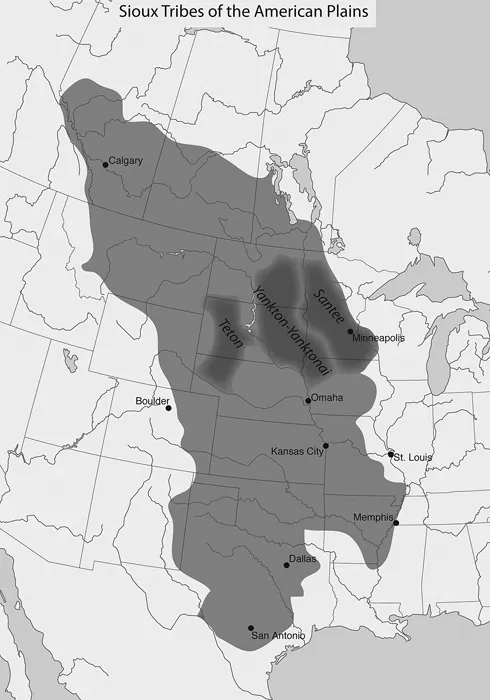
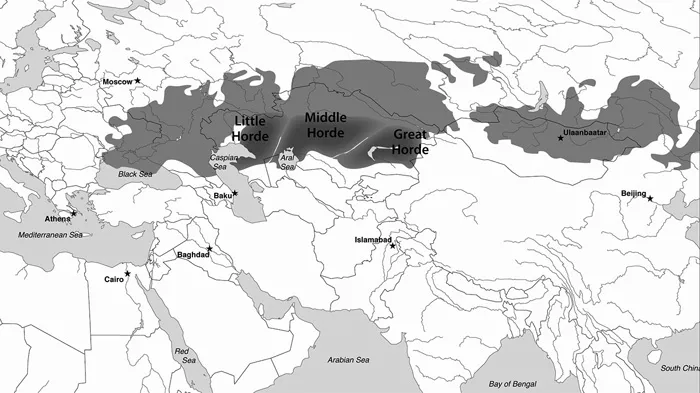
In order to understand American and Russian perceptions and their partial justifications for conquest, it is also necessary to situate the Sioux and the Kazakhs in their world—in their social, cultural, and economic milieu—which requires a brief overview. There is no shortage of information or scholarship to draw on to examine and understand Sioux and Kazakh nomadic cultures, societies, political or economic structures, customs, myths, religion, and even games and amusements. Unfortunately, generalizations are unavoidable in a comparative study, particularly when treating subjects as complex as “societies” and “cultures” or “customs” and “traditions.”
One facet of the stereotypical image held by the Americans and the Russians was that the nomadic lifeways of Sioux and Kazakh societies made them and their economies clearly backward. But in a sense, neither the Sioux nor the Kazakhs were fully nomads; agriculture, hunting and gathering, and the trappings of sedentary life were not completely alien to them. The difference between nomadic or seminomadic peoples was that they did not live in fixed abodes or in a fixed place. Sioux and Kazakh economies were generally dependent upon mobility. The Sioux lived by the hunt; the Kazakhs raised large herds of sheep, goats, camels, and horses. The Sioux were migratory hunters and the Kazakhs were pastoral nomads.
Americans and Russians based their attitudes on superficial images and representations and somewhat subjective oversimplifications; they did not make a significant leap into some unknown universe that lacked awareness or experience with nomads. The image of nomadic culture and society was that they were static cultures and societies. American and Russian perceptions were grounded in the belief that nomads lived an ancient lifestyle. In the minds of Americans and Russians, nomadic culture and society were homogenized and easily deciphered because of universal conceptions about nomads and traits and characteristics that they believed were common to all equestrian, nomadic, warrior societies. Yet twentieth-century scholars (chiefly historians and anthropologists) demonstrated—in fact, marveled at—the global diversity of nomadic societies and cultures.
For centuries, the nomads’ sedentary neighbors observed and commented upon nomadism and nomadic peoples—especially the Eurasian nomads vilified in Chinese literature. The Greeks wrote about the Scythians inhabiting the steppe lands of southern Russia. With their nomadic mode of life and seemingly endless wanderings, the Chinese and Greeks provided the stereotypical representations of nomadic peoples living beyond the boundaries of civilization whose pastimes consist of “conquest and rapine in the fat lands and rich cities of the plain.” The life of the Eurasian nomad was “riding a horse[,] living in a tent[, and being] menaced by perennial uncertainty of supplies of grass and water. His temptation to maraud was strong and oft-repeated. The mobile existence of the grassland man made it easy for him to raid and pillage.”1
Writers in sedentary societies depicted nomads as uncivilized, but they also generally perceived nomads to be very traditional, almost timeless societies that abhorred change and lacked a future: “nomads have no history; they only have geography.”2 Agrarian, non-nomadic societies relegated nomads to a peripheral social, cultural, and political status as barbarians—a “raw” people that lacked civilization and were pushed aside in “spatial terms, and to antiquity in temporal terms.”3 Geography and epoch, not society or culture, were all that seemed to distinguish between Scythians, Huns, Vandals, and other nomads such as Bedouins, Berbers, Sioux, or Kazakhs.4
The quintessential nomadic tribes—certainly in popular imagination—were Chingis (Genghis) Khan and his Mongol hordes thundering out of the Eurasian steppe to terrorize the civilized world with plunder and rapine. Uttering the name of the Mongols was almost a metaphor for savagery, barbarism, wanton cruelty, death, and destruction. By the end of the thirteenth century, Europeans and Russians gradually transformed the Mongol appellation into Tatars (or Tartars), convinced that classical Tartarus was their place of origin. In time, as Devin DeWeese noted, in E...