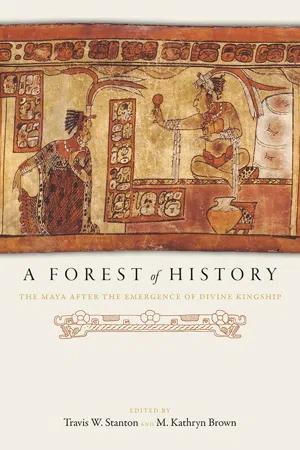
David Freidel and Linda Schele's monumental work A Forest of Kings: The Untold Story of the Ancient Maya (1990) offered an innovative, rigorous, and controversial approach to studying the ancient Maya, unifying archaeological, iconographic, and epigraphic data in a form accessible to both scholars and laypeople. Travis Stanton and Kathryn Brown's A Forest of History: The Maya after the Emergence of Divine Kingship presents a collection of essays that critically engage with and build upon the lasting contributions A Forest of Kings made to Maya epigraphy, iconography, material culture, and history.
These original papers present new, cutting-edge research focusing on the social changes leading up to the spread of divine kingship across the lowlands in the first part of the Early Classic. The contributors continue avenues of inquiry such as the timing of the Classic Maya collapse across the southern lowlands, the nature of Maya warfare, the notion of usurpation and "stranger-kings" in the Classic period, the social relationships between the ruler and elite of the Classic period Yaxchilán polity, and struggles for sociopolitical dominance among the later Classic period polities of Chichén Itzá, Cobá, and the Puuc kingdoms.
Many of the interpretations and approaches in A Forest of Kings have withstood the test of time, while others have not; a complete understanding of the Classic Maya world is still developing. In A Forest of History recent discoveries are considered in the context of prior scholarship, illustrating both the progress the field has made in the past quarter century and the myriad questions that remain. The volume will be a significant contribution to the literature for students, scholars, and general readers interested in Mesoamerican and Maya archaeology.
Contributors:
Wendy Ashmore, Arlen F. Chase, Diane Z. Chase, Wilberth Cruz Alvarado, Arthur A. Demarest, Keith Eppich, David A. Freidel, Charles W. Golden, Stanley P. Guenter, Annabeth Headrick, Aline Magnoni, Joyce Marcus, Marilyn A. Masson, Damaris Menéndez, Susan Milbrath, Olivia C. Navarro-Farr, José Osorio León, Carlos Peraza Lope, Juan Carlos Pérez Calderón, Griselda Pérez Robles, Francisco Pérez Ruíz, Michelle Rich, Jeremy A. Sabloff, Andrew K. Scherer, Karl A. Taube
eBook - ePub
A Forest of History
The Maya after the Emergence of Divine Kingship
- English
- ePUB (mobile friendly)
- Available on iOS & Android
eBook - ePub
A Forest of History
The Maya after the Emergence of Divine Kingship
About this book
Information
Publisher
University Press of ColoradoYear
2020Print ISBN
9781646422357
9781646420452
eBook ISBN
9781646420469
1
See the Forest for the Trees
An Introduction to the Volume
Travis W. Stanton and M. Kathryn Brown
This volume is part of a two-part reflection on the impact that A Forest of Kings, written by Linda Schele and David Freidel (1990), has had on the field of Maya archaeology since its publication. Stemming from a Society for American Archaeology double-symposium held in San Francisco in 2015 to mark the twenty-fifth anniversary of this momentous publication, this volume focuses on Maya archaeology, iconography, and history from the Classic period onward. We believe that the title of this chapter, “See the forest for the trees,” aptly describes the vision that Schele and Freidel shared with scholars and the public through their significant publication. A Forest of Kings was more than a retelling of ancient Maya history through the use of a conjunctive approach, but rather, for the first time, a holistic and discerning attempt to explain how Maya history was constructed in both the past and present. As Arthur Demarest notes in chapter 2 of this volume, they truly saw the forest, and not just the trees. Schele and Freidel realized that the ancient Maya history that they constructed in A Forest of Kings would by reshaped by future scholars with new discoveries and shifts in theoretical approaches. Through their contribution, they opened the door, or rather a portal, to another world of Maya scholarship. As the chapters in this volume demonstrate, the journey of “time travel in the jungle” first embarked on by Schele and Freidel has continued in their wake. The contributors to this tribute volume were asked to reflect on the legacy of A Forest of Kings in shaping the study of ancient Maya societies and where we stand today regarding some of the key questions posed by Schele and Freidel’s work. The result is a rich collection of papers that situate current research in historical context. In this brief chapter, we contextualize and introduce the following chapters to provide a roadmap to this book. Longer treatments of the overall impact of A Forest of Kings are undertaken by Guernsey and Reese-Taylor (n.d.) in the companion volume and Demarest in chapter 2 of this volume.
As discussed by Guernsey and Reese-Taylor (n.d.) and Demarest (chapter 2, this volume), A Forest of Kings was a watershed publication in many regards. From the postmodern style of writing to the ambitious historical narrative woven throughout the text, Schele and Freidel’s work made an impact on both scholars of the Maya and the public. Written at a critical time when many of the old models created by the first generation of Maya archaeologists were finally being laid to rest (see Jeremy Sabloff, foreword to this volume) and advances in epigraphy were providing a way to historicize the Maya, the publication of A Forest of Kings can be seen as a key piece of scholarship that ushered in a paradigm shift for the field. As Demarest makes abundantly clear in chapter 2, however, A Forest of Kings was highly controversial, and not only because it marked the shift to a conjunctive approach that combined epigraphy and archaeology. Many of the more theoretical concepts proposed Schele and Freidel, such as termination rituals, were not received well, even by more junior scholars. Demarest’s contribution provides a highly personal reflection on some of the more transformative and revisionist ideas laid out in A Forest of Kings that are widely accepted by the field today, demonstrating its lasting legacy on how scholars conceptualize ancient Maya societies. In the second half of his chapter he frames some of these ideas in terms of his own work at the site of Cancuén and discusses the implications for the timing of the Classic Maya collapse across the southern lowlands.
In chapter 3, Arlen Chase and Diane Chase take up the topic of Maya warfare, a major theme of Classic period Maya inscriptions and one of the primary threads holding together the chapters in A Forest of Kings. In the late 1980s, epigraphers were just beginning to build a more holistic sense of the broader sociopolitical landscape of Classic Maya society. At this time, increased understanding of the conflicts, marriage alliances, and other forms of interaction that elites commemorated in durable forms of writing was resulting in the crystallization of real regional histories, at least for parts of the Maya lowlands. This work would eventually reach an apex of sorts that is best typified by the superstate model proposed by Simon Martin and Nikolai Grube (1995, 2000) not long after the publication of A Forest of Kings. Focusing on the importance of warfare in the inscriptions, Chase and Chase revisit the topic of the nature of Maya warfare and its implications for understanding the relationship between the sites of Caracol and Tikal, squarely situated in chapter 5 of A Forest of Kings. Using the conjunctive approach espoused by Schele and Freidel, they argue that the concept of “stranger-kings” can be useful in understanding burial patterns at Tikal that suggest lords from Caracol were interred at this important Maya city. Embarking on the historical journey set out by Schele and Freidel in A Forest of Kings, Chase and Chase’s contribution exemplifies an example of reshaping Maya history through new data and interpretations.
Using examples from several sites throughout the Maya lowlands, Joyce Marcus also discusses the idea of “stranger-kings” in her treatment of usurpation during the Classic period in chapter 4. A Forest of Kings began to open up the elite history of the Classic Maya to wider academic and public audiences when it was published, and this history highlighted the political machinations that occurred in both intersite and intrasite contexts. Using two examples each from Tikal and Copán, Marcus explores the idea of usurpation, especially in light of “Teotihuacan influence.”
Continuing along the themes of Late Classic wars and hegemonies found in chapter 5 of A Forest of Kings, Olivia Navarro-Farr and her colleagues discuss the relationship between the realm of the Kaanul lords and the site of El Perú–Waka’, where at the beginning of the third millennium David Freidel began testing many of the hypotheses first laid out in A Forest of Kings a decade earlier. Work at El Perú–Waka’ has added to a growing body of epigraphic, iconographic, and archaeological evidence that indicates Kaanul’s hegemonic success, during the latter part of the Classic period at least, was due in large part to the role played by particular women of Kaanul ancestry. Presenting the role of these women at El Perú–Waka’ as active agents in the building and maintenance of intersite alliances rather than solely in terms of their relationships to male peers or seniors, Navarro-Farr and her colleagues continue in the tradition of multivocality that Schele and Freidel so embraced in A Forest of Kings. Through this contribution, the authors move the narrative forward from a discussion dominated by generally androcentric language, to one that is more gender inclusive.
Work at El Perú–Waka’ is again the focus of chapter 6, where Michelle Rich and Keith Eppich address agency and alliance building among the elite of El Perú–Waka’ itself. Chapter 7 (Bird-Jaguar and the Caholob) of A Forest of Kings focuses more on the internal sociopolitical dynamics of the site of Yaxchilán and its local allies along the Usumacinta River than the contribution to this volume by Rich and Eppich, which emphasizes a more regional gaze. Taking this internal focus as a starting point, Rich and Eppich discuss the similarities of two Early-to-Late Classic transition tombs, only one of which is considered to be the resting place of a member of the royal family, as evidence of alliance building and maintenance among the elite of El Perú–Waka. Having the kind of power that Classic Maya rulers wielded required negotiating the support of other important members of the community. Much like the intrapolity alliances commemorated on the Late Classic Yaxchilán region monuments that depict secondary elites performing activities with the ruler, the similarities of the tombs, Rich and Eppich contend, is a material manifestation of the garnering of nonroyal support for the El Perú–Waka’ dynasty. This chapter emphasizes the valuable role that the material focus of archaeology plays in the construction of Maya history.
The question of intrapolity political dynamics along the Usumacinta is revisited by Charles Golden and Andrew Scherer in chapter 7. Taking the Late Classic history of the Yaxchilán polity (chapter 7 of A Forest of Kings) as the focus of study, Golden and Scherer discuss the symbiotic social relationships between the ruler and subordinate elite that characterized the upper levels of the social hierarchy during the Classic period. Using the concept of personhood, the authors argue that sajal were crafted, or in their terms “cultivated,” as particular kinds of humans, humans who through performance could “constitute, activate, and perpetually maintain and redefine the limits of the kingdom and the bounds of its moral community” in concert with the person of the ruler.
Moving to the southeastern limits of the Maya world, Wendy Ashmore revisits chapter 8 of A Forest of Kings and the rivalry between Copán and Quiriguá. In 1990 interdisciplinary work at Copán was in full swing and many data were available, from epigraphic texts and iconography to artifacts and architecture. As Ashmore details, Schele and Freidel used these data to craft a well-grounded narrative of rulers in the southeastern fringes of the Classic period Maya world using their conjunctive approach that was so aptly applied to the such a detailed, copious, and diverse data set. This truly pioneering research at Copán, however, continued past the publication of A Forest of Kings. Ashmore reconsiders the early work by Schele and Freidel in light of significant discoveries over the following years.
Moving to the northern Maya lowlands in chapter 9, Travis Stanton and his colleagues revisit the theme of struggles for sociopolitical dominance among the later Classic period polities of Chichén Itzá, Cobá, and the Puuc kingdoms, the focus of chapter 9 of A Forest of Kings. Freidel had begun work at the site of Yaxuná in 1986 in part to test the idea that these polities vied for control of the northern lowlands at the close of the Classic period. Focusing heavily on data from Yaxuná and Chichén Itzá, Schele and Freidel had proposed an alliance between the Puuc region and Cobá against the expanding hegemony of Chichén Itzá. Using new data from Yaxuná, Stanton and his colleagues propose an alternative chronology for understanding interpolity interactions during the latter part of the Classic.
Continuing on the theme of Chichén Itzá, Karl Taube analyzes the iconography of war and the afterlife at this important northern lowland center in chapter 10. Warfare is a consistent theme throughout A Forest of Kings, though in chapter 9 of Schele and Freidel’s volume it is discussed in the explicit framework of empire building. Situating militarism at Chichén Itzá in a broader spatial-temporal perspective that includes Teotihuacan and the Contact period Aztec, Taube illustrates that much of the copious amount of iconography dedicated to warriors and organized violence relates to broader concepts of an otherworld paradise where the souls of heroic warriors reside.
In chapter 11, Annabeth Headrick rounds out the discussion of Chichén Itzá in a rather personal account of the treatment of empire and governance, among other topics such as captive taking and trade, in A Forest of Kings. The question of Central Mexican iconography, with its more anonymous depictions of human figures, at Chichén Itzá has raised questions about the nature of political organization at the site since the beginning of professional archaeology in Yucatán (e.g., Tozzer 1957). Schele and Freidel furthered these debates by proposing the controversial concept of multepal for the site in A Forest of Kings. In her contribution, Headrick broadly reviews concepts such as multepal, situating the narrative surrounding Chichén Itzá in chapter 9 of A Forest of Kings as but a snapshot of an extended discussion of these issues that continues to the present day.
While the time depth represented in the narratives woven throughout A Forest of Kings was extensive, one period that did not receive systematic treatment was the Late Postclassic. In chapter 12, Marilyn Masson and her colleagues discuss data from the most important Late Postclassic urban center from this period, the city of Mayapán. Framing their discussion in terms of termination rituals, a controversial proposal at the time A Forest of Kings was published (see Demarest, chapter 2 in this volume), Masson and her colleagues analyze a series of broken censers dating to the some 50 to 150 years prior to the collapse of the city. The authors argue that the termination deposit from the Itzmal Ch’en group indicates violence and/or abandonment of this public architecture well before the “storied collapse due to the Xiu-Cocom war of Katun 8 Ahau in the mid-fifteenth century AD.” This chapter illustrates the important contribution of archaeological data to a more nuanced understanding of Maya history.
Moving into the Colonial period, in chapter 13 Stanley Guenter discusses the significance of the date of Katun 8 Ahau, characterized by several of the books of Chilam Balam as a moment of collapse, abandonment, migration, and political change. Inspired by the broad temporal and spatial reach to interpreting data used in A Forest of Kings, in chapter 13 Guenter provides an analysis of the hieroglyphic inscription of Copán Stela 11, a monument of the last ruler of this site, Yax Pasaj Chan Yopaat. He suggests that the text on the stela may allude to the destruction of an actual building, perhaps the Temple of the Sun at Teotihuacan, and the associations with calamity that the 8 Ahau date had during the Colonial period may have much deeper origins.
Finally, Freidel provide...
Table of contents
- Cover
- Title Page
- Copyright Page
- Contents
- List of Figures
- List of Tables
- Foreword
- 1. See the Forest for the Trees: An Introduction to the Volume
- 2. “Terminal” Termination Rituals and the Felling of A Forest of Kings: Past Struggles and Recent Triumphs of the Core Concepts of a Seminal Work
- 3. The Materialization of Classic Period Maya Warfare: Caracol Stranger-Kings at Tikal
- 4. Maya Usurpers
- 5. Forest of Queens: The Legacy of Royal Calakmul Women at El Perú–Waka’s Central Civic-Ceremonial Temple
- 6. Statecraft in the City of the Centipede: Burials 39, 38, and Internal Alliance Building at El Perú–Waka’, Guatemala
- 7. Revisiting Bird Jaguar and the Sajal of the Yaxchilán Kingdom
- 8. Macaw Mountain and Ancient Peoples of Southeast Mesoamerica
- 9. Borderland Politics: A Reconsideration of the Role of Yaxuná in Regional Maya Politics in the Latter Part of the Classic
- 10. In Search of Paradise: Religion and Cultural Exchange in Early Postclassic Mesoamerica
- 11. Empire at Chichén Itzá Revisited
- 12. Closing the Portal at Itzmal Ch’en: Effigy Censers and Termination Rituals at a Mayapán Ceremonial Group
- 13. On Copán Stela 11 and the Origins of the Ill Omen of Katun 8 Ahau
- 14. Into the Woods: Archaeology, Epigraphy, and Iconography in Classic Maya Studies
- References Cited
- Contributors
- Index
Trusted by 375,005 students
Access to over 1.5 million titles for a fair monthly price.
Study more efficiently using our study tools.
Frequently asked questions
Yes, you can cancel anytime from the Subscription tab in your account settings on the Perlego website. Your subscription will stay active until the end of your current billing period. Learn how to cancel your subscription
No, books cannot be downloaded as external files, such as PDFs, for use outside of Perlego. However, you can download books within the Perlego app for offline reading on mobile or tablet. Learn how to download books offline
Perlego offers two plans: Essential and Complete
- Essential is ideal for learners and professionals who enjoy exploring a wide range of subjects. Access the Essential Library with 800,000+ trusted titles and best-sellers across business, personal growth, and the humanities. Includes unlimited reading time and Standard Read Aloud voice.
- Complete: Perfect for advanced learners and researchers needing full, unrestricted access. Unlock 1.5M+ books across hundreds of subjects, including academic and specialized titles. The Complete Plan also includes advanced features like Premium Read Aloud and Research Assistant.
We are an online textbook subscription service, where you can get access to an entire online library for less than the price of a single book per month. With over 1.5 million books across 990+ topics, we’ve got you covered! Learn about our mission
Look out for the read-aloud symbol on your next book to see if you can listen to it. The read-aloud tool reads text aloud for you, highlighting the text as it is being read. You can pause it, speed it up and slow it down. Learn more about Read Aloud
Yes! You can use the Perlego app on both iOS and Android devices to read anytime, anywhere — even offline. Perfect for commutes or when you’re on the go.
Please note we cannot support devices running on iOS 13 and Android 7 or earlier. Learn more about using the app
Please note we cannot support devices running on iOS 13 and Android 7 or earlier. Learn more about using the app
Yes, you can access A Forest of History by Travis W. Stanton, M. Kathryn Brown, Travis W. Stanton,M. Kathryn Brown in PDF and/or ePUB format, as well as other popular books in Social Sciences & Archaeology. We have over 1.5 million books available in our catalogue for you to explore.