eBook - ePub
Anthropomorphic Imagery in the Mesoamerican Highlands
Gods, Ancestors, and Human Beings
- English
- ePUB (mobile friendly)
- Available on iOS & Android
eBook - ePub
Anthropomorphic Imagery in the Mesoamerican Highlands
Gods, Ancestors, and Human Beings
About this book
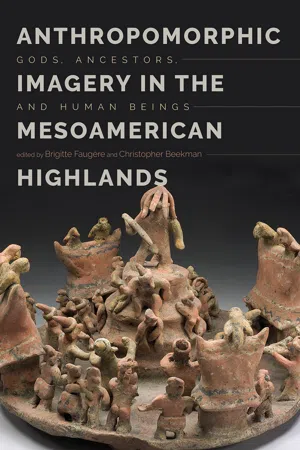
In Anthropomorphic Imagery in the Mesoamerican Highlands, Latin American, North American, and European researchers explore the meanings and functions of two- and three-dimensional human representations in the Precolumbian communities of the Mexican highlands. Reading these anthropomorphic representations from an ontological perspective, the contributors demonstrate the rich potential of anthropomorphic imagery to elucidate personhood, conceptions of the body, and the relationship of human beings to other entities, nature, and the cosmos.
Using case studies covering a broad span of highlands prehistory—Classic Teotihuacan divine iconography, ceramic figures in Late Formative West Mexico, Epiclassic Puebla-Tlaxcala costumed figurines, earth sculptures in Prehispanic Oaxaca, Early Postclassic Tula symbolic burials, Late Postclassic representations of Aztec Kings, and more—contributors examine both Mesoamerican representations of the body in changing social, political, and economic conditions and the multivalent emic meanings of these representations. They explore the technology of artifact production, the body's place in social structures and rituals, the language of the body as expressed in postures and gestures, hybrid and transformative combinations of human and animal bodies, bodily representations of social categories, body modification, and the significance of portable and fixed representations.
Anthropomorphic Imagery in the Mesoamerican Highlands provides a wide range of insights into Mesoamerican concepts of personhood and identity, the constitution of the human body, and human relationships with gods and ancestors. It will be of great value to students and scholars of the archaeology and art history of Mexico.
Contributors: Claire Billard, Danièle Dehouve, Cynthia Kristan-Graham, Melissa Logan, Sylvie Peperstraete, Patricia Plunket, Mari Carmen Serra Puche, Juliette Testard, Andrew Turner, Gabriela Uruñuela, Marcus Winter
Using case studies covering a broad span of highlands prehistory—Classic Teotihuacan divine iconography, ceramic figures in Late Formative West Mexico, Epiclassic Puebla-Tlaxcala costumed figurines, earth sculptures in Prehispanic Oaxaca, Early Postclassic Tula symbolic burials, Late Postclassic representations of Aztec Kings, and more—contributors examine both Mesoamerican representations of the body in changing social, political, and economic conditions and the multivalent emic meanings of these representations. They explore the technology of artifact production, the body's place in social structures and rituals, the language of the body as expressed in postures and gestures, hybrid and transformative combinations of human and animal bodies, bodily representations of social categories, body modification, and the significance of portable and fixed representations.
Anthropomorphic Imagery in the Mesoamerican Highlands provides a wide range of insights into Mesoamerican concepts of personhood and identity, the constitution of the human body, and human relationships with gods and ancestors. It will be of great value to students and scholars of the archaeology and art history of Mexico.
Contributors: Claire Billard, Danièle Dehouve, Cynthia Kristan-Graham, Melissa Logan, Sylvie Peperstraete, Patricia Plunket, Mari Carmen Serra Puche, Juliette Testard, Andrew Turner, Gabriela Uruñuela, Marcus Winter
Frequently asked questions
Yes, you can cancel anytime from the Subscription tab in your account settings on the Perlego website. Your subscription will stay active until the end of your current billing period. Learn how to cancel your subscription.
At the moment all of our mobile-responsive ePub books are available to download via the app. Most of our PDFs are also available to download and we're working on making the final remaining ones downloadable now. Learn more here.
Perlego offers two plans: Essential and Complete
- Essential is ideal for learners and professionals who enjoy exploring a wide range of subjects. Access the Essential Library with 800,000+ trusted titles and best-sellers across business, personal growth, and the humanities. Includes unlimited reading time and Standard Read Aloud voice.
- Complete: Perfect for advanced learners and researchers needing full, unrestricted access. Unlock 1.4M+ books across hundreds of subjects, including academic and specialized titles. The Complete Plan also includes advanced features like Premium Read Aloud and Research Assistant.
We are an online textbook subscription service, where you can get access to an entire online library for less than the price of a single book per month. With over 1 million books across 1000+ topics, we’ve got you covered! Learn more here.
Look out for the read-aloud symbol on your next book to see if you can listen to it. The read-aloud tool reads text aloud for you, highlighting the text as it is being read. You can pause it, speed it up and slow it down. Learn more here.
Yes! You can use the Perlego app on both iOS or Android devices to read anytime, anywhere — even offline. Perfect for commutes or when you’re on the go.
Please note we cannot support devices running on iOS 13 and Android 7 or earlier. Learn more about using the app.
Yes, you can access Anthropomorphic Imagery in the Mesoamerican Highlands by Brigitte Faugère,Christopher Beekman in PDF and/or ePUB format, as well as other popular books in Social Sciences & Archaeology. We have over one million books available in our catalogue for you to explore.
Information
Table of contents
- Cover
- Title Page
- Copyright Page
- Contents
- List of Figures
- List of Tables
- Introduction:. Gods, Ancestors, and Human Beings
- 1. Pretty Face and Naked Body in Context: Meanings and Uses of Chupícuaro Figurines (Guanajuato) during the Late Formative
- 2. Unseating the Shaman: Narrative Performance and Co-Essences in the Hollow Figures of Western Mexico
- 3. Gender and Paired Ceramic Figures in Late Formative West Mexico
- 4. Sexuality and Regeneration in the Underworld: Earth Sculptures in the Cueva del Rey Kong-Oy, Sierra Mixe, Oaxaca
- 5. Costumes and Puppets among Cholula’s Early Classic Figurines and the Formation of Social Worlds
- 6. Unmasking Tlaloc: The Iconography, Symbolism, and Ideological Development of the Teotihuacan Rain God
- 7. The Nature of the Old God of Teotihuacan: Why Would the Old God Be Represented by an Elderly Human Body?
- 8. Epiclassic Figurines of Xochitécatl, Tlaxcala, Mexico: Hypotheses on Their Social Lives and Their Ideological Relevance
- 9. All the Earth Is a Grave: Ancestors and Symbolic Burials at Tula
- 10. Representing the Human Body in Postclassic Central Mexico: A Study of Proportions and Their Evolution in the Aztec Pictorial Tradition
- 11. The Notion of Substitution in Aztec Kingship
- Contributors
- Index