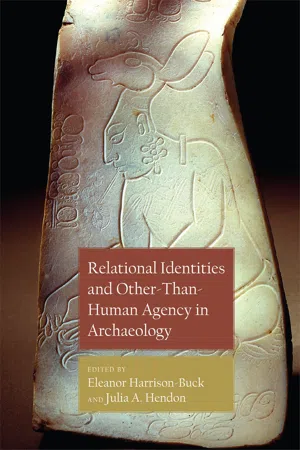
Relational Identities and Other-than-Human Agency in Archaeology explores the benefits and consequences of archaeological theorizing on and interpretation of the social agency of nonhumans as relational beings capable of producing change in the world. The volume cross-examines traditional understanding of agency and personhood, presenting a globally diverse set of case studies that cover a range of cultural, geographical, and historical contexts.
Agency (the ability to act) and personhood (the reciprocal qualities of relational beings) have traditionally been strictly assigned to humans. In case studies from Ghana to Australia to the British Isles and Mesoamerica, contributors to this volume demonstrate that objects, animals, locations, and other nonhuman actors also potentially share this ontological status and are capable of instigating events and enacting change. This kind of other-than-human agency is not a one-way transaction of cause to effect but requires an appropriate form of reciprocal engagement indicative of relational personhood, which in these cases, left material traces detectable in the archaeological record.
Modern dualist ontologies separating objects from subjects and the animate from the inanimate obscure our understanding of the roles that other-than-human agents played in past societies. Relational Identities and Other-than-Human Agency in Archaeology challenges this essentialist binary perspective. Contributors in this volume show that intersubjective (inherently social) ways of being are a fundamental and indispensable condition of all personhood and move the debate in posthumanist scholarship beyond the polarizing dichotomies of relational versus bounded types of persons. In this way, the book makes a significant contribution to theory and interpretation of personhood and other-than-human agency in archaeology.
Contributors:
Susan M. Alt, Joanna Brück, Kaitlyn Chandler, Erica Hill, Meghan C. L. Howey, Andrew Meirion Jones, Matthew Looper, Ian J. McNiven, Wendi Field Murray, Timothy R. Pauketat, Ann B. Stahl, Maria Nieves Zedeño
eBook - ePub
Relational Identities and Other-than-Human Agency in Archaeology
- English
- ePUB (mobile friendly)
- Available on iOS & Android
eBook - ePub
Relational Identities and Other-than-Human Agency in Archaeology
About this book
Information
Publisher
University Press of ColoradoYear
2018Print ISBN
9781646421350
9781607327462
eBook ISBN
9781607327479
1
An Introduction to Relational Personhood and Other-than-Human Agency in Archaeology
Eleanor Harrison-Buck and Julia A. Hendon
Archaeologists who engage in relational personhood and other-than-human agency, often characterized as a relational or ontological archaeology (Alberti 2016; Watts 2013a), variously identify as post-humanist, (neo-)materialist, non-representationalist, or realist, among other labels. Bruno Latour’s (1993, 2013) work has been hugely influential among this diverse body of scholarship, recently labeled the “new ontological realism” (Gabriel 2015) or, alternatively, the “new materialist” archaeology (Thomas 2015). Generally speaking, these scholars reject the classic “humanist” divides, such as culture-nature, human-animal, and animate-inanimate (Watts 2013b:16). In studies of relational personhood, this so-called post-humanist approach is not anti-human but rather considers personhood more broadly to include both human and other-than-human beings, such as animals, plants, spirits, and inanimate things (Thomas 2002; Fowler 2004, 2016).
Some of the most prominent “problem domains” in studies of ontological archaeology involve agency and personhood. There is a long history of attention given to studies of relational personhood in archaeology (Brück 2001; Fowler 2004, 2016; Thomas 2002; Gillespie 2001; Wilkinson 2013, 2017, among others) and in recent years a burgeoning of literature focused specifically on object-based agencies, biographies, and itineraries (Gosden and Marshall 1999; Hodder 2012; Joyce and Gillespie 2015b; Knappett and Malafouris 2008; Mills and Walker 2008; Olsen 2010; Webmoor and Witmore 2008, among others). This volume provides a global perspective on these two interrelated “problem domains”—agency and personhood—and adds to a growing body of archaeological literature that explores the regional variability and intricacies of agency and how this ontological status informs relational personhood (for other recent contributions, see Buchanan and Skousen 2015; Watts 2013a).
Agency is closely related to animacy—“an ontology in which objects and other nonhuman beings possess souls, life-force and qualities of personhood” (Brown and Walker 2008:297). Here we note the important point that agency and personhood (and therefore animacy) are not synonymous. In other words, while all things have the potential for agency, not all agents (including humans) are necessarily persons. As Hill (this volume) notes, while many things have agency—the ability to act—not all of them possess the capacity for reciprocity where social identity is a mutually constituted relationship, which defines personhood in many societies (Ingold 2006; see also Pauketat and Alt, this volume). While some gloss agency and animacy as the same, the studies presented here and elsewhere highlight important distinctions between these two terms that are not just semantic (Ingold 2013:248; Zedeño 2013:121). Timothy Ingold (2013:248) suggests that agency and animacy “pull in opposite directions,” with the former referencing the intention of humans and nonhumans and the latter involving attention, vitalism, growth, and becoming. Ingold (2013:248) concludes that the term “agency” is tied to cognitivism and should be replaced with animacy, which he defines as non-discursive or bodily experienced knowledge (cf. Budden and Sofaer 2009; Harrison-Buck, this volume). While many of the contributions in this volume deal explicitly with animacy, the term strictly references a being with a life force—a quality associated with personhood—and is not applicable to every agent, namely non-persons. In this volume we maintain the term “agency” because it allows contributors to appropriately characterize a broader array of actors, not just social beings but also the asocial entities.
The terms “other-than-human” and “nonhuman” are used interchangeably in the literature and in this volume to refer to relational (social) beings, such as animals, plants, objects, and spirits. Terms like “other-than-human” or “nonhuman” distinguish between biologically human beings and other beings. We recognize that in many ways such terms are problematic in that they perpetuate a false subject-object divide that does not accurately portray the shared ontological status between human and nonhuman beings (sensu Ingold 2013:247). Some, like Benjamin Alberti and Yvonne Marshall, question whether we can overcome this and other forms of “hypocrisy” in our theorizing of relational ontologies (Alberti and Marshall 2009), echoing the sentiments of Eduardo Viveiros de Castro (2002) who suggests that “other peoples’ ontological commitments (their worlds) have been converted by anthropology into epistemologies (worldviews)” (Alberti and Marshall 2009:346). While the contributors of this volume are encouraged to explore ontological difference in their case studies, they also recognize the interpretative challenges and acknowledge that our modes of inquiry in archaeological anthropology are deeply rooted in Western onto...
Table of contents
- Cover
- Title Page
- Copyright Page
- Contents
- 1 An Introduction to Relational Personhood and Other-than-Human Agency in Archaeology
- 2 Personhood and Agency in Eskimo Interactions with the Other-than-Human
- 3 Dead Kettles and Indigenous Afterworlds in Early Colonial Encounters in the Maritimes
- 4 Water and Shells in Bodies and Pots: Mississippian Rhizome, Cahokian Poiesis
- 5 The Inalienable-Commodity Continuum in the Circulation of Birds on the North American Plains
- 6 Objects with Voices among the Ancient Maya
- 7 Can Tools Have Souls? Maya Views on the Relations between Human and Other-than-Human Persons
- 8 Torres Strait Canoes as Social and Predatory Object-Beings
- 9 Efficacious Objects and Techniques of the Subject: “Ornaments” and Their Depositional Contexts in Banda, Ghana
- 10 Finding Objects, Making Persons: Fossils in British Early Bronze Age Burials
- 11 Relational Matters of Being: Personhood and Agency in Archaeology
- Contributors
- Index
Trusted by 375,005 students
Access to over 1.5 million titles for a fair monthly price.
Study more efficiently using our study tools.
Frequently asked questions
Yes, you can cancel anytime from the Subscription tab in your account settings on the Perlego website. Your subscription will stay active until the end of your current billing period. Learn how to cancel your subscription
No, books cannot be downloaded as external files, such as PDFs, for use outside of Perlego. However, you can download books within the Perlego app for offline reading on mobile or tablet. Learn how to download books offline
Perlego offers two plans: Essential and Complete
- Essential is ideal for learners and professionals who enjoy exploring a wide range of subjects. Access the Essential Library with 800,000+ trusted titles and best-sellers across business, personal growth, and the humanities. Includes unlimited reading time and Standard Read Aloud voice.
- Complete: Perfect for advanced learners and researchers needing full, unrestricted access. Unlock 1.5M+ books across hundreds of subjects, including academic and specialized titles. The Complete Plan also includes advanced features like Premium Read Aloud and Research Assistant.
We are an online textbook subscription service, where you can get access to an entire online library for less than the price of a single book per month. With over 1.5 million books across 990+ topics, we’ve got you covered! Learn about our mission
Look out for the read-aloud symbol on your next book to see if you can listen to it. The read-aloud tool reads text aloud for you, highlighting the text as it is being read. You can pause it, speed it up and slow it down. Learn more about Read Aloud
Yes! You can use the Perlego app on both iOS and Android devices to read anytime, anywhere — even offline. Perfect for commutes or when you’re on the go.
Please note we cannot support devices running on iOS 13 and Android 7 or earlier. Learn more about using the app
Please note we cannot support devices running on iOS 13 and Android 7 or earlier. Learn more about using the app
Yes, you can access Relational Identities and Other-than-Human Agency in Archaeology by Eleanor Harrison-Buck, Julia A. Hendon, Eleanor Harrison-Buck,Julia A. Hendon in PDF and/or ePUB format, as well as other popular books in Social Sciences & Archaeology. We have over 1.5 million books available in our catalogue for you to explore.