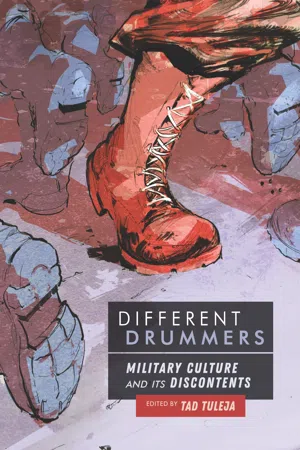
Different Drummers explores the disjunction between organizational solidarity and individual pushback in military organizations, examining how members of the armed forces express ambivalent attitudes about their service. The volume focuses not on antimilitary sentiment but on psychological complexity within a loyal opposition, considering examples of creative insubordination and analyzing the "oppositional positioning" of individuals whose military identity is conflicted.
This multidisciplinary collection brings in the perspectives of scholars from folklore, literary studies, psychology, and media studies, as well as the first-person perspectives of veterans. It includes chapters on the vernacular genres of bodylore, folksong, personal narrative, and legend; literary items like soldiers' memoirs and poetry; the artwork of soldier cartoonists; and accounts of defying the chain of command in the field. Ideally, the goal of military basic training is to replace recruits' focus on their own individuality with an unquestioned devotion to group solidarity. In reality, unit cohesion is constantly challenged by humans clinging obstinately to their non-collective personalities. Different Drummers focuses on those in uniform who feel themselves to be both of the military culture and at odds with it. It shows how these loyal "discontents" find ways of communicating and interacting with others that sometimes defy institutional expectations.
Contributors:
Ron Ben-Tovim, Carol Burke, Richard Allen Burns, Catherine Calloway, James I. Deutsch, Ronald Fry, Angus Kress Gillespie, Christina M. Knopf, Jay Mechling, Matthew David Perry, Mark C. Russell, John Paul Wallis
- English
- ePUB (mobile friendly)
- Available on iOS & Android
eBook - ePub
About this book
Information
Topic
Ciencias socialesSubtopic
Folklore y mitologíaPart I
Weapons of the Weak
1
On the Griping of Grunts
Angus Kress Gillespie
IN THE LATTER YEARS OF WORLD WAR II, A baby-faced artist from Mountain Park, New Mexico, was among the most famous soldiers in the American army. Bill Mauldin, born in 1921 into a military family, joined the US Army in 1940, served with the Forty-fifth Infantry Division in North Africa and Italy, and left the service at the end of the war with a Legion of Merit. His fame rested not on battlefield heroics, but on the cartoons he drew, beginning in February 1944, for the service newspaper Stars and Stripes. In six of these a week, he depicted ordinary combat infantrymen—those we today would call “grunts”—not as the ramrod-stiff stalwarts of regimental fantasy but as tough, disheveled, grumbling, plucky souls making the best they could of terrible situations. Mauldin’s “Up Front” cartoons, often featuring the haggard foxhole buddies Willie and Joe, were enormously popular with American troops, who saw him as their spokesman and defender against an impersonal military system (Severo 2003).
Mauldin did have detractors, especially among the brass whose privileges he sometimes mocked. According to one Mauldin biographer, the cartoonist ran into trouble with three-star general John Lee when Mauldin ridiculed Lee’s management of gasoline supplies (DePastino 2008, 185). And his cartoons so offended another general, George S. Patton, that for a time the survival of “Up Front” seemed in jeopardy. Famously devoted to spit-and-polish discipline, Patton saw in the chronically unshaven Willie and Joe examples of scruffy and potentially insubordinate laxity—griping, “unsoldierly” characters who were bad for morale. They were not as disreputable, perhaps, as the two battle-weary soldiers whom Patton had slapped during the Sicilian campaign—an action that brought him a reprimand from General Eisenhower (Blumenson 1985, 209–210). But to Patton being bearded and sardonic was bad enough, and in 1944 he threatened to block distribution of Stars and Stripes to his troops unless the paper dropped Mauldin. At that point his superiors arranged a meeting between him and the cartoonist, where, it was hoped, some compromise to the morale question might be achieved.
The meeting took place at Patton’s Luxembourg headquarters in February 1945. Mauldin describes it vividly in his memoir The Brass Ring. After greeting Mauldin with disarming cordiality, he writes, Old Blood and Guts quickly launched into a tirade that came close to equating “Up Front” with Bolshevik propaganda. What on earth did Mauldin mean, Patton demanded to know, by drawing “those god-awful things you call soldiers.”
You know goddamn well you’re not drawing an accurate representation of the American soldier. You make them look like goddamn bums. No respect for the army, their officers, or themselves. You know as well as I do that you can’t have an army without respect for officers. What are you trying to do, incite a goddamn mutiny? (Mauldin 1973, 312)
“Sergeant,” he concluded, “I don’t know what you think you’re trying to do, but the krauts ought to pin a medal on you for helping them mess up discipline for us” (315).
Patton then produced copies of two Mauldin cartoons, which he claimed had no discernible purpose but to “create disrespect for officers.” I’ll look at other Mauldin cartoons later in the chapter, but these two provide a useful starting point, as they illustrate nicely why Mauldin’s grumbling grunts—so beloved among GIs themselves—offended old-school disciplinarians such as George Patton.
In the first cartoon, US Army jeeps driving through a liberated French town are being “deluged by flowers, fruit, and wine,” while some American soldiers, “taking advantage of the general confusion,” are “pelting the convoy commander . . . with riper examples of the fruit” (Mauldin 1973, 315). “My, sir,” says a junior officer in the caption, “what an enthusiastic welcome.” In the second (uncaptioned) cartoon, GIs wait to enter a USO show featuring “Girls, Girls, Girls” while officers wait at the stage door, ready to take the girls out after the performance. In both drawings, the overt theme is resentment of rank and the subtext the grunts’ understanding that the hardest workers in the war—the Willies and Joes—are not being given the respect their privations should have earned them.
To Mauldin, this unequal privilege was not only unjust; it was damaging to morale. As he explained to Patton in a remarkable passage, he saw his drawings as in a sense restoring morale, by letting soldiers see that at least somebody sympathized with them and was able to express their grievances in a humorous format. Here’s what he told the general:
The soldier is back in his foxhole stewing about officers and thinking he’s got the short end of the stick in everything, even women . . . He feels there’s been an injustice, and if he stews long enough about this, or about any of the other hundreds of things soldiers stew about, he’s not going to be thinking about his job. All right, sir, he picks up a paper and he reads a letter or sees a cartoon by some other soldier who feels the same way, and he says, “Hell, somebody else said it for me,” and he goes back to his job. (1973, 317)
This explanation was lost on Patton, who retorted, “You can’t run an army like a mob.” But it’s a sensitive and pragmatic explanation, and in proposing that soldiers’ griping provides a restorative or “venting” function, it clarifies a great deal more than Bill Mauldin’s cartoons.
I will return to this idea in a moment, as I examine other examples of World War II grumbling. But let me first clarify the scope of this inquiry by saying what I mean—and what I think Mauldin meant—by “griping.” To George Patton, it seems, any objection to authority opened the road to mob rule. In daily practice, though—and not just in the military—it is worthwhile to distinguish among different forms of complaining, since not all complaints have the same gravity, the same impact on morale, the same ability to relieve frustration, or the same expectation of achieving positive results.
Three Modes of Objection
Mauldin’s cartoons, like many other satires, are a form of objection—a behavior that expresses dissatisfaction with mistreatment. I would suggest separating such objections into three main types: Complaining, Whining, and Griping. I borrow these terms from Robin Kowalski’s work on “positivity in the negative,” where they are used interchangeably along with other terms such as grumbling, venting, and kvetching (2002, 1024). In the military context, it’s useful to see these behaviors not as interchangeable but as distinct forms of objection to official mistreatment. Here is how I would define the distinctions.
The first type of objection, Complaining, I see as a legitimate observation about injustice or stupidity, directed against an authority that is violating its duty to treat one fairly. When soldiers say that they haven’t been paid in three months, that they have filled out paperwork and received no response, or that they have been issued Kevlar vests that do not stop bullets, they are saying that are being victimized by a military system that is failing to provide some benefit that is required by law or at least by commonly accepted understandings of service protocol.
Because it identifies a clear violation of established practice, Complaining of this sort is meant seriously and is expected to be taken seriously. When the complainer mounts such an objection, even though official channels may be slow to respond, he or she still has the right to expect a response. If one is lacking, the complainer may issue a formal complaint with his or her commanding officer or, if that doesn’t work, with higher authorities such as the IG or a congressional representative. For example, when Navy psychologist Mark Russell (chapter 4) “jumps the chain” of command to seek better treatment for returning combat vets, he is engaging in this first type of legitimized Complaining.
Complaining is thus at the “high end” of the objection continuum. At the opposite end—the less legitimate end—fall those objections that I would call Whining. Psychologist Guy Winch draws the distinction clearly: “Complaining involves voicing fair and legitimate dissatisfactions with the goal of attaining a resolution or remedy . . . And when the dissatisfactions we voice are trivial or inconsequential and not worthy of special attention, we are whining.” Experiments have shown that even children as young as three years are able to distinguish between these legitimate and trivial forms of complaining (Winch 2012).
Whining tends to be less focused on violations of justice than on affronts to what the Whiner considers his dignity or comfort. As with Complaining, humor rarely enters the picture here. The whiner, primed to take offense at the least provocation, sees the system’s intrusions on his or her perceived well-being as evidence not of the system’s general oppressiveness but as inconveniences designed especially for him or her. “My shoes are the wrong size.” “Why do I always get guard duty on weekends?” “Sergeant Brady has it in for me.” These are the complaints you hear from a chronic whiner. They are generally not taken seriously either by the brass or by the whiner’s fellow soldiers. Like three-year-olds, they too can see what complaints are trivial.
This is not to say that are trivial to the whiner. Indeed, it’s reasonable to see Whining as a cry of distress. It’s an expression of frustration, fatigue, dissatisfaction, or discontent but one that lacks any stoical acceptance of a common situation and any humorous sense of self-awareness. Whiners do not, like Mauldin’s readers, see that “someone else” has aired their grievances for them. Rather, they feel themselves to be singularly abused and alone. That is why they are shunned rather than embraced.
The third type of objection is what I call Griping. A kind of middle ground between Complaining and Whining, Griping tends to be lighter than the former, more serious than the latter—and yet much more resigned to a difficult situation, so long as someone acknowledges that it is difficult. Thus Griping usually takes the form of “humorous complaining,” a social strategy adopted by those who feel abused and yet are able to accept the abuse as a “benign violation.” This is the paradox of humorous complaining. It comes into play “when something that is perceived to threaten a person’s well-being, identity, or normative belief structure (i.e., a violation) simultaneously seems okay or acceptable (i.e., benign)” (McGraw, Warren, and Kan 2015, 1154).
It is Griping that was represented in Mauldin’s cartoons and that also provided the spark for other creative efforts by the long-suffering dogfaces of World War II. In reviewing some examples of these efforts here, I will show how they reveal the “venting” function that Bill Mauldin himself so clearly defined and that—General Patton’s outrage notwithstanding—may have actually improved American troops’ morale.
Griping: A Closer Look
Griping has probably been a feature of military life for as long as there have been militaries. Soldiers in all centuries and all places have had difficult, often perilous, jobs, and it would be surprising if members of even crack units such as the Roman legions did not at moments give way to venting their frustrations. So it must have been throughout history. During the American Civil War, Southern troops referenced their meager diet of boiled peanuts in the sardonic folksong “Goober Peas.” During World War I, one doughboy, Corporal Adel Storey, illustrated the joking resignation to misery that is characteristic of griping: “It is so muddy,” he wrote to his parents, “that I think I am getting web-footed . . . for we eat in mud, sleep in mud, and live in mud, and if there is anything else to do, I guess we do it in mud too” (cited in Cowing and Cooper 1919, 56–57). At about this same time, Stars and Stripes, then the official newspaper of the American Expeditionary Force, began to include items of humorous dissatisfaction, such as the story “People We’d Like to Meet,” which ran on February 15, 1918. Among the people the writer wanted to pummel for transgressions were “the composer who wrote the Reveille call,” “the contractor who made those field shoes,” and “the packer who concocted that ‘canned Willy’ ” (“People” 1918)—a trio of villains responsible not for injustice but for creating an uncomfortable world that had to be humorously endured.
If the miseries of the trenches created the twentieth century’s first wave of colorful griping, World War II brought this soldierly tradition to full flower. Its ubiquity among GIs is suggested by a 1943 photograph from a Virginia army camp. It shows a sergeant named John Haar registering a grievance in a “machine” called a “Gripe-o-Graf” (Virginia Press Photo 1943). The machine label lists typical sources of grumbling including no dough, no date, bad chow, bad weather, no gas, no butts, no Cokes, no pass, no furlough, hikes, and miscellaneous. The idea behind the machine—in fact a cardboard box decorated with lights and wires—was that a soldier could insert a written criticism into a slot on the top, and the machine would register on a dial the soldier’s degree of dissatisfaction. The machine is not designed to correct the soldier’s problem, only to acknowledge it, and this makes it an appropriate instrument for the “management” of griping. Unlike the whiner, the military griper does not take bad chow personally, and he does not expect the machine ...
Table of contents
- Cover
- Title Page
- Copyright Page
- Dedication
- Contents
- Preface: Oppositional Positioning
- Introduction: The Myth of the Robot Soldier
- Part I: Weapons of the Weak
- Part II: Rattling the Chain of Command
- Part III: Questioning the Patriotic Crusade
- Part IV: Messing with the Narrative
- Contributors
Trusted by 375,005 students
Access to over 1.5 million titles for a fair monthly price.
Study more efficiently using our study tools.
Frequently asked questions
Yes, you can cancel anytime from the Subscription tab in your account settings on the Perlego website. Your subscription will stay active until the end of your current billing period. Learn how to cancel your subscription
No, books cannot be downloaded as external files, such as PDFs, for use outside of Perlego. However, you can download books within the Perlego app for offline reading on mobile or tablet. Learn how to download books offline
Perlego offers two plans: Essential and Complete
- Essential is ideal for learners and professionals who enjoy exploring a wide range of subjects. Access the Essential Library with 800,000+ trusted titles and best-sellers across business, personal growth, and the humanities. Includes unlimited reading time and Standard Read Aloud voice.
- Complete: Perfect for advanced learners and researchers needing full, unrestricted access. Unlock 1.5M+ books across hundreds of subjects, including academic and specialized titles. The Complete Plan also includes advanced features like Premium Read Aloud and Research Assistant.
We are an online textbook subscription service, where you can get access to an entire online library for less than the price of a single book per month. With over 1.5 million books across 990+ topics, we’ve got you covered! Learn about our mission
Look out for the read-aloud symbol on your next book to see if you can listen to it. The read-aloud tool reads text aloud for you, highlighting the text as it is being read. You can pause it, speed it up and slow it down. Learn more about Read Aloud
Yes! You can use the Perlego app on both iOS and Android devices to read anytime, anywhere — even offline. Perfect for commutes or when you’re on the go.
Please note we cannot support devices running on iOS 13 and Android 7 or earlier. Learn more about using the app
Please note we cannot support devices running on iOS 13 and Android 7 or earlier. Learn more about using the app
Yes, you can access Different Drummers by Tad Tuleja in PDF and/or ePUB format, as well as other popular books in Ciencias sociales & Folklore y mitología. We have over 1.5 million books available in our catalogue for you to explore.