1
Friction in the Educational Marketplace
I, Steve, drive past the state capitol toward the Michigan State campus, where I teach a composition course filled with Chinese international students. One of my Taiwanese colleagues jokes that an outsider visiting these basic writing courses on the MSU campus might think they were outside the United States. As I continue down the Michigan Avenue corridor past strips of dollar stores and boarded-up buildings, I pass a modern urban apartment complex with a Chinese character on the side of the rental office. Disrupting the midwestern landscape, the character jia (家), or “home,” suggests the complex ways notions of home are being remixed on the local campus and in the surrounding area. This sign in the middle of a rustbelt town is disruptive, with the tensions indexing how the university and local community are entangled in a globalizing marketplace. Michigan State University is a major land-grant institution located in the heart of the Midwest in the state’s capitol region. The college has grown into a sprawling campus over a 153-year history, with its core values centered on service and engagement in the wider community and the state of Michigan. Historically, the college has sought to provide educational opportunities to the local community, especially to those from the farming and working classes. Over the past ten years, however, in response to declines in state funding and in the face of sharply decreasing number of high-school graduates in the state (National Center for Education Statistics 2013), the student demographic has begun to shift. While in 2006 the number of Chinese international students at Michigan State was 2 percent, by 2014 the figure had increased to 13 percent (MSU Office of the Registrar 2014). These rapid changes are transforming the local cultural, economic, and linguistic landscape. Evidence of these transformations is found across campus and along the main city street dividing the university and the wider community, where one finds a wide array of Chinese posters, flyers, bookstores, educational centers, hot-pot restaurants, apartments, and oriental markets. These constellations are entangled with the academic market, where language and literacy are key forms of capital. As a writing instructor, I am densely enmeshed with students in networks, or knotworks, of activity.
Arriving in the parking lot across from the Agricultural Engineering Hall, I pull up directly in front of a yellow sports car driven by one of my students. I enter the overheated class filled with Chinese students, three African Americans, a Nigerian, and one Latino from Texas. With most of the background discussion before class in Chinese, I try to imagine how to balance the needs of the different populations. The unevenness within my own classroom indexes wider messy and highly uneven shifts at the university as instructors, departments, and units adjust to a new set of dynamics. At the center of these tensions are questions about who changes, how much, and to what effect. These struggles are unfolding in moments of everyday practice as the influx of students is destabilizing the everyday norms of campus life. Anna Lowenhaupt Tsing (2005) refers to friction as the process of messy and unequal encounters across differences through which cultural forms are continually coproduced. As she further argues, the metaphorical image of friction reminds us that “heterogeneous and unequal encounters can lead to new arrangements of culture and power” (5). Indeed, the Chinese students’ presence on the MSU campus has been accompanied by increasing friction between the students and the university administration. In this chapter, I attend to how these messy and unequal encounters mediate how the world grant university is being invented.
Grounded in our analytic frame is the conception of the university as a mobility system (Nordquist 2017; Urry 2007) mediating who moves, how they move, when they move, and to what effect. This analytic optic foregrounds how the university disciplines the traversals of international students as students are regulated through visas, language requirements, tuition fees, residential-hall living arrangements, and grading policies. However, I further attend to how the transnational movements of the students are in similar fashion reshaping the university as part of a complex and dynamic struggle. Aiwa Ong (1999) writes that transnationalism refers to moving through space and across lines “as well as the changing nature of something” (4). In this chapter, I look at the changing nature of the social, cultural, and linguistic landscape on the MSU campus. Grounded in our mobile-literacies framework is a shift from spatial container models toward a less bounded approach, with the university conceptualized as shot through with multiple and competing trajectories knotted into everyday activities. As Stephen J. Rosow (n.d.) argues, higher education is not an ivory tower walled off from the uncertainties, tensions, complexities, and ambiguities of economic, social, and political life. Rather, the university exists in deeply interwoven contexts with different intersecting forces comprising multiple positions, ideologies, and motives of diverse actors. Turning to the knotty nature of this activity, this analysis uncovers wider sets of contradictions, and things turning up in unexpected places. Leander and Sheehy (2004) argue that the purpose of a spatial analysis is not to reduce space to a fixed map but instead to show how space is always changing and to question how, when, and into what. Posing these key questions about the higher education landscape, such moves allow us to glimpse wider power geometries (Massey 1994) and the politics of mobility.
Attending to the convergence of multiple spatial trajectories, I survey these complex entanglements in and across local, regional, national, and international scales of activity. I wish to emphasize that the concept of scale (Nespor 2004) is not imagined as static but as dynamic, emergent, constructed, and bound up in a wider struggle. To offer a fine-grained account of this globally complex system, I draw on data gathered through linguistic and semiotic landscaping (Blommaert 2013); the collection of artifacts (posters, flyers, websites, white papers, social media posts); participant observation on university committees, meetings, and activities and events aimed at international students (full-day workshops, documentaries, coffee hours); and semistructured interviews with approximately twenty-five administrators, instructors, and students. Assembling this data, I sorted and traced the networked connections among people, practices, objects, and locations to identify relations between near and distant social spaces. Through tracing these networks, or knotworks, I uncovered forces mediating the politics of mobility (Cresswell 2010), or the rhythms, velocities, routes, turbulence, and sources of friction. In making these moves, I first turn to a broad-brush sketch of the restructuring of the linguistic and social landscape off campus in the local Lansing economy. I then focus more fully on structural shifts on the MSU campus as it repositions itself both at home and abroad, with attention to transformations in missions, policies, administrative and departmental units, and, finally, classroom practices.
Globalizing the Local Landscape
Entangled in a globally complex network, or knotwork, the influx of international students is impacting the shifting structures of the state. The economy in the state of Michigan has been struggling due to the decline of manufacturing and automotive industries. In an effort to retool, the local capitol area has formed a consortium identified as Global Lansing. One of the aims of this group is to “utilize the valuable international resources and talent available in the greater Lansing area including international students [emphasis added], businesses, and international relationships” (LEAP 2015). In this manner, the city and state are moving to reposition themselves within a wider global marketplace. The state is moreover leveraging international investment through the Michigan EB-5 program, which is intended to stimulate job creation and capital investment from outside the United States in exchange for permanent residence for participants, with more than 25 percent of all inquiries about the program originating from local Chinese students. Directly stemming from this program, a pair of Chinese international students have been involved in the creation of Port Lansing, or a foreign trade zone, at the Capital Regional International Airport to provide a competitive advantage to companies doing international commerce. The port entry is intended to make it simpler for goods to clear US customs, with reduced, deferred, and eliminated customs fees. The Port Lansing website includes a picture of the city pinned to a world map and the tagline calling it a “Gateway to the World.” Contributing to the construction of this space, the international students located investors from China and have been involved with the architectural plans for two cargo spaces estimated at $2.5 million total. In this fashion, the movement of people and things across borders is reshaping the local landscape.
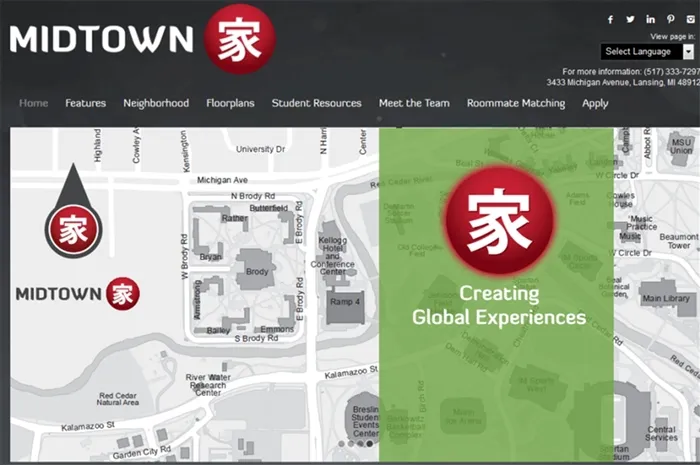
Further evidence of these transformations is an urban mixed-use residential and commercial development project on a lot purchased from the county land bank. Mentioned at the beginning of this chapter, the symbol on the rental office, 家 (jia/home), serves as a linguistic branding strategy further articulated in the marketing materials.
Part of a global strategic plan, the vision is to rebrand the region as a new cosmopolitan center. Further, on the website is a map (Figure 1.1) illustrating the proximity of the apartment complex to the MSU campus, with a Chinese character 家 on one side of street (the housing complex) and again on the other side (the MSU campus), under which is written the slogan “Creating Global Experiences.” The map is an act of placemaking reconfiguring the relationship between the university and the global economy. In this context, the map is a political and interpretative act disrupting current material and cognitive maps of the local physical and social landscape. Central to these moves is a commodification of culture with a cosmopolitan sense of place, or “home,” densely intertwined with marketplace forces. The merging of these geographic and social spaces indexes ways the university is increasingly entangled in a wider economic restructuring mediated by flows of actors, objects, and ideologies across a transnational social field.
The World Grant University
In this section, I continue to explore these complex and messy entanglements and the ways that marketplace and neoliberal logics are bound up in the reconstruction of the MSU campus. In parallel with the urban developers, the university is engaged in moves to reposition itself as it shifts from a land-grant to a world grant university. This is represented as an effort to “establish a new twenty-first century framework” (Simon 2013, 49) that extends the university’s “traditional values” of community engagement to a global frame. As officially articulated by the university president, central to this strategic shift is the creation of global linkages to infuse international and comparative perspectives throughout the mission of higher education. An extension of the ideals of the land grant created under the Morrill Act, the world grant ideal is an effort to “reinvigorate the public trust” (Simon 2010, 42) and expand the notion of the common good on a global scale. In a white paper articulating these basic tenets, the university president (Simon 2009) says, “At its core, the World Grant Ideal is not about dominance or status. . . . It is about helping people and communities—local, national, ad global—to realize their dreams and to make their dreams bigger” (15). Motivated by a belief in the common good, the aim is to create a “sustainable global prosperity that goes beyond the finances and fortunes of any single institution, state, or nation” (19).
Forced to confront state disinvestment in higher education, however, this vision of education as a public good conflicts with wider shifts toward a degree as a private good measured in terms of market logics (Giroux 2010). Evidence of these contradictory knots are found at administrative and structural levels at the university, including the president’s establishment of the China Initiative, which targets the People’s Republic of China (PRC) as a strategic partner. Central to this initiative is the Office of China Programs, which is tasked with expanding the university’s presence, alliances, and outreach in the PRC. Framed squarely around academic capitalism, a white paper found on its site argues for strategic gl...