eBook - PDF
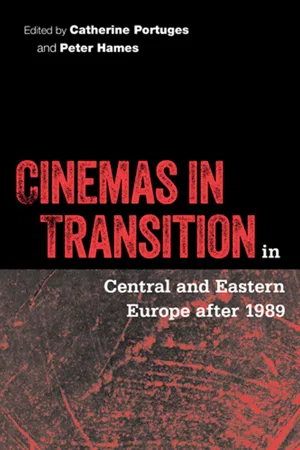
Cinemas in Transition in Central and Eastern Europe after 1989
- English
- PDF
- Available on iOS & Android
eBook - PDF
Cinemas in Transition in Central and Eastern Europe after 1989
About this book
The cinemas of Eastern and Central Europe have been moving away from earlier Cold War perspectives and iconographies toward identifications more closely linked to a redefined Europe. Cinemas in Transition in Central and Eastern Europe after 1989 studies the shifts in the dynamics between film production, exhibition, and reception in Eastern bloc countries as they moved from state-sponsored systems toward the free market.
The contributors and editors of this exciting volume examine the interrelations between thematic, aesthetic, and infrastructural changes; the globalization of the international cinema marketplace; and the problems and promises arising from the privatization of national cinemas.
Cinemas in Transition in Central and Eastern Europe after 1989 also addresses the strategies employed for preserving national cinemas and cultures through an analysis of films from the Czech and Slovak republics, the former German Democratic Republic, Hungary, Poland, Romania, Ukraine, and the former Yugoslavia. The study provides a picture of Eastern European cinema at a critical juncture as well as its connections to the emergent world of transnational media.
Contributors include Barton Byg, Alexandra Foamente, Andrew Horton, Dina Iordanova, Ewa Mazierska, Bohdan Y. Nebesio, and Bogdan Stefanescu,
The contributors and editors of this exciting volume examine the interrelations between thematic, aesthetic, and infrastructural changes; the globalization of the international cinema marketplace; and the problems and promises arising from the privatization of national cinemas.
Cinemas in Transition in Central and Eastern Europe after 1989 also addresses the strategies employed for preserving national cinemas and cultures through an analysis of films from the Czech and Slovak republics, the former German Democratic Republic, Hungary, Poland, Romania, Ukraine, and the former Yugoslavia. The study provides a picture of Eastern European cinema at a critical juncture as well as its connections to the emergent world of transnational media.
Contributors include Barton Byg, Alexandra Foamente, Andrew Horton, Dina Iordanova, Ewa Mazierska, Bohdan Y. Nebesio, and Bogdan Stefanescu,
Frequently asked questions
Yes, you can cancel anytime from the Subscription tab in your account settings on the Perlego website. Your subscription will stay active until the end of your current billing period. Learn how to cancel your subscription.
At the moment all of our mobile-responsive ePub books are available to download via the app. Most of our PDFs are also available to download and we're working on making the final remaining ones downloadable now. Learn more here.
Perlego offers two plans: Essential and Complete
- Essential is ideal for learners and professionals who enjoy exploring a wide range of subjects. Access the Essential Library with 800,000+ trusted titles and best-sellers across business, personal growth, and the humanities. Includes unlimited reading time and Standard Read Aloud voice.
- Complete: Perfect for advanced learners and researchers needing full, unrestricted access. Unlock 1.4M+ books across hundreds of subjects, including academic and specialized titles. The Complete Plan also includes advanced features like Premium Read Aloud and Research Assistant.
We are an online textbook subscription service, where you can get access to an entire online library for less than the price of a single book per month. With over 1 million books across 1000+ topics, we’ve got you covered! Learn more here.
Look out for the read-aloud symbol on your next book to see if you can listen to it. The read-aloud tool reads text aloud for you, highlighting the text as it is being read. You can pause it, speed it up and slow it down. Learn more here.
Yes! You can use the Perlego app on both iOS or Android devices to read anytime, anywhere — even offline. Perfect for commutes or when you’re on the go.
Please note we cannot support devices running on iOS 13 and Android 7 or earlier. Learn more about using the app.
Yes, you can access Cinemas in Transition in Central and Eastern Europe after 1989 by Catherine Portuges, Peter Hames, Catherine Portuges,Peter Hames in PDF and/or ePUB format, as well as other popular books in Media & Performing Arts & Eastern European History. We have over one million books available in our catalogue for you to explore.
Information
Table of contents
- Contents
- Acknowledgments
- Introduction - Peter Hames and Catherine Portuges
- 1. Bulgarian Cinema: Optimism in Moderation - Dina Iordanova
- 2. The Czech and Slovak Republics: The Velvet Revolution and After - Peter Hames
- 3. Is There Still an East German Cinema? - Barton Byg
- 4. Memory and Reinvention in Post-Socialist Hungarian Cinema - Catherine Portuges
- 5. Searching for Survival and Meaning: Polish Film after 1989 - Ewa Mazierska
- 6. Narratives of the Emerging Self: Romania’s First Years of Post-totalitarian Cinema - Bogdan Ştefănescu and Sanda Foamete
- 7. The First Five Years with No Plan: Building National Cinema in Ukraine, 1992–1997 - Bohdan Y. Nebesio
- 8. Cinema Haunts My Memory: Filmmaking in the Former Yugoslavia - Andrew Horton
- Contributors
- Index