Using government documents, archives, and local histories, Simmons has painstakingly separated the often repeated and often incorrect hearsay from more accurate accounts of the Ute Indians.
- English
- ePUB (mobile friendly)
- Available on iOS & Android
eBook - ePub
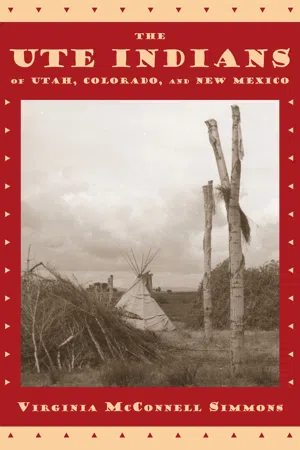
Ute Indians of Utah, Colorado, and New Mexico
About this book
Information
Publisher
University Press of ColoradoYear
2001Print ISBN
9780870816475
9780870815713
eBook ISBN
9781607321163
1

Mother Earth, Father Sky
In the Ute Indians’ traditional view of the natural world, Father Sky created the sun, moon, stars, and Earth. Mother Earth provides what is needed by those who show reverence and respect. For Utes, there was a vast and varied land—sometimes gentle and sometimes severe—where they survived by living respectfully in harmony with their environment, whatever it might be.
Before there were people, Senawahv, the Creator, made buffalo and deer, berries and piñon nut trees, and everything the people would need to live. Then he cut up sticks and put them in a bag. He meant for the sticks to be different peoples to whom he would give equal portions of the land and its good things, but Coyote, the curious trickster, opened the bag to see what was inside, and people scrambled forth in disorder, speaking many tongues. Senawahv looked inside and saw the remaining people, the Utes, and he declared that they would be so brave and strong that they would be able to defeat all others.1
The land Senawahv gave to the Utes encompassed part of the eastern Great Basin in Utah; a large portion of the Colorado Plateau in Utah as well as all of it in Colorado; all of the Rocky Mountains within Colorado, north to the Yampa River, and within northernmost New Mexico; and the eastern edge of the mountains where the High Plains abruptly meet them, from Colorado’s South Platte River south to New Mexico’s Mora River. The topography of the mighty sweep of land looked much as it had when humans first occupied it about 10,000 or 12,000 years ago.
Legends notwithstanding, geologists tell us that the land as we know it was billions of years in the making. The Ancestral Rockies go back hundreds of millions of years. Later, a great inland sea, dinosaurs, and forests of giant ferns came and went, followed eventually by the building of today’s Rocky Mountains, the “shining mountains,” about sixty million years ago. Next came enormous volcanic activity, further changing the face of the land and leaving basalt and lava flows in the Great Basin, northern New Mexico, and south-central Colorado.
Later, the Great Ice Age descended on the Northern Hemisphere. Although the ice cap did not extend as far south as Utah and Colorado, glaciers covered the mountains. During this time, evaporation lowered sea levels. In the far North, a previously drowned land bridge permitted the migration of Paleo-Indians, who entered the North American continent and hunted megafauna with atlatls and spears.
As the climate warmed again, the land bridges closed. Glaciers retreated, carving and polishing the mountains and depositing moraines of boulder and gravel. Melting water filled lakes, the largest of which was Utah’s Lake Bonneville—about 150 miles wide and 350 miles long and covering all of western Utah. When its natural dam in Idaho gave way, Lake Bonneville drained and left broad, dry terraces and remnant bodies of water such as briny Great Salt Lake, which dwarfs all other remnants, and Sevier Lake. Where sufficient fresh water from the mountains on the east reached a lake, it was fresh, as is the case with Utah Lake, which, in turn, empties into Great Salt Lake through the Jordan River.
The Great Basin, where Lake Bonneville was located, is part of an immense alkaline desert, reaching from Utah’s Wasatch Range on the east to the Sierra Nevada on the west. The basin occupies most of the western half of Utah, nearly all of Nevada, and portions of eastern California, Oregon, and Idaho. The only river outlet is Nevada’s Humboldt. The province has low annual precipitation—five inches or less—with constant dusty winds, searing summers, and bitter winters. This inhospitable demeanor is relieved by north-south–trending ranges of hills and mountains that sustain animal life and vegetation, although in Utah most of these hills and mountains in the basin are too short and low to provide for many people.
Nevertheless, the hunter-gatherers of this province—members of what is called the Desert Culture—survived even in recent history by carefully observing the seasons, weather, and available resources of the Great Basin. They moved about in small, territorial groups, and they traveled light, in constant search of food—lizards, grasshoppers, crickets, ants, larvae, rats, mice, snakes, prairie dogs, jackrabbits, and cottontails to supplement grass seeds and roots. In historic times, the occupants were Western Shoshones and Gosiutes (Goshutes), or “Digger Indians” as some have called them. Despite the poverty of their natural resources, through remarkable ability these hunter-gatherers survived in a hostile environment.
Ancestors of today’s Utes probably lived at one time in the basin’s deserts and later traveled there from time to time. In the historic period their western boundary ran southwest from the Jordan River around Utah Lake and west of Sevier Lake before angling southeast. Although indefinite, the southern boundary in Utah is thought to have been near Beaver or a little farther north at what is called the “Rim” between Kanosh and Cove Fort.2
Utah’s Utes enjoyed the largesse of the wetlands around lakes and the streams feeding into them, especially the rich environs of Utah Lake, where Provo now stands. Here were reeds and rushes, cattails, willows, grasses and sedges, numerous forbs and roots, fish in great abundance, geese, ducks, birds’ eggs, beaver, muskrats, badgers, skunks, deer, and rabbits—a cornucopia.
The Utes also favored the fringe of the Wasatch Front—at elevations of 4,000 to 5,000 feet—where streams exited. Here were grasses, sagebrush, willows, alder, cottonwoods, chokecherries, serviceberries, some bison, pronghorn antelope, mule deer, beaver, sage hens, and coyotes, among many other flora and fauna. Up the slopes, moving through life zones from the Upper Sonoran to Alpine, the mountains offered the Utes a vertical buffet, limited only by the seasons. There were deer, elk, mountain lions, black bears, mountain sheep, fox, martens, squirrels, and other small species. On the mountain slopes piñon pines (called cedars in Utah), junipers, shrubby maple, ponderosas, bristle cones, aspens, fir, and spruce provided firewood, lodgepoles, and pine nuts. Everything one could want for food, shelter, clothing, medicines, and tools was at hand near the banks of Provo Canyon, the Spanish Fork, the Sevier River, Corn Creek, and the slopes of the Wasatch. The name of this range means “mountain pass,” and routes offered by passes and river canyons were another of the area’s advantages.
The north-south–trending Wasatch Range, whose highest peaks are 12,000 feet above sea level, forms a barrier when storms blow eastward across the Great Basin. Heavy precipitation falls on the mountains, up to two hundred inches of snow in winter, for example, causing a rain shadow to the east. In the vast uplift of the Colorado Plateau Province, east of the Wasatch, are component plateaus of various heights, some of which rise high enough to capture rain and snow and are crowned with forests and lakes, game, and abundant vegetation. Fish Lake is the largest of the bountiful plateau lakes that attracted the Indians.
Beyond the Wasatch a few mountains are found. To the north, the Uinta Range (near the pine canyons), reaching 13,000 feet—even higher than the Wasatch—offers good resources, but dry conditions at low elevations reduced the desirability of the canyons and foothills for prolonged occupation by Indians. In southeast Utah are found the isolated dome ranges of the La Sals (called the Elk Mountains by some early people), the Blue Mountains (also known as the Abajos, meaning “low”), and the Henry Mountains, providing welcome oases in the country lying east toward the Colorado border. The La Sals are the second-highest peaks in Utah. Bison occurred in the valleys as well as in the Uinta Basin, but not in large numbers.
On the whole, this was a hazardous region for foot travelers, who found little water, vegetation, and other resources. The Uinta Basin has a few rivers, the most important being the Strawberry, Uinta, Whiterocks, and Duchesne, the last-named emptying the water of them all into the Green River (once called the Seedskeedee-Agee after the prairie chickens of the area). South of the Uinta Basin lies the Tavaputs Plateau, meaning “the land of the sun.” This plateau is a badlands of barren, eroded cliffs, carrying some bunchgrass but little else. South of it is the sweeping, nearly waterless Castle Valley of Emery County, a land of dazzling escarpments best enjoyed from the security of an air-conditioned automobile and a modern highway. Summer temperatures of 110 degrees are not uncommon in this region. Coming off the San Rafael Swell, which rises here, is a muddy river, the San Rafael, that empties into the Green. Clearer and more reliable is the Fremont River, but between the two lie miles of sand and barren, deeply eroded cliffs resembling multihued layer cakes with few streams or springs. Around Capitol Reef, the rocks in Waterpocket Fold provided natural pockets of rainwater, or “tanks,” for those few nomads who penetrated this rugged area.3
Nearly waterless but awesome, the “standing up country” of Canyonlands lies between the plateau’s deserts and the southeastern corner of Utah. Getting from one side to the other through the tangle of eroded needles, domes, crevices, arches, and impassable chasms once presented a seemingly impossible challenge, but some tough people were able to do so. Utes, Southern Paiutes, and Navajos were able to reach and traverse the Colorado River, sometimes using crude rafts. The Spanish Domínguez-Escalante expedition was directed by Indians to the Ute Ford, later called the Crossing of the Fathers, now under Lake Powell. Upriver, just north of Moab, was a commonly used ford, and north of Canyonlands the Green could be crossed about three miles above the town of Green River, Utah, at a point called Ute Crossing. The river could also be forded about two miles below the mouth of the Duchesne River, as well as six miles above Jensen, near Dinosaur National Monument—where Domínguez and Escalante forded with the guidance of a Ute—as well as at a point south of Flaming Gorge.4
There are no indications that Utes or other aboriginal peoples had an inkling about the Mesozoic giants sleeping in the earth near the Green River at Dinosaur Monument or in other locations like the red rocks near present-day Morrison, Colorado, although the Utes often camped there and enjoyed soothing baths in the mud springs. Further, no evidence shows that the fossil fuels of northeast Utah and northwest, southwest, west-central, and central Colorado were used, with the exception of an oil seep near Cañon City, Colorado, where the black ooze relieved injuries, aches, and pains of Utes camping in a nearby cave. The Utes were unaware of the wealth of coal in Carbon County, Utah, and in Colorado’s Moffat, Routt, Gunnison, Fremont, and Las Animas Counties. Undiscovered were the oil and gas of Utah’s Uintah and San Juan Counties, Colorado’s La Plata and Montezuma Counties, and New Mexico’s San Juan County.
The crest of the Uintas, west of Dinosaur National Monument, was a flexible northern boundary of Ute country, and the beautiful Yampa River, which joins the Green in the canyons of the monument, provided a similar border farther east. Sometimes called the Bear River in early days, the Yampa River’s name refers to a plant of the area, whose roots were a favorite food of Utes and Comanches, the latter coming to the area from the north in pre-horse times. Both tribes had groups called Yamparikas, “yampa eaters.” North of the Yampa is Brown’s Park or Hole, part of Colorado’s Washakie Basin, where the Utes’ enemies from the north made even Senawahv’s favorites cautious and scarce. The Little Snake River east of Brown’s Park offered a wide valley where Utes and hostile neighboring tribes from Wyoming often fought during hunting excursions.
Most of northwest Colorado consists of semiarid steppe, broken up by the Roan Plateau, which includes the stark Book Cliffs, and the Axial and Piceance Basins. Higher elevations are capped with forests like those on the White River Plateau, better known as the Flattops. From the Flattops down to the Green River flows the White River, or Smoking River as the Utes called it. It was an important pathway. The White River’s confluence with the Green is at the ford just south of the mouth of the Duchesne in the Wonsits Valley (meaning “antelope”), so the neighborhood was a crossroad of trails traveled by early Indians and subsequently by trappers, traders, and explorers. In west-central Colorado the Colorado River was an obstacle to those who needed to cross it, but a few fords, known to Indians, could be found above Westwater Canyon, at Grand Junction, and near DeBeque.
Dinosaur beds along the Colorado River contain many fossils, whereas the colorful sandstone cliffs and canyons of Colorado National Monument, prominent west of Grand Junction, contain petrified wood—a potential subject for Indian legends. The mighty forces of the Gunnison and Colorado Rivers join at Grand Junction. Between the two rivers looms the great hulk of Grand Mesa with its thick forests, lakes, and game of many kinds—a favorite haunt of aboriginal peoples and modern hunters alike. To the south is the long uplift of the Uncompahgre Plateau (meaning “red water source” or “lake”). North of the plateau lies Unaweap Valley (“red canyon”), and southwest is the Paradox Basin of uranium mining fame, with the Dolores River flowing through it. The terrain from this basin rises through slick rock and piñon-juniper country to meet the La Sals, Canyonlands, and the sage plains around the Abajos in Utah.
The far southwest corner of Colorado is dominated by dry washes, Sleeping Ute Mountain, countless ancient stone structures, and Mesa Verde, where Anasazis (Ancestral Puebloans) dwelled before Ute people occupied the area. The small amount of flowing water in the Four Corners area flows down the sandy beds, primarily in the Mancos River, McElmo Creek, and Montezuma Creek—all seeking the San Juan River in northwest New Mexico. The San Juan River was an indefinite southern boundary of the early Utes. To the east along the state line is the San Juan Basin, where oil and gas are now extracted, as they are also in the Four Corners area. Through the San Juan Basin flow the San Juan River’s tributaries—the Piedra, Navajo, Los Piños, Florida, Animas, and La Plata—all of which begin in Colorado’s snowy mountains.
Skirting the Navajos’ Gobernador region, Ute territory continued to the southeast—down the Chama River and sandy hills, pastel cliffs, and forested, yellow-soiled Tierra Amarilla country to the Rio Grande and the heart of the northern Pueblo Indian region in New Mexico. Northward on both sides of the Rio Grande, piñon-juniper woodland ascends the Taos Plateau to Colorado’s San Luis Valley and New Mexico’s Taos Valley and Red River area. In this area the Rio Grande cuts a deep gorge, an obstacle to east-west travel, although Indians were able to create footpaths down the steep embankments to cross the river. To the east is the Sangre de Cristo Range, containing New Mexico’s highest peaks and some of Colorado’s 14,000 footers.
North and northeast of the San Juan Basin, relatively low hogbacks and hills of sandstone and shale tilt toward the heady heights of the mineral-rich La Plata and San Juan Mountains. In these 13,000- and 14,000-foot volcanic peaks lay treasures of gold and silver that would lure hordes of white newcomers to usurp the Indians’ land. The silvery San Juans, as they are sometimes called, are so rugged and beautiful that it is impossible to suppose the Utes ignored aesthetics as they went about their rounds of hunting and gathering. Surely they loved these mountains passionately in autumn, in “Indian summer,” when golden aspen leaves framed jagged summits, gleaming with their early snow, and the sun, shining out of a cerulean heaven, still breathed warm on Ute shoulders. When it was time to descend, it was not far to the Uncompahgre Valley to the north or the Animas to the south, both favorite winter campgrounds.
To the north of the San Juans are the West Elk and the Elk Mountains—which should not be confused with Utah’s pseudonymous La Sals—offering outstanding hunting and, unfortunately for the Utes, more seductive minerals that would bring whites. Knee-deep wildflowers bloom in profusion, turning valleys and woodlands into magnificent gardens in summer while scrub oak and aspens weave Persian carpets in fall. The breathtaking Elk Mountains, volcanic like the San Juans, lie between the Gunnison Valley on the south and the famous Maroon Bells on the north. Colorado’s Rockies were rich in plant and animal resources similar to those in Utah’s high elevations.
To the east in the mineral belt are the soaring Sawatch Range and the Mosquito Range. Several of Colorado’s summits over 14,000 feet lie in these two groups, including Mount Elbert, the highest. Altitude would prove no deterrent to gold and silver miners, though. Between the Sawatch and the Mosquitoes are the headwaters of the Arkansas River, flowing south for several miles in a valley formed by a deep fault before it turns east toward the Royal Gorge and the Great Plains.
This fault, called the Rio Grande Rift, continues south from the Upper Arkansas River through the San Luis Valley and New Mexico, funneling the waters of the Rio Grande for much of this distance. The semiarid climate and cold winters of the San Luis Valley belie its value as good hunting land for bison, deer, and pronghorn antelope in former times, and wetlands in its basin attracted great numbers of waterfowl. Not only Utes but also Pueblo peoples visited this area and held it sacred. Tewa people believed one of the lakes was their place of origin, and Navajos made pilgrimages to Blanca Peak, rising to over 14,000 feet elevation in the Sangre de Cristos, as it was their sacred mountain of the east. The San Juan Mountains lie on the west side of the San Luis Valley, and the high, ragged Sangre de Cristo Range extends down the east side and into New Mexico as far as Santa Fe.
Three other large mountain parks, like bowls in a sea of mountains, are found in Colorado. Better watered but smaller than the San Luis Valley are South Park (or Bayou Salado), Middle Park, and North Park, all prized as hunting grounds by the Utes. From North Park, the North Platte flows toward Wyoming, creating a thoroughfare for Utes and enemy Plains tribes. In addition to many bison, deer, elk, and pronghorns in these parks, beaver awaited trappers. The streams also contained flakes of gold, promising veins and lodes to prospectors who one day would swarm into the parks and their surrounding peaks. To the west of South Park is the Mosquito Range. The Gore and Park Ranges bound the west sides of Middle Park and North Park.
To the east of the Sangre de Cristos in Colorado are the Wet Mountains, which drop off to grassy foothills and the Great Plains. In similar fashion the Front Range separates the northern two-thirds of Colorado’s mountains from the plains, which begin at elevations of about 4,000 to 6,000 feet about sea level—approximately the same as the base of the Wasatch Front, with similar natural resources, far to the west. Hogbacks of sandstone, like those at Red Rocks near Denver, were tilted to the west as the Rockies rose. With the exception of these hogbacks, the eastern foothills in early times were well supplied with grasses, yucca, cacti, oak thickets, wild turkeys, game, ...
Table of contents
- Cover Page
- Title Page
- Copyright Page
- Dedication
- Contents
- Illustrations
- Maps
- Preface
- Acknowledgments
- The Ute Indians of Utah, Colorado, and New Mexico
- 1 Mother Earth, Father Sky
- 2 The Núu-ci
- 3 The Coming of the White Man (1598–1821)
- 4 Trappers, Traders, and Transition (1810–1846)
- 5 On a Collision Course (1846–1858)
- 6 Sherman’s Solution: Freeze and Starve (1859–1867)
- 7 Attempts to Create Reservations (1868–1874)
- 8 Beating Plowshares into Swords (1875–1881)
- 9 The Unraveling Begins (1882–1895)
- 10 Disorder and Chaos (1896–1915)
- 11 From the Ashes: Today’s Ute Indians
- Notes
- Bibliography
- Index
Trusted by 375,005 students
Access to over 1.5 million titles for a fair monthly price.
Study more efficiently using our study tools.
Frequently asked questions
Yes, you can cancel anytime from the Subscription tab in your account settings on the Perlego website. Your subscription will stay active until the end of your current billing period. Learn how to cancel your subscription
No, books cannot be downloaded as external files, such as PDFs, for use outside of Perlego. However, you can download books within the Perlego app for offline reading on mobile or tablet. Learn how to download books offline
Perlego offers two plans: Essential and Complete
- Essential is ideal for learners and professionals who enjoy exploring a wide range of subjects. Access the Essential Library with 800,000+ trusted titles and best-sellers across business, personal growth, and the humanities. Includes unlimited reading time and Standard Read Aloud voice.
- Complete: Perfect for advanced learners and researchers needing full, unrestricted access. Unlock 1.5M+ books across hundreds of subjects, including academic and specialized titles. The Complete Plan also includes advanced features like Premium Read Aloud and Research Assistant.
We are an online textbook subscription service, where you can get access to an entire online library for less than the price of a single book per month. With over 1.5 million books across 990+ topics, we’ve got you covered! Learn about our mission
Look out for the read-aloud symbol on your next book to see if you can listen to it. The read-aloud tool reads text aloud for you, highlighting the text as it is being read. You can pause it, speed it up and slow it down. Learn more about Read Aloud
Yes! You can use the Perlego app on both iOS and Android devices to read anytime, anywhere — even offline. Perfect for commutes or when you’re on the go.
Please note we cannot support devices running on iOS 13 and Android 7 or earlier. Learn more about using the app
Please note we cannot support devices running on iOS 13 and Android 7 or earlier. Learn more about using the app
Yes, you can access Ute Indians of Utah, Colorado, and New Mexico by Virginia McConnell Simmons in PDF and/or ePUB format, as well as other popular books in History & North American History. We have over 1.5 million books available in our catalogue for you to explore.