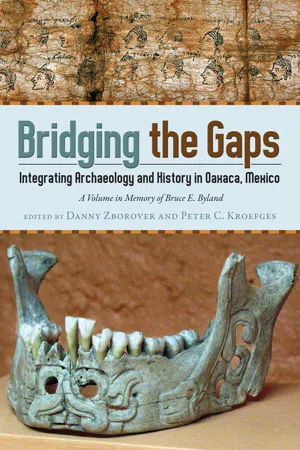
Bridging the Gaps: Integrating Archaeology and History in Oaxaca, Mexico does just that: it bridges the gap between archaeology and history of the Precolumbian, Colonial, and Republican eras of the state of Oaxaca, Mexico, a cultural area encompassing several of the longest-enduring literate societies in the world.
Fourteen case studies from an interdisciplinary group of archaeologists, anthropologists, ethnohistorians, and art historians consciously compare and contrast changes and continuities in material culture before and after the Spanish conquest, in Prehispanic and Colonial documents, and in oral traditions rooted in the present but reflecting upon the deep past. Contributors consider both indigenous and European perspectives while exposing and addressing the difficulties that arise from the application of this conjunctive approach.
Inspired by the late Dr. Bruce E. Byland's work in the Mixteca, which exemplified the union of archaeological and historical evidence and inspired new generations of scholars, Bridging the Gaps promotes the practice of integrative studies to explore the complex intersections between social organization and political alliances, religion and sacred landscape, ethnic identity and mobility, colonialism and resistance, and territoriality and economic resources.
eBook - ePub
Bridging the Gaps
Integrating Archaeology and History in Oaxaca, Mexico; A Volume in Memory of Bruce E. Byland
- English
- ePUB (mobile friendly)
- Available on iOS & Android
eBook - ePub
Bridging the Gaps
Integrating Archaeology and History in Oaxaca, Mexico; A Volume in Memory of Bruce E. Byland
About this book
Information
1
From “1-Eye” to Bruce Byland
Literate Societies and Integrative Approaches in Oaxaca
DANNY ZBOROVER
A major problem has been to bridge the gap between the peoples who are identified by Spanish and Indian documentary records and those who are known to us only through the ruins of their buildings and the broken elements of their material culture which have survived. —Vaillant 1937:324
The would-be correlator faces the problem of a genuine “gap” between the emphasis in the native traditions on political and dynastic history and the sequent modifications in artifact form which are the chief concern of the excavator . . . The problem is to bridge this gap, to tie the two kinds of history together at key points, to integrate the two sets of data in a meaningful synthesis. —Nicholson 1955:596
Los avances que se han hecho y los que están por hacerse, descansan en la confluencia conciente y coordinadora de dos disciplinas . . . esta recreación del acercamiento antropológico unificado, que llena la brecha entre disciplinas, es la ola del futuro. En la medida en que nuestras tareas estén coordinadas, en esa medida podremos aprender. —Byland and Pohl 1990:385–386
Scope and Definitions
It is safe to assume that all past human societies were both material and historical, in the sense that all created objects and had developed visual and rhetorical strategies to encode and transmit social memory. Yet of those, only a few societies ever “materialized” their history to create durable record-keeping systems that would preserve their voices for future generations. Mesoamerican civilization was unified in the past, and defined in the present, by its shared material and intellectual achievements, most notably as expressed through art styles, iconography, architecture, ceramics, calendars, and writing systems (Kirchhoff 1952; R. Joyce 2004). The cultural area roughly corresponding to the modern state of Oaxaca has been long recognized as a focal point for these cultural manifestations, while serving as a crossroads of people, objects, and ideas within greater Mesoamerica. For the last 12,000 years or so people settled throughout the complex Oaxacan geography, which encompasses steep mountain ranges, ample valleys, lush lowlands, and coastal plains, creating in the process a remarkable cultural and ethnolinguistic tapestry. Today we recognize several subregions within Oaxaca, which largely correspond to these broad geographical zones (figure 1.1).
Bearing in mind that the modern state boundaries of Oaxaca are the abstraction of a long geopolitical process that began in the 1520s CE and was formalized in the mid-nineteenth century, it is remarkable that these still roughly correspond to the spatial extent of several artifactual types throughout prehispanic times, the known distribution of the Classic-period Zapotec script variants in southern Mexico, certain documentary traditions of the Postclassic and Colonial periods, as well as the historical and contemporary dispersion of most Otomanguean languages (Cline 1972; Gerhard 1993; Urcid 1993, 2001, 2005a, 2011b, 2011c; see also Chance 1986; Kowalewski et al. 1989; Paddock 1966a). Consequently, these subregions and the state boundaries themselves have played significant roles in the way integrative research has been defined and conducted in the region, and have shaped a scholarly tradition that for the most part is distinctively “Oaxacan” (see below). As such, this volume’s spotlight on Oaxaca is firmly rooted in the idiosyncratic geographical, material, documentary, and cultural parameters that set the region apart from adjacent ones, yet without overlooking the region’s mutual influences on neighboring states and the larger Mesoamerican picture.
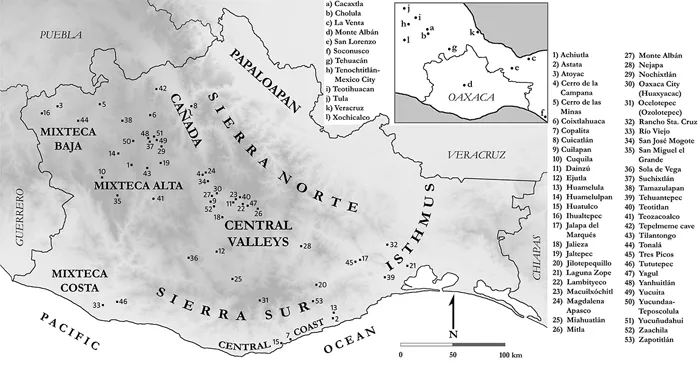
Figure 1.1. The state of Oaxaca and adjacent areas, with places and regions mentioned in the volume.
The distinct practice of integrating the durable material and historical records so as to reflect upon the past can often be traced back to the same early scholars of those literate societies, through the beginning of archaeology as a modern discipline in the nineteenth century and down to modern-day scholarship. The recent and growing international literature on the subject of interdisciplinary integration of material culture, documentary, and oral sources in reconstructing the past clearly demonstrates that the topic is still highly relevant today, even as the goal continues to be extremely challenging.1 Considering the long trajectory of literate societies and their respective academic research in the culture area under focus, it is surprising that despite the numerous publications on both Mesoamerican archaeology and ethnohistory, only one thematic volume on the subject of material and documentary source integration has been previously dedicated to Mesoamerica in general (Brambila Paz and Monjarás-Ruiz 1996), and none to Oaxaca in particular. This volume attempts to fill this gap, by taking an interdisciplinary and long-term perspective through several Oaxacan case studies that approach artifacts, documents, and oral traditions as distinct yet interrelated heuristic modes of inquiry about the past.2
There are frequently three assumptions at the heart of our enduring fascination with literate societies: (1) that these were intrinsically different from nonliterate or oral cultures; (2) that the interplay between the material and the documentary, conceived as distinct modes of cultural expression, substantially shapes our understanding of these societies; and (3) that our respective...
Table of contents
- Cover
- Contents
- Acknowledgments
- 1 From “1-Eye” to Bruce Byland: Literate Societies and Integrative Approaches in Oaxaca
- 2 The Convergence of History and Archaeology in Mesoamerica
- 3 Bruce Edward Byland, PhD: 1950–2008
- 4 Multidisciplinary Fieldwork in Oaxaca
- 5 Mythstory and Archaeology: Of Earth Goddesses, Weaving Tools, and Buccal Masks
- 6 Reconciling Disparate Evidence between the Mixtec Historical Codices and Archaeology: The Case of “Red and White Bundle” and “Hill of the Wasp”
- 7 Mixteca-Puebla Polychromes and the Codices
- 8 Pluri-Ethnic Coixtlahuaca’s Longue Durée
- 9 The Archaeology and History of Colonialism, Culture Contact, and Indigenous Cultural Development at Teozacoalco, Mixteca Alta
- 10 Salt Production and Trade in the Mixteca Baja: The Case of the Tonalá- Atoyac-Ihualtepec Salt Works
- 11 Integrating Oral Traditions and Archaeological Practice: The Case of San Miguel el Grande
- 12 Decolonizing Historical Archaeology in Southern Oaxaca, and Beyond
- 13 Prehispanic and Colonial Chontal Communities on the Eastern Oaxaca Coast on the Eve of the Spanish Conquest
- 14 Locating the Hidden Transcripts of Colonialism; Archaeological and Historical Evidence from the Isthmus of Tehuantepec
- 15 Using Nineteenth-Century Data in Contemporary Archaeological Studies: The View from Oaxaca and Germany
- List of Contributors
- Index
Trusted by 375,005 students
Access to over 1.5 million titles for a fair monthly price.
Study more efficiently using our study tools.
Frequently asked questions
Yes, you can cancel anytime from the Subscription tab in your account settings on the Perlego website. Your subscription will stay active until the end of your current billing period. Learn how to cancel your subscription
No, books cannot be downloaded as external files, such as PDFs, for use outside of Perlego. However, you can download books within the Perlego app for offline reading on mobile or tablet. Learn how to download books offline
We are an online textbook subscription service, where you can get access to an entire online library for less than the price of a single book per month. With over 1.5 million books across 990+ topics, we’ve got you covered! Learn about our mission
Look out for the read-aloud symbol on your next book to see if you can listen to it. The read-aloud tool reads text aloud for you, highlighting the text as it is being read. You can pause it, speed it up and slow it down. Learn more about Read Aloud
Yes! You can use the Perlego app on both iOS and Android devices to read anytime, anywhere — even offline. Perfect for commutes or when you’re on the go.
Please note we cannot support devices running on iOS 13 and Android 7 or earlier. Learn more about using the app
Please note we cannot support devices running on iOS 13 and Android 7 or earlier. Learn more about using the app
Yes, you can access Bridging the Gaps by Danny Zborover, Peter Kroefges, Danny Zborover,Peter Kroefges in PDF and/or ePUB format, as well as other popular books in Social Sciences & Archaeology. We have over 1.5 million books available in our catalogue for you to explore.