Emotional labor is not adequately talked about or addressed by writing program administrators. The Things We Carry makes this often-invisible labor visible, demonstrates a variety of practical strategies to navigate it reflectively, and opens a path for further research. Particularly timely, this collection considers how writing program administrators work when their schools or regions experience crisis situations.
The book is broken into three sections: one emphasizing the WPA's own work identity, one on fostering community in writing programs, and one on balancing the professional and personal. Chapters written by a diverse range of authors in different institutional and WPA contexts examine the roles of WPAs in traumatic events, such as mass shootings and natural disasters, as well as the emotional labor WPAs perform on a daily basis, such as working with students who have been sexually assaulted or endured racist, sexist, homophobic, and otherwise disenfranchising interactions on campus. The central thread in this collection focuses on "preserving" by acknowledging that emotions are neither good nor bad and that they must be continually reflected upon as WPAs consider what to do with emotional labor and how to respond. Ultimately, this book argues for more visibility of the emotional labor WPAs perform and for WPAs to care for themselves even as they care for others.
The Things We Carry extends conversations about WPA emotional labor and offers concrete and useful strategies for administrators working in both a large range of traumatic events as well as daily situations that require tactical work to preserve their sense of self and balance. It will be invaluable to writing program administrators specifically and of interest to other types of administrators as well as scholars in rhetoric and composition who are interested in emotion more broadly.
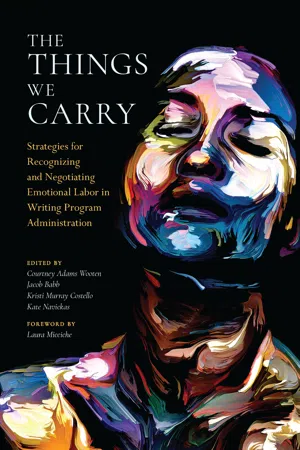
eBook - ePub
Things We Carry
Strategies for Recognizing and Negotiating Emotional Labor in Writing Program Administration
- English
- ePUB (mobile friendly)
- Available on iOS & Android
eBook - ePub
Things We Carry
Strategies for Recognizing and Negotiating Emotional Labor in Writing Program Administration
About this book
Information
Index
academic communities: caring in, 23; socialization in, 99
academic discourse: emotional constructs in, 91–92
academic rank, 105–6
academics: ideal, 78; work and responsibilities of, 97, 270–71. See also administrators; faculty
Accelerated Learning Program, equity-centered, 42
accountability models, 40
achievement, 32–33, 290
Achieving the Dream, 38
acting, surface and deep, 22–23
activities: attention to, 263–64; emotion-driven, 106–7; low-value, 86
Adams Wooten, Courtney, 59, 155
adjunct faculty. See contingent faculty
Adler-Kassner, Linda, 51
Administrative Problem-Solving for Writing Program and Writing Centers (Myers-Breslin), 275–76
administrators, administration, 50, 97–98, 108; African American, 309–10; agency of, 69–70; availability of, 251; crisis response by, 132–34, 141–42; culture of, 48–49; feminist, 247; reflection, 106–7; support and advocacy for, 139; valuing, 20–21
advice, peer, 239
advocacy: for students, 138; for teachers and administrators, 139; for WPA positions, 41
affect: expressing, 122–23; managing, 219–24; theory of, 82–83
African Americans, 13, 200, 309–10; etiquette and performance behavior, 206–8; female WPAs, 197, 198, 199; inclusion, 212–13; marginalization, 203–5; self-care, 211–12; uncompensated labor, 202–3
agency: administrative, 69–70, 71; emotion and, 255; slow, 238
Ahmed, Sara, 7, 20, 34, 59, 64, 82, 98, 261, 265; happiness scripts, 271–73
Alexander, Jonathan, 217; “Frameworks for Failure,” 3...
Table of contents
- Cover
- Title Page
- Copyright Page
- Contents
- Foreword
- Preface
- Acknowledgments
- Introduction: Emotional Labor, Writing Studies, and Writing Program Administration
- Section I: Preserving Work Identities
- Section II: Preserving Communities
- Section III: Preserving Balance
- Strategy Sheets
- Index
Trusted by 375,005 students
Access to over 1.5 million titles for a fair monthly price.
Study more efficiently using our study tools.
Frequently asked questions
Yes, you can cancel anytime from the Subscription tab in your account settings on the Perlego website. Your subscription will stay active until the end of your current billing period. Learn how to cancel your subscription
No, books cannot be downloaded as external files, such as PDFs, for use outside of Perlego. However, you can download books within the Perlego app for offline reading on mobile or tablet. Learn how to download books offline
Perlego offers two plans: Essential and Complete
- Essential is ideal for learners and professionals who enjoy exploring a wide range of subjects. Access the Essential Library with 800,000+ trusted titles and best-sellers across business, personal growth, and the humanities. Includes unlimited reading time and Standard Read Aloud voice.
- Complete: Perfect for advanced learners and researchers needing full, unrestricted access. Unlock 1.5M+ books across hundreds of subjects, including academic and specialized titles. The Complete Plan also includes advanced features like Premium Read Aloud and Research Assistant.
We are an online textbook subscription service, where you can get access to an entire online library for less than the price of a single book per month. With over 1.5 million books across 990+ topics, we’ve got you covered! Learn about our mission
Look out for the read-aloud symbol on your next book to see if you can listen to it. The read-aloud tool reads text aloud for you, highlighting the text as it is being read. You can pause it, speed it up and slow it down. Learn more about Read Aloud
Yes! You can use the Perlego app on both iOS and Android devices to read anytime, anywhere — even offline. Perfect for commutes or when you’re on the go.
Please note we cannot support devices running on iOS 13 and Android 7 or earlier. Learn more about using the app
Please note we cannot support devices running on iOS 13 and Android 7 or earlier. Learn more about using the app
Yes, you can access Things We Carry by Courtney Adams Wooten, Jacob Babb, Kristi Murray Costello, Kate Navickas, Courtney Adams Wooten,Jacob Babb,Kristi Murray Costello,Kate Navickas in PDF and/or ePUB format, as well as other popular books in Languages & Linguistics & Linguistics. We have over 1.5 million books available in our catalogue for you to explore.