In December 2017, the Royal Commission into Institutional Responses To Child Sexual Abuse established by the Commonwealth Government published its final report. Anglicans were represented and disgraceful behaviour by both lay and clerical officers of church institutions and grossly negligent conduct by a number of bishops were reported. Several bishops, including one archbishop, resigned when this negligence was exposed. The actual offenders are being or have been dealt with by police and church authorities. However, the commission had some difficulty in coming to terms with the organisational complexity of the Anglican Church. They worked with the General Synod thinking that it was the national body and had some kind of jurisdiction in relation to the twenty-three dioceses. The reality was that the jurisdiction lay with the dioceses and the General Synod was an arena in which some agreement might be negotiated but from which no certain jurisdiction flowed to the dioceses. When the Commission asked for information from the dioceses about schools one diocese included all the schools in the diocese that described themselves as Anglican, another diocese included only those that came specifically under the jurisdiction of the synod of the diocese. In one sense both were correct depending on how one counted what was the Anglican Church and what counted as an Anglican institution. Such distinctions in a loose voluntary association such as the Anglican Church of Australia presented a real difficulty for the Royal Commission. It worked in jurisdictional terms and generally on assumptions that were national in character. For outside bodies such as the government it is not entirely straight forward to identify what is the Anglican Church or even an Anglican body. This becomes a more complex question for Anglican welfare agencies who receive substantial government funding for some of their services. This is even more complicated where entities themselves comprehend a variety of internal sub groups such as schools within a diocesan church schools system. It has not always been so in relations between church and state. In the early years of the colony of New South Wales it was much simpler. The governor represented the state and the Anglican Archdeacon represented the Church of England. In 1829 William Grant Broughton arrived in Sydney as the Church of England Archdeacon. He was responsible for all schools in the colony and was third in seniority in the government. In 1836, Broughton became Bishop of the new Diocese of Australia and in the same year lost his monopoly control of schools in the colony and of government financial support for his church. He remained part of the government but with a diminished role. In 1847 his Diocese was divided and he became bishop of Sydney but Metropolitan of Australasia. In 1852, he left for England hoping to sort out the problems of colonial churches but he died without achieving this goal. When he left Sydney, he was no longer part of the government and had to battle for private support for his church. He was challenged by a growing presence of other churches and more so by dramatic changes in society and the politics of the colony which arrived at local representative government just as he was leaving. Broughton's transition from senior government officer to independent player in a plural environment was neither easy nor comfortable for him. He was not alone in this. The abandonment of convict immigration, which Broughton had strongly supported, had a profound effect on the colony. Older social groups like the 'exclusives' were being challenged by the new men of the rising generation. Shadows of uncertainty clouded hopes for the future for some while others could not wait to embrace what was to come. The middle two decades of the century was a time of great transition that heralded profound changes in the colony and in the place of the Church of England in the colony. Broughton was greeted with gubernatorial splendour and public acclaim when he arrived. When he departed it was a somewhat miserable and lonely affair. His personal circumstances had been marred by personal tragedy and he had given away half his income to support the creation of another diocese. His church reforms for Sydney had been rejected in the midst of public protest and counter petitions to the Queen. When he departed there was no public farewell from the governor. The great social and political currents in the colony in the middle of the nineteenth century enveloped Broughton but he was not to be swept away. He had the intelligence, strength and personal gifts to be a major contributor to the colony. At a memorial event for Broughton the Chief Justice, Sir Alfred Stephen, declared 'There was not one great object for the promotion of civilisation and special advancement in the colony with which he was not connected; there was not one effort to raise its name in the estimation of the world with which his name was not identified' In England he was entombed in Canterbury Cathedral as a hero of the Church of England and the Empire. This period in the history of Australia has been widely studied and in many respects has become a distinctive turning point by which to interpret succeeding decades and generations. It was a significant period in the sense that major changes occurred which had a profound influence on the future. But the history of societies is more a wandering affair than a series of straight grid lines as if a great matter settled at one point remains a determining force into the future. This mid-century period has itself been seen to be marked by some surprising even unexpected turns. The period also draws attention to areas of startling surprise in the longer run. Who at the time could have thought that the long struggle over the control of school education from Bourke in the 1830s to Parkes in 1880 might be totally turned on its head in the second half of the twentieth century by a Commonwealth Government providing finance for science laboratories and then moving on to provide munificent funding for non-government schools. The case of the Church of England in mid nineteenth century New South Wales in relation to some critical social and institutional changes does however present a useful study of how some of the dynamics of memory and hope contribute to informing action in the present. The essays in this volume are concerned with these social and political issues as they affected both the government and the Church of England in the middle of the nineteenth century. On the one hand was the heritage that the Church of England brought to the colony, principally in the person of the archdeacon and later bishop Broughton. But, on the other hand, were the social and political dynamics that emerged in the colony. The matter was complicated by the fact that these two aspects of life in the colony did not arrive as separate streams. The colonising power was the political entity of the English Christendom, a system in which the clerical and lay elements shared in the government of the kingdom. Not only so but the kingdom was professedly a christian kingdom, indeed in this case a kingdom that professed the faith of the Church of England. Its colony in New South Wales began on the same terms. At one level these essays could be seen as historical in character and intention. They address particular historical events or people and seek to set them in their context. In that respect, they participate in the general conversation about mid nineteenth century history of New South Wales. However, they are also concerned with a theological endeavour that has to do with the way in which a christian tradition like Anglicanism is sustained through changes in time and place. In that respect they are theological. Christianity is rightly described as an historical religion. That is not only because it has existed over time, but more importantly because it is founded on beliefs about an historical figure, Jesus of Nazareth, who lived in a particular time and place. The belief, central to Christianity, is that Jesus of Nazareth, as articulated by the apostle Peter and by subsequent Christians, is the Christ the Son of the living God. Debates among early christians about what came to be called Christology arise from these roots. How may christians speak of Christ as both divine and human, and in what way. These foundations have meant that christians have had to exist, as they early began to express it, in two worlds or kingdoms: the kingdom of this world and the kingdom of Christ. But this dynamic in Christianity has also meant that christians have had to take the mundane historical reality of their lives seriously and thus also the material culture that they created over the centuries. As a consequence for christians historical interpretation has always paid attention to continuities in history and to the means of transmission in christian culture and faith. Such continuity has been thought of in a variety of terms such as the working of the Holy Spirit to reveal new truths; the memory of things Jesus or the apostles did or said or wrote; memory laden activities like the Lord's Supper or Baptism; arrangements like ministerial order or texts regarded as authoritative or political relations with governments. These are matters that involve theological questions; they are not simply historical developments. The inter-penetration of events and theology remains whether the Christian lives in a Christendom or some other kind of society. These essays are focussed on a period in which the transition from a Church of England Christendom to a different kind of society was already underway. That transition dynamic shaped the character of significant parts of the conflict described in these essays. These essays do not refer to these changes in the middle of the nineteenth century as if they necessarily set the path ahead into the distant futu
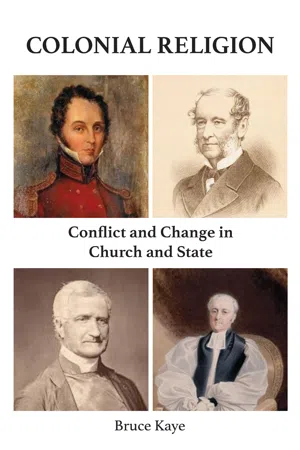
- 238 pages
- English
- ePUB (mobile friendly)
- Available on iOS & Android
eBook - ePub
About this book
Trusted by 375,005 students
Access to over 1.5 million titles for a fair monthly price.
Study more efficiently using our study tools.
Information
Topic
Teología y religiónSubtopic
Historia del cristianismoChapter 1
The ‘Old High Church’ Baggage of William Grant Broughton
This article examines the intellectual and ecclesiastical baggage which WG Broughton brought with him when he came to New South Wales as Archdeacon in 1829 by tracing Broughton’s early life and education, his early ministry and scholarly writings, and identifying Broughton’s circle of friends in the Church of England. The travel diary, which Broughton kept on his journey to New South Wales is examined for his estimate of the books he read while on ship. Broughton emerges from this study as a person of considerable scholarly talent, and a member of the old High Church group (The Hackney Phallanx) by both theological, and political conviction as well as personal friendships.
_________
Late in the afternoon on 26 May 1829 the recently appointed archdeacon of New South Wales could have been seen deftly stepping aboard the convict ship John with his wife and two daughters. In such a manner did he set out from Sheerness for the other side of the world with their assorted household baggage. The baggage that he carried in his head, and which would direct the way in which he tried to arrange the affairs of the Church of England and its mission in the colony, is also reasonably identifiable. Here we have a high churchman of the Hanoverian church/state mould. He was entirely committed to the Church of England as the fruit of the Protestant Reformation with its basis in the authority of scripture. The Duke of Wellington, great though he was, had made a terrible mistake with Roman Catholic emancipation, for Romanism was not just politically subversive it was a system of error from which the Reformation had delivered the Church of England.
Broughton warrants more attention than he has been given so far in terms of Australian history and religion.1 However, he also deserves some consideration in terms of the English framework within which he spent the first forty-one years of his life, and that in two respects. First, with what convictions, habits of thought and educational qualities did he venture to Australia to deal with this new and threatening situation for the Church of England in New South Wales. Secondly, does an examination of his background shed any light on our understanding of church and theological movements in the early part of the nineteenth century in England itself, especially the position of the old high church group?2 It may, therefore, prove of interest from both an English point of view, and also from an Australian point of view, to look a little more carefully at the baggage which Broughton took with him to Australia.
Such an examination, I suggest, places Broughton in the category of the ‘Old High Church’ group. There is a certain difficulty of definition involved in this statement, since it is a matter of discussion as to how exactly that High Church group should be characterised, a characterisation which may well vary according to the point in time in which one was interested. The term in an ecclesiastical sense goes back to the last decade of the seventeenth century when ‘High Churchmen’ tried to respond to a flood of anti-clerical publicity.3 The term comes to have a variety of connotations in the nineteenth century, in no small measure as a result of the division which developed between Tractarianism and the High Church group in the late 1830s.4 We are concerned here, however, with the period up to 1829, when Broughton departed for New South Wales. In this period that division had not occurred. It is very easy to project the post Tractarian categories back on to the earlier period, just as, more generally, it has proved to be a temptation for historians to read back later Victorian categories into the interpretation of the eighteenth century.
William Grant Broughton was born on 22 May 1788 at Bridge Street, Westminster. When he was six years old the family moved to Barnet in Hertfordshire, and the young Broughton went to Barnet Grammar school. In January 1797 he entered the King’s College Canterbury, and at the end of that year he was granted a King’s scholarship. He left school in December 1804, having won an exhibition to Pembroke College, Cambridge, but he was not able to take up his position for lack of funds. For the next two years he appears to have lived at home and then, in April 1807, obtained a position at the East India Company in London. Six years later he inherited £1000 from his uncle and this enabled him to take up his position at Pembroke in October 1814. He graduated BA (sixth wrangler in mathematics) in 1818, and then was ordained deacon by the Bishop of Salisbury, married his long time sweetheart Sarah Francis and became the curate of Hartley Wespall in Hampshire, where he stayed for nine years. In 1827 he went to be Assistant at Farnham in Kent and was also appointed Chaplain to the Tower of London in 1828. He was offered the position of Archdeacon of NSW in October 1828, for which colony he set sail on 26 May 1829, four days after his forty-first birthday.
Such, in brief outline, is the course for the formation of the Archdeacon. That formation and its results can be identified in more detail by concentrating on three stages in his life, each of which contributed something to the final outcome; his early life, time at Cambridge and his ministerial period. Before turning to these details, it will help to focus the developing picture if we pause briefly to note the sorts of issues which Broughton would have to face in New South Wales first as Archdeacon and then later as the first Bishop of Australia. The English background can be focussed as well by identifying Broughton’s circle of friends and acquaintances, for they securely locate him in the High Church tradition.
New South Wales was founded as a convict colony and this fact dominated the first twenty-five years of its existence. The Governor was supreme and the Archdeacon was an important person in the hierarchy of the colony. Although he came later in the life of the colony, Broughton still had to contend with some of the convict problems. The role of the church in relation to marriage, divorce and social mores certainly were a concern to him. The problems of the developing colony in matters such as immigration, the cessation of transportation, the settlement of land and the basis of its tenure, and the supply of labour in the colony all occupied his attention as an advisor to the government. For a number of years he was the chairman of the immigration committee of the Legislative Council. He was continually occupied with the problems of the role of the church in education, particularly with the rising anti-ecclesiastical sentiment in this area. In his episcopal role he was faced with questions of church government and the relation of the church to the colonial government. As we shall see these challenges pick up elements in his background and development. The ‘baggage’ he took with him was useable in the colony, but it had to be significantly re-arranged.
An interesting circle of Broughton’s acquaintances within the ecclesiastical life of the Church of England can be identified. At Cambridge the Greek Professor, James Henry Monk, turns up again as the Bishop of Gloucester at Broughton’s consecration. He was the leading light on Greek textual criticism at Cambridge, and he was also a staunch high churchman. Broughton would also have met or known of, George D’Oyly who was the Christian Advocate at Cambridge in Broughton’s first two years as a student. D’Oyly was well known in his day as a theologian, was the Treasurer of the Society for the Promotion of Christian Knowledge (SPCK) and a member of the committee of the Society for the Propagation of the Gospel (SPG); the two societies which Broughton supported, the latter being the object of his first published sermon at Reading in 1822. D’Oyly’s successor as Christian Advocate during Broughton’s time at Cambridge was Thomas Rennell, who was also the editor of the British Critic from 1811.
Rennell was a close friend of the Revd Handley H Norris, whom we know from Broughton’s correspondence was an old friend of Broughton as well. An indication of Broughton’s friendship with Norris and his identification with the ‘church principles’ of Norris, and thus the Hackney Phalanx group, can be seen in their correspondence. Norris had written to Broughton about his appointment to NSW and in his reply of February 9 1829, Broughton said;
you are quite right in saying that there is no ground for congratulation on my appointment . . . you have taken what appears to me to be the truest view of the relation in which the maintenance of the Church of England stands to the present and future happiness of mankind; and it is truly in the hope of recommending such views that I am going to what I know and feel to be a banishment.5
Norris was an extremely close friend of Joshua Watson, who not only knew Broughton well but also was one of his greatest and warmest supporters in the colonial church. Years later, when Watson’s daughter Mary died, Broughton wrote to Watson to console and encourage his friend with recollections of the work which he had done for the church.
Your mind should preserve its activity and interest in those plans which were cherished by you and others within the bosom of the church at a time when the world at large, though retaining the word church in the creed, yet seemed to have forgotten that it had any proper meaning. You have lived to see the revival of a better feeling.6
Then, of course, we have Dr Keate, with whom Broughton was on close and familial terms from the time at Hartley Westpall when he was Broughton’s non-resident rector. Keate maintained his connections with Eton, which institution, through the person of the Revd Edward Coleridge was to play such a vital part in Broughton’s work later as a bishop. Last but not least we note Bishop Pretyman-Tomline, to whom Broughton dedicated his first significant publication which was an answer to Palaeoromaica. Tomline wrote to Broughton with approval for his work,7 and in relation to Broughton’s publication on the politically more sensitive issue of the Eikon Basilike he told Broughton that he strongly inclined to his side of the matter. Tomline was also on personal terms with Broughton’s father in law, the Rev J Francis.8
We see here a circle of friends and acquaintances of not inferior influence in the institutions of Church, State and University in the persons of Marsh, Tomline, French and also Wellington, through whose patronage Broughton was appointed to the chaplaincy of the Tower of London, and then the Archdeaconary of New South Wales. Tomline, together with Monk, D’Oyly, Rennel, Norris and Watson indicate Broughton moving in the orbit of the Hackney Phalanx. Certainly this grouping sits well with Broughton’s opinions and convictions. We might even say that Broughton was the sort of person who could be covered by Lyall’s phrase ‘. . . men who had no other claim except that of merit . . . persons whose fathers were in very humble stations in life . . .’9
Edward Churton wrote to S Copeland on 29 October 1855 saying that some good might come from ‘quietly rebuking the upstart self-satisfied spirit of some whom I have heard preaching up their noble selves as if they had been the people and the knowledge might die with them.’ Peter Nockles relates this...
Table of contents
- Cover
- Half-title Page
- Title Page
- Copyright
- Table of Contents
- Author Information
- Acknowledgments
- Sources
- Introduction
- 1. The ‘Old High Church’ Baggage of William Grant Broughton
- 2. Laity in Church Governance—Broughton’s Non-Adventure
- 3. The Collapse of the Royal Supremacy: Broughton’s Struggle
- 4. Broughton’s 1850 Bishops Conference and the Energetic Bishop Selwyn
- 5. The Strange Birth of Anglican Synods in Australia and the 1850 Bishops Conference
- 6. Church Conflict and the Founding of Sydney University
- 7. From Anglican Gaol to religious Plurality: How Time has Changed the Terms of Reference in ‘Church State Relations’
- Index of Names and Subjects
Frequently asked questions
Yes, you can cancel anytime from the Subscription tab in your account settings on the Perlego website. Your subscription will stay active until the end of your current billing period. Learn how to cancel your subscription
No, books cannot be downloaded as external files, such as PDFs, for use outside of Perlego. However, you can download books within the Perlego app for offline reading on mobile or tablet. Learn how to download books offline
Perlego offers two plans: Essential and Complete
- Essential is ideal for learners and professionals who enjoy exploring a wide range of subjects. Access the Essential Library with 800,000+ trusted titles and best-sellers across business, personal growth, and the humanities. Includes unlimited reading time and Standard Read Aloud voice.
- Complete: Perfect for advanced learners and researchers needing full, unrestricted access. Unlock 1.5M+ books across hundreds of subjects, including academic and specialized titles. The Complete Plan also includes advanced features like Premium Read Aloud and Research Assistant.
We are an online textbook subscription service, where you can get access to an entire online library for less than the price of a single book per month. With over 1.5 million books across 990+ topics, we’ve got you covered! Learn about our mission
Look out for the read-aloud symbol on your next book to see if you can listen to it. The read-aloud tool reads text aloud for you, highlighting the text as it is being read. You can pause it, speed it up and slow it down. Learn more about Read Aloud
Yes! You can use the Perlego app on both iOS and Android devices to read anytime, anywhere — even offline. Perfect for commutes or when you’re on the go.
Please note we cannot support devices running on iOS 13 and Android 7 or earlier. Learn more about using the app
Please note we cannot support devices running on iOS 13 and Android 7 or earlier. Learn more about using the app
Yes, you can access Colonial Religion by Bruce Kaye in PDF and/or ePUB format, as well as other popular books in Teología y religión & Historia del cristianismo. We have over 1.5 million books available in our catalogue for you to explore.