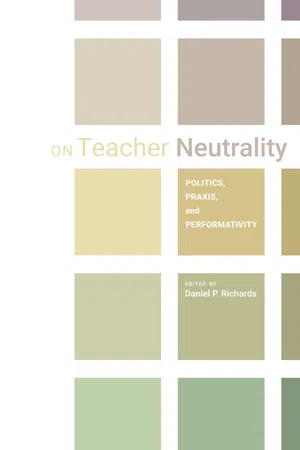
On Teacher Neutrality explores the consequences of ideological arguments about teacher neutrality in the context of higher education. It is the first edited collection to focus exclusively on this contentious concept, emphasizing the practical possibilities and impossibilities of neutrality in the teaching of writing, the deployment of neutrality as a political motif in the public discourse shaping policy in higher education, and the performativity of individual instructors in a variety of institutional contexts. The collection provides clarity on the contours around defining "neutrality," depth in understanding how neutrality operates differently in various institutional settings, and nuance in the levels and degrees of neutrality—or what is meant by it—in the teaching of writing.
Higher education itself and its stakeholders are continually exploring the role of teachers in the classroom and the extent to which it is possible or ethical to engage in neutrality. Amplifying voices from teachers in underrepresented positions and institutions in discussions of teacher ideology, On Teacher Neutrality shapes the discourse around these topics both within the writing classroom and throughout higher education. The book offers a rich array of practices, pedagogies, and theories that will help ground instructors and posits a way forward toward better dialogue and connections with the various stakeholders of higher education in the United States.
Contributors:
Tristan Abbott, Kelly Blewett, Meaghan Brewer, Christopher Michael Brown, Chad Chisholm, Jessica Clements, Jason C. Evans, Heather Fester, Romeo García, Yndalecio Isaac Hinojosa, Mara Holt, Erika Johnson, Tawny LeBouef Tullia, Lauren F. Lichty, Adam Pacton, Daniel P. Richards, Patricia Roberts-Miller, Karen Rosenberg, Allison L. Rowland, Robert Samuels, David P. Stubblefield, Jennifer Thomas, John Trimbur
- English
- ePUB (mobile friendly)
- Available on iOS & Android
eBook - ePub
About this book
Information
Section II
Praxis
6
Strangers on Their Own Campus
Listening across Difference in Qualitative Research
Kelly Blewett, with Tyler S.
Teachers are expected to perform neutrality, but what Arlie Russell Hochschild calls empathy walls certainly exist in higher education. Hochschild defines an empathy wall as “an obstacle to deep understanding of another person, one that can make us feel indifferent or even hostile to those who hold different beliefs” (Hochschild 2016, 5). Performing neutrality may seem a way to avoid confronting difference in the classroom. Yet behind this performance, teachers may feel wary, especially if the teacher leans left politically and culturally, but senses that students—and the community surrounding the campus—lean right.
In my own qualitative study of first-year writing, a master’s student in her second year of teaching writing indicated she had already tired of seeing what she regarded as the conservatism of the city in which she was teaching show up in the students’ writing. To mitigate these unwelcome reminders of the gap between her own politics and those of (some) students, she decided to simply declare certain topics off limits, such as gay marriage, gun control, and political correctness. Liberal/conservative divides, in fact, dominate much of our field’s discussion of student resistance, particularly as it relates to critical pedagogy (for example, Durst 1999; Greenbaum 2001; Ratcliffe 2005).
Just as Hochschild, a progressive academic from California, felt like a “stranger in her own country” when interviewing Tea Party members in Louisiana, so I argue that many teachers feel like strangers on their own campuses. Further, my contention is that the desire to ignore, quarter off, or disregard the beliefs, values, and preferred writing topics of conservative students may be heightening empathy walls within our classrooms. By instead considering how to build empathy bridges, as Hochschild proposes, we might be able to find mutual common ground, decrease fear, and increase the sense of connectedness between students and teachers. Increasing feelings of connectedness and empathy are particularly important in our current political climate, when anxiety, frustration, distrust, and contempt are rapidly circulating. I will shortly be discussing a qualitative study conducted in the fall of 2016; a few months prior, during the summer, a Pew Research Center poll indicated that more than four in ten Democrats and Republicans “perceived the other party’s policies as so misguided that they pose a threat to the nation” (“Partisanship” 2016). Where can common ground be found amidst so many differences? One answer is at the site of qualitative research.
Qualitative research is less encumbered by entrenched roles and authority structures than teaching, particularly when informed by feminist methodologies that seek to challenge dominant systems of representation (Sheridan-Rabideau 2003; Kirsch and Ritchie 1995), and therefore presents different, perhaps easier, spaces for engaging difference. In this essay, I describe an unexpected connection fostered between myself (a researcher and doctoral candidate who identified as liberal) and Tyler (a participant and student who identified as conservative). The purpose in detailing this exchange is to demonstrate the unanticipated effects that unfold when diverse teachers and students connect. My aim is to suggest, and demonstrate, that by finding ways to identify with students and establish trusting relationships with them, teachers might find useful applications to the classroom.
In the following sections, I describe how my interviews with Tyler both followed and defied interview protocols, how trust was established, and what revelations Tyler made in this space. Next, Tyler will have an opportunity to respond to my portrayal of our research experience. Finally, in the discussion, I’ll offer a few thoughts about how this research engagement changed me as a liberal-identified teacher and what it might suggest for other teachers who are struggling to perform neutrality, who feel ill at ease in classrooms in which they suspect that their deepest political commitments are not shared by their students, who feel—as many of us might—the height and complexity of an empathy wall.
Introducing Tyler and the Research Site
Tyler, a 23-year-old veteran who was returning to college following four years in the Marines, was one of eight focal students in my study. While the site of the study was a first-year writing course, I was also interested in how students adapted to life at the University of Cincinnati (UC), an urban public institution whose writing program serves nearly six thousand students every year. Tyler intended to study business but switched to communications in the middle of the term. The oldest of five children, Tyler grew up on the West Side of Cincinnati.
When initially asked to describe himself, Tyler replied, as though this fact explained everything, “I went to Elder.” Elder is a private, male Catholic high school on the West Side. After graduation, Tyler became the first in his family to go to college, but dropped out to enter the military. Tyler felt deeply indebted to his parents and was aware of the many sacrifices they’d made to care for him:
When I was a kid, they grinded. All my friends have no clue, because all their parents . . . had them later in their lives, and careers, and all this. My dad at one point was working . . . he’d go in at six, and he would finish his job at around five. Then he would go to his other security job from six until nine. And then he would go to where you do the corn and the funnel cakes. We used to have the Festival of Lights account for corn and funnel cakes. So he would go from the second security job to the Festival of Lights. For years, the dude was working nineteen-hour-days for months.1
In the spring of 2016, Tyler was ready to return to UC, this time with the military footing the bill. He registered for his classes from Camp Miramar in California: “I was doing everything over the phone and I hadn’t been in school in a long time so I didn’t even really know where to begin.” He had no expectation for what first-year writing would be like, but in the Marines Tyler had developed a strong set of writing skills that he anticipated would serve him well in college. He said, “I think that I’m pretty well spoken and that comes out in my writing. I write pretty smooth.”
In fact, Tyler positioned himself as something of a writing coach for the men he supervised in his unit. Offering both formative and summative assessment on writing and speaking, Tyler worked with those in his unit closely:
I had a Marine of mine who could not communicate, period. Wasn’t a good talker, we worked on that. I would make him present things to me all the time because he would get so nervous and that’s how we would knock that out, more or less. He never sent a thing without sending it to me or one of my peers. We would look over everything and give him feedback, but not hateful feedback. We would make sure that we were pretty positive about it. We all knew [he] was not a good writer, that’s fine. We’re going to work on that together.
Perhaps because Tyler’s beliefs about feedback mirrored my own, or perhaps because Tyler was four years older than my other study participants, or perhaps because relationship-building is so central to both teaching and qualitative research, I found myself telling things to Tyler to help me establish a rapport with him. Lad Tobin (2010) would position these tidbits of shared information as the sort of “purposeful self-disclosure” that is essentially rhetorical in nature. My disclosures emphasized our commonalities: my husband’s service in the military, and my own experiences as a military spouse. I shared that I was gifted a social manual when my husband and I married. We laughed when I said I didn’t read it but we understood what I meant when I said that I followed the rules anyway.
In making these disclosures, some might say that I was making my identity stable and legible to Tyler and also might note that the identity I performed was highly normative: able-bodied, middle-class, heterosexual, White, married. I didn’t worry overmuch about these disclosures. Surely part of the reason I was able to make them is that I anticipated correctly that they would be welcomed by my audience. Teachers whose identity characteristics are non-normative may not be able to make the same assumption (Kopelson 2006; Gutiérrez y Muhs et al. 2012).
I had determined, through this brief initial interview, that I genuinely liked Tyler. I liked his frankness, his articulateness, his willingness to participate in the study, his desire to perform well in school, his commitment to his family and his community. From this foundation, I came to trust Tyler and, of course, I wanted to prove myself a trustworthy person for him.
Trust has been studied from a range of disciplinary perspectives, and some general themes have emerged. To be trustworthy one must be perceived as both caring and credible. Trust is established between people and heightens the expectations that they have for each other. As philosopher Katherine Hawley puts it, “trust is at the center of a whole web of concepts: reliability, predictability, expectation, cooperation, goodwill, and—on the dark side—distrust, insincerity, conspiracy, betrayal, and incompetence” (Hawley 2012, 3). Neutrality—an openness to listening, a making of space for the student to explore their own ideas—can be a natural precursor of trust.
As much as I liked Tyler, the additional three hours we spent together were characterized by a kind of push and pull. On many topics, we simply didn’t agree: the protests in the National Football League, the value of political correctness, the candidate for whom we would vote for in the 2016 presidential election. As Kenneth Burke has written, “but put identification and division ambiguously together, so that you cannot know for certain just where one ends and the other begins and you have the characteristic invitation to rhetoric” (Burke 1969, 25).
In discussion, I didn’t call attention to our disagreement. Instead, I drew attention to places where I thought Tyler’s views didn’t stick neatly together (see Stubblefield and Chisholm, chapter 15 in this collection, who make a similar move when engaging students). For instance, how could Tyler say he wanted a supportive feedback environment, and then say that political correctness was a waste of time? It seemed to me that political correctness was foundational to a supportive environment. As we had these disagreements—edged our way into various contact zones—there was a directness to the exchanges that I found both invigorating and unsettling. I was unsettled because I wasn’t sure if I was overstepping the boundaries of my researcher role.
Irving Seidman, who has written a manual on qualitative interviewing, would say that I’d gone too far in engaging Tyler—that I’d shifted our relationship from one that was I/Thou to one that was We. In a We relationship, Seidman writes, there is an equal exchange of ideas (Seidman 2013). The line between I/Thou and We is blurry, and some feminist researchers argue that all good research should begin with a We. Exactly how much someone should share of themselves in qualitative interviewing is debatable. Seidman recommends “enough to be alive and responsive” but not enough to redirect the interview (Seidman 2013, 97). I was torn, though, because it was in these moments of redirections that the exchange between myself and Tyler seemed most vital. Tyler seemed to think so, too. “We do good work together,” he commented after one of our discussions, and held out his hand for me to shake. As the political intensity of campus life escalated throughout the fall, I also did a lot of listening to Tyler. What I heard genuinely surprised me.
Tyler’s Admissions and Kelly’s Responses
I heard about Tyler’s disappointment in college as an experience. While he thought there would be a free exchange of ideas, it turned out that people seemed to really “tiptoe” (his word) around hot topics. The environment seemed alienating. “It seems like the whole class is on this side, and then I’m over there on some of these conversations,” he said. The lack of direct exchange left him puzzled.
I don’t know why we’re tiptoeing, and I keep seeing that. It’s not just in English. It’s in a couple of different classes where some topics are stifled, and it’s strange to me because this is college. Where ideas should be, like there’s an acceptance thing going on at the same time. But not accepting if it’s not in this progressive kind of field. We’ll avoid topics. It’s a little too iffy. Let’s not talk about that, and it’s like, well that’s weird. But it’s just not comfortable.
Like what? I asked. Like race, he answered. To Tyler, our campus was a place where his own identity characteristics—a West Sider, a former Marine—were not particularly welcome. I listened as he talked about feeling out of step with the other men on campus, feeling that he was a throwback to an older model of masculinity. “I couldn’t even talk to him about guns or sports,” he said of another man in his composition classroom. “Are those your only interests?” I asked, “Guns and sports?” He agreed they were not. I listened as he attempted to analyze what exactly it was about his self-presentation that threw people off: “I need to be friendlier[. . .]Seriously, there’s just something about my face[. . .]I need to come across as less stern.” I listened as he talked about his attempts to feign political neutrality around campus, his attempts not to take up too much room or to make trouble. I listened as he talked about his concern that women on campus were uncomfortable with him, especially in his composition classroom. “I can’t make her talk to me!” he said. “I just knew that as she was looking at me, she didn’t want me here.” He went on, “girls are very darty-eyed around me.” And finally, I listened as he asked:...
Table of contents
- Cover
- Title Page
- Copyright Page
- Dedication
- Contents
- Foreword
- Acknowledgments
- Introduction: The Politics, Praxis, and Performativity of Teacher Neutrality
- Section I: Politics
- Section II: Praxis
- Section III: Performativity
- Section IV: Conclusion
- About the Authors
- Index
Trusted by 375,005 students
Access to over 1.5 million titles for a fair monthly price.
Study more efficiently using our study tools.
Frequently asked questions
Yes, you can cancel anytime from the Subscription tab in your account settings on the Perlego website. Your subscription will stay active until the end of your current billing period. Learn how to cancel your subscription
No, books cannot be downloaded as external files, such as PDFs, for use outside of Perlego. However, you can download books within the Perlego app for offline reading on mobile or tablet. Learn how to download books offline
Perlego offers two plans: Essential and Complete
- Essential is ideal for learners and professionals who enjoy exploring a wide range of subjects. Access the Essential Library with 800,000+ trusted titles and best-sellers across business, personal growth, and the humanities. Includes unlimited reading time and Standard Read Aloud voice.
- Complete: Perfect for advanced learners and researchers needing full, unrestricted access. Unlock 1.5M+ books across hundreds of subjects, including academic and specialized titles. The Complete Plan also includes advanced features like Premium Read Aloud and Research Assistant.
We are an online textbook subscription service, where you can get access to an entire online library for less than the price of a single book per month. With over 1.5 million books across 990+ topics, we’ve got you covered! Learn about our mission
Look out for the read-aloud symbol on your next book to see if you can listen to it. The read-aloud tool reads text aloud for you, highlighting the text as it is being read. You can pause it, speed it up and slow it down. Learn more about Read Aloud
Yes! You can use the Perlego app on both iOS and Android devices to read anytime, anywhere — even offline. Perfect for commutes or when you’re on the go.
Please note we cannot support devices running on iOS 13 and Android 7 or earlier. Learn more about using the app
Please note we cannot support devices running on iOS 13 and Android 7 or earlier. Learn more about using the app
Yes, you can access On Teacher Neutrality by Daniel P. Richards in PDF and/or ePUB format, as well as other popular books in Languages & Linguistics & Linguistics. We have over 1.5 million books available in our catalogue for you to explore.