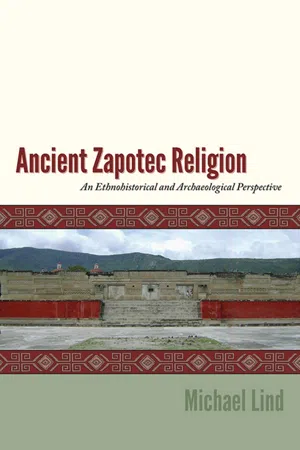
Ancient Zapotec Religion is the first comprehensive study of Zapotec religion as it existed in the southern Mexican state of Oaxaca on the eve of the Spanish Conquest. Author Michael Lind brings a new perspective, focusing not on underlying theological principles but on the material and spatial expressions of religious practice.
Using sixteenth- and seventeenth-century Spanish colonial documents and archaeological findings related to the time period leading up to the Spanish Conquest, he presents new information on deities, ancestor worship and sacred bundles, the Zapotec cosmos, the priesthood, religious ceremonies and rituals, the nature of temples, the distinctive features of the sacred and solar calendars, and the religious significance of the murals of Mitla—the most sacred and holy center. He also shows how Zapotec religion served to integrate Zapotec city-state structure throughout the valley of Oaxaca, neighboring mountain regions, and the Isthmus of Tehuantepec.
Ancient Zapotec Religion is the first in-depth and interdisciplinary book on the Zapotecs and their religious practices and will be of great interest to archaeologists, epigraphers, historians, and specialists in Native American, Latin American, and religious studies.
- English
- ePUB (mobile friendly)
- Available on iOS & Android
eBook - ePub
About this book
Information
1
Introduction
This study is about Zapotec religion as it existed around the time of the Spanish Conquest. Our knowledge of ancient Zapotec religion, like ancient Mesoamerican religions in general, comes principally from Spanish colonial documents (Nicholson 1971:396–97). From an analysis of sixteenth- and seventeenth-century documents, the nature of ancient Zapotec religion will be described and interpreted. This description and interpretation includes an identification of Zapotec deities, the role of ancestor worship, the nature of the Zapotec cosmos, the composition of the Zapotec priesthood, the rituals and ceremonies performed, and the use of the Zapotec sacred and solar calendars in religious activities. This study also relies on the archaeological record from the Postclassic, the time period leading up to the Spanish Conquest. Archaeological evidence of the nature of Postclassic Zapotec temples, tombs, ritual areas of palaces, and representations of deities in murals and artifacts also will be discussed. The role of religion in ancient Zapotec society will be examined in the conclusion to this study.
Society, Culture, and Religion
To place religion within the context of society and culture requires some definitions. A society is a group of people who have a history of interacting with one another behaviorally, such as the ancient Zapotecs, and a culture is the behavior patterns that characterize their interactions. Together, a society and culture form a sociocultural system. From an analytical perspective, a sociocultural system consists of technology, social organization, and ideology. Technology is the manner in which the members of a sociocultural system interact with their habitat. Social organization involves the interaction of members of a sociocultural system with one another. Ideology represents the ways that the members of a sociocultural system interact with regard to ideas. Ideology encompasses religion.
Anthropologists have found religion difficult to define. Saint Jerome evidently first used the term religion in Western civilization in the late fourth century AD, but the term was not widely used in Christianity until the Reformation (Insoll 2004:6). Edward B. Tylor (1960:202), seeking to define religion universally, as it applies to all human groups, first defined religion in anthropological terms as the “belief in spiritual beings.” More recently, Clifford Geertz (2005:14) has defined religions as “systems of ideas about the ultimate shape and substance of reality.” Marcus Winter (2002:50) simply defines religion as an “institutionalized system of beliefs and practices relating to the supernatural or gods.” Zapotec religion generally conforms to all these definitions. There is no Zapotec word for religion, but instead the concept of “sacred” exists (de la Cruz 2002a:xxix).
Approaches to the study of religion reflect approaches to the study of sociocultural systems in general. The neo-evolutionary, or processual, approach regards technology as the driving force in a sociocultural system. Social organization is determined by technology, and ideology or religion functions to reinforce social organization (White 1949; Sahlins and Service 1960). In this view, religion is seen as ultimately determined by technology (Harris 1974). More recently, the post-processual approach, associated with action theory or agency, views ideology as the driving force in the sociocultural system (Bourdieu 1977; Ortner 1984). In this view, the ideas (thoughts and actions) of its individual members determine all aspects of the sociocultural system (Hodder and Hutson 2003:30–31). In this regard, Insoll (2004:22–23, figure 2) has argued that religion determines the sociocultural system.
Lars Fogelin has reviewed both processual and post-processual approaches to the study of religion in archaeology. “Archaeologists studying religion often focus on ritual” because “ritual is a form of human activity that leaves material traces, whereas religion is a more abstract symbolic system consisting of beliefs, myths, and doctrines” (Fogelin 2007:56). Processual archaeologists “see rituals as the enactment of religious principles or myths” (Fogelin 2007:55). Post-processual archaeologists focus “on the ways that the experience of ritual and ritual symbolism promotes social orders and dominant ideologies” (Fogelin 2007:55). Herein, Zapotec religion is conceived as a shared worldview that helped integrate Postclassic Zapotec city-state culture, a point that will be explored in the conclusion to this study.
Ancient Mesoamerican Religions
Ancient Mesoamerican religions are best known for the Aztecs—or more properly and generally, the Nahuas—and the Maya because of the numerous documentary sources pertaining to them combined with the ritual or religious codices and the Classic Maya hieroglyphic records.1 Eduard Seler (1904) pioneered the study of Nahua and Maya religions and wrote extensively about them. Seler (1904:273) also wrote a lengthy article that still stands today as a pioneer study of Zapotec religion, although he noted the limited amount of information available on Zapotec religion compared to the Maya and the Nahuas. An unpublished AD 1910 manuscript by Martínez Gracida also deals with Zapotec religion, although it lacks the scholarly approach of Seler (Adam Sellen, personal communication, 2011). Most recently, Victor de la Cruz and Winter (2002) have published a series of articles that includes a Spanish translation of Seler’s original work and provides new insights into various aspects of Zapotec religion from linguistic, archaeological, ethnohistoric, and ethnographic points of view.
Seler (1904:266–75) was perhaps the first to point out a basic unity among Mesoamerican religions. Nahua, Maya, and Zapotec religions, among others throughout Mesoamerica, share many basic concepts, exemplified by the 260-day sacred calendar. Alfonso Caso (1971a) agreed with Seler that a basic unity existed among Mesoamerican religions and argued that we should speak of a Mesoamerican religion instead of Mesoamerican religions. Caso (1971a:199) believed that we can speak of a single Mesoamerican religion from as far back as the Classic period (AD 300–900). de la Cruz (2002b:279), who agrees with Caso about the unity of Mesoamerican religion, has suggested that this unity is best exemplified during the Late Postclassic (AD 1200–1521), when the merchants and soldiers of the Aztec Triple Alliance imposed religious uniformity throughout much of Mesoamerica. Wigberto Jiménez Moreno (1971) opposed this view and considered there to be a plurality of Mesoamerican religions with differences comparable to Judaism, Christianity, and Islam in the Middle East. He argued that the crucible of Western civilization in Mesopotamia, a region comparable to Mesoamerica, produced these identifiably different religions that, despite their differences, share many basic concepts. The same could be said for Mesoamerican religions....
Table of contents
- Cover
- Contents
- List of Figures
- List of Tables
- Preface
- 1 Introduction
- 2 Zapotec Deities in Sixteenth-Century Documents
- 3 Zapotec Deities in Seventeenth-Century Documents
- 4 Zapotec Temple Priests
- 5 Zapotec Temples: Mitla
- 6 Zapotec Temples: Yagul
- 7 Colaní: Zapotec Community Priests and Their Rituals
- 8 Zapotec Ritual Books and Sacred Calendars
- 9 The Mitla Murals
- 10 Religion in Ancient Zapotec Society
- References
- Index
Trusted by 375,005 students
Access to over 1.5 million titles for a fair monthly price.
Study more efficiently using our study tools.
Frequently asked questions
Yes, you can cancel anytime from the Subscription tab in your account settings on the Perlego website. Your subscription will stay active until the end of your current billing period. Learn how to cancel your subscription
No, books cannot be downloaded as external files, such as PDFs, for use outside of Perlego. However, you can download books within the Perlego app for offline reading on mobile or tablet. Learn how to download books offline
Perlego offers two plans: Essential and Complete
- Essential is ideal for learners and professionals who enjoy exploring a wide range of subjects. Access the Essential Library with 800,000+ trusted titles and best-sellers across business, personal growth, and the humanities. Includes unlimited reading time and Standard Read Aloud voice.
- Complete: Perfect for advanced learners and researchers needing full, unrestricted access. Unlock 1.5M+ books across hundreds of subjects, including academic and specialized titles. The Complete Plan also includes advanced features like Premium Read Aloud and Research Assistant.
We are an online textbook subscription service, where you can get access to an entire online library for less than the price of a single book per month. With over 1.5 million books across 990+ topics, we’ve got you covered! Learn about our mission
Look out for the read-aloud symbol on your next book to see if you can listen to it. The read-aloud tool reads text aloud for you, highlighting the text as it is being read. You can pause it, speed it up and slow it down. Learn more about Read Aloud
Yes! You can use the Perlego app on both iOS and Android devices to read anytime, anywhere — even offline. Perfect for commutes or when you’re on the go.
Please note we cannot support devices running on iOS 13 and Android 7 or earlier. Learn more about using the app
Please note we cannot support devices running on iOS 13 and Android 7 or earlier. Learn more about using the app
Yes, you can access Ancient Zapotec Religion by Michael Lind in PDF and/or ePUB format, as well as other popular books in Social Sciences & Archaeology. We have over 1.5 million books available in our catalogue for you to explore.