1
Introduction
EMILIANO GALLAGA M.
“Here is the Mirror of Galadriel,” she said. . . . . . . “What shall we look for, and what shall we see?” asked Frodo. . . . . . .“[T]he mirror will also show things unbidden, and those are often stranger and more profitable than things which we wish to behold. What you will see, if you leave the Mirror free to work, I cannot tell. For it shows things that were, and things that are, and things that yet may be. But which it is that he sees, even the wisest cannot always tell. Do you wish to look?”
(Tolkien 1991: 381)
In our daily life, it is not a surprise to see our reflection in a mirror early in the morning and identify that it is our image reproduced by this solid, reflective surface. For most people, one’s reflection in a mirror is unremarkable, as we do not attribute a divine quality to seeing our double image. However, while this daily act is mundane for most of us today, reflected images were viewed as quite profound by many ancient humans around the globe, and by pre-Hispanic indigenous people in particular.
Since the beginning of time, humans have been so mesmerized and/or challenged by their physical environment that there has always been a need to understand it, to own it, and to transform it. This need applies not only to our surroundings but to ourselves as well. We like to know who and what we are, change the way we look and the things we own, and to make or acquire things that say something about us and about the community to which we belong. This need for knowledge and transformation is an essential spark for the cultural development of the human animal, creating a universe of objects that help us understand and change our environment into a familiar landscape. Among that great universe of items, mirrors or reflecting surfaces have occupied an important place in the human mind. Pendergrast (2003: 13) states that “the ability to recognize themselves in the mirror seems peculiar to superior primates.” Humans are likewise captivated by the reproduction of one’s own image in a mirror or other reflecting surface. Accordingly, the ancient Indus, Chinese, Egyptian, Greek, Roman, Inca, Aztec, and Maya civilizations created objects that fulfill the need to have and control reflective surfaces (Albenda 1985; Baboula 2000; Beasley 1949; Bulling 1960; Cameron 1979; Cammann 1949; Lilyquist 1979; Pendergrast 2003). Of course, only the gods would know exactly what the ancients would think about the parallel worlds glimpsed through the shiny surfaces of mirrors, an archaeological mystery about which we can now only make educated guesses.
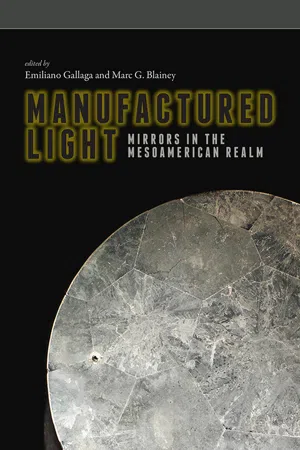
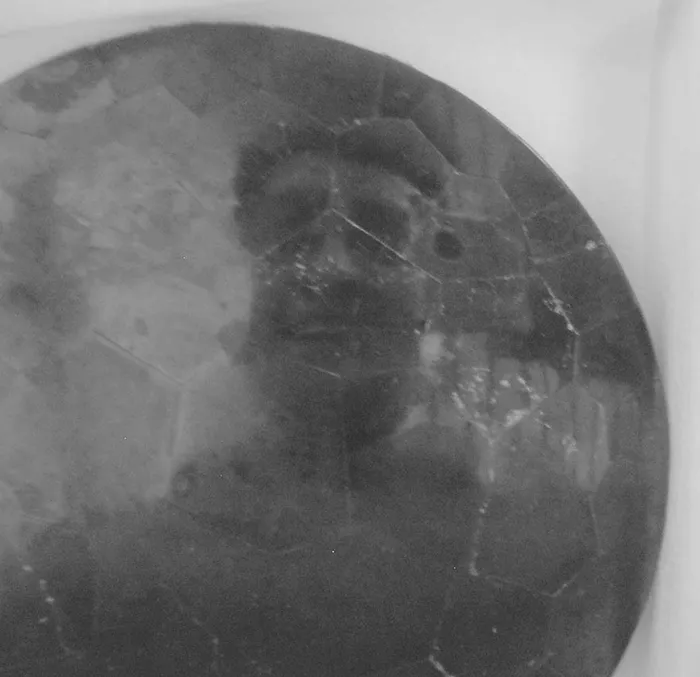
Complex and time-consuming to produce, mirrors and other reflective objects made of hematite, obsidian, or pyrite material stand out within the universe of pre-Hispanic artifacts for their aesthetics, their beauty, and their complexity of production (Blainey 2007; Gallaga 2001, 2009; Healy and Blainey 2011; Pereira 2008; Salinas 1995). Yes, these artifacts were probably also used for vanity purposes in domestic contexts, to see the perfection or imperfections of the onlooker’s facial features or to see what cosmetic or jewelry to use. But this was not the only purpose or objective to create and own a mirror. Due to their capacity for projecting an inverse reflection of the spectator’s reality (where right becomes left and vice versa), mirrors were used as divinatory or magical portals to communicate between parallel dimensions, worlds, or realities (figure 1.1). With this idea in mind, mirrors were also endowed with the capacity to be a means of contact with the ancestors and more importantly with the gods. It is not hard to imagine complex ceremonial procedures accompanied by chants and dances in secluded locations, perhaps involving fasting and/or the ingestion of psychoactive substances. Such rituals might have been required in order to prepare and train the body and mind to be in contact with the spirits; with the help of the mirror, one presumes that such spirits’ advice, guidance, or support was sought out when making important decisions about a course of action to follow. Whether as a ruler, adviser, priest, shaman, or just a brujo or curandero, the individual or group of individuals who performed these types of actions, envisioned as necessary tasks for the common good of the community, would thereby have acquired great prestige or social position.
Although past studies have acknowledged the difficulty of manufacturing these mirrors as well as their importance as objects of prestige and magical-religious worldview, very little research has been carried out concerning how ancient iron-ore mirrors were constructed. Dealing with the issue of mirror production, Emiliano Gallaga (chapter 2, this volume) presents preliminary results of an experimental archaeological project that has the aim of reproducing the operative chain of pyrite mirror manufacture using possible pre-Hispanic tools and techniques. Preliminary results illustrate that this process could take an average of 800–1200 person-hours, representing between 100 and 150 working days for a single person to make an encrusted pyrite mirror. Melgar, Gallaga, and Solis (chapter 3, this volume) also tackle this important question, and present a technological analysis of the manufacturing traces that were applied on different pyrite inlays, using experimental archaeology and scanning electron microscopy (SEM). This methodology allows the authors to identify the lithic tools employed in the production of mirrors with great accuracy and to distinguish different technological styles—fundamental advancements for the study of mirrors, their uses, and the definition of Mesoamerica’s artifact assemblage.
In the social realm the possession of iron-ore items would most certainly bestow a high status or social distinction on the owner, not only due to the object’s magical-religious connotations, but also for their rarity and cost of manufacturing (Blainey 2007; Gallaga 2001; Pereira 2008; Sugiyama 1992; Taube 1992). In general, items that provide a reflection of an image were not a common thing in ancient times, and yet they were conspicuously present among pre-Hispanic elites. Although pre-Hispanic artisans knew about and used metals, the use of metals was not as vital as that of other materials. Thus, the recognition of mirror craftsmanship is greater if we note the fact that the makers of mirrors almost completely lacked metal tools to fashion the finished mirrors. Due to both their highly symbolic/religious meaning/use and the cost of manufacture, we can infer that mirrors were not a common item to be found on the local markets at the plazas of pre-Hispanic communities. On the contrary, the production of mirrors was most likely restricted and controlled b...