Using an illuminating method that challenges the popular notion of Romanticism as aesthetic escapism, Theodore Ziolkowski explores five institutions--mining, law, madhouses, universities, and museums--that provide the socio-historical context for German Romantic culture. He shows how German writers and thinkers helped to shape these five institutions, all of which assumed their modern form during the Romantic period, and how these social structures in turn contributed to major literary works through image, plot, character, and theme. "Ziolkowski cannot fail to impress the reader with a breadth of erudition that reveals fascinating intersections in the life and works of an artist.... He conveys the sense of energy and idealism that fueled Schiller and Goethe, Fichte and Hegel, Hoffmann and Novalis...."--Emily Grosholz, The Hudson Review "[This book] should be put in the hands of every student who is seriously interested in the subject, and I cannot imagine a scholar in the field who will not learn from it and be delighted with it."--Hans Eichner, Journal of English and Germanic Philology "Ziolkowski is among those who go beyond lip-service to the historical and are able to show concretely the ways in which generic and thematic intentions are inextricably enmeshed with local and specific institutional circumstances."--Virgil Nemoianu, MLN
- 458 pages
- English
- PDF
- Available on iOS & Android
eBook - PDF
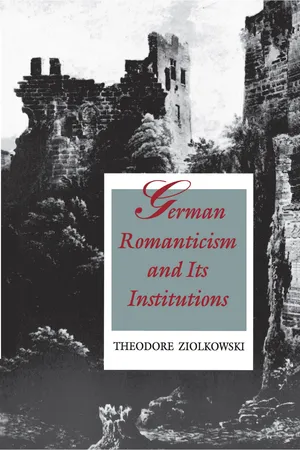
German Romanticism and Its Institutions
About this book
Information
Publisher
Princeton University PressYear
2021Print ISBN
9780691015231
9780691068015
eBook ISBN
9780691225760
Table of contents
- Cover Page
- Title Page
- Copyright Page
- Dedication
- Contents
- Preface
- Chapter One: The Institutional Approach
- Chapter Two: The Mine: Image of the Soul
- Chapter Three: The Law: Text of Society
- Chapter Four: The Madhouse: Asylum of the Spirit
- Chapter Five: The University: Model of the Mind
- Chapter Six: The Museum: Temple of Art
- Chapter Seven: Conclusion
- Notes
- Editions Cited
- Index
Trusted by 375,005 students
Access to over 1.5 million titles for a fair monthly price.
Study more efficiently using our study tools.
Frequently asked questions
Yes, you can cancel anytime from the Subscription tab in your account settings on the Perlego website. Your subscription will stay active until the end of your current billing period. Learn how to cancel your subscription
No, books cannot be downloaded as external files, such as PDFs, for use outside of Perlego. However, you can download books within the Perlego app for offline reading on mobile or tablet. Learn how to download books offline
Perlego offers two plans: Essential and Complete
- Essential is ideal for learners and professionals who enjoy exploring a wide range of subjects. Access the Essential Library with 800,000+ trusted titles and best-sellers across business, personal growth, and the humanities. Includes unlimited reading time and Standard Read Aloud voice.
- Complete: Perfect for advanced learners and researchers needing full, unrestricted access. Unlock 1.5M+ books across hundreds of subjects, including academic and specialized titles. The Complete Plan also includes advanced features like Premium Read Aloud and Research Assistant.
We are an online textbook subscription service, where you can get access to an entire online library for less than the price of a single book per month. With over 1.5 million books across 990+ topics, we’ve got you covered! Learn about our mission
Look out for the read-aloud symbol on your next book to see if you can listen to it. The read-aloud tool reads text aloud for you, highlighting the text as it is being read. You can pause it, speed it up and slow it down. Learn more about Read Aloud
Yes! You can use the Perlego app on both iOS and Android devices to read anytime, anywhere — even offline. Perfect for commutes or when you’re on the go.
Please note we cannot support devices running on iOS 13 and Android 7 or earlier. Learn more about using the app
Please note we cannot support devices running on iOS 13 and Android 7 or earlier. Learn more about using the app
Yes, you can access German Romanticism and Its Institutions by Theodore Ziolkowski in PDF and/or ePUB format, as well as other popular books in History & German History. We have over 1.5 million books available in our catalogue for you to explore.