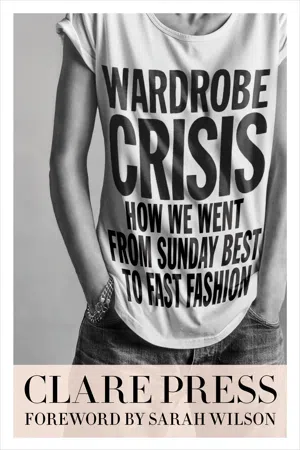
Who makes your clothes? This used to be an easy question to answer: it was the seamstress next door, or the tailor on the high street – or you made them yourself. Today we rarely know the origins of the clothes hanging in our closets. The local shoemaker, dressmaker and milliner are long gone, replaced by a globalised fashion industry worth $1.5 trillion a year.In Wardrobe Crisis, fashion journalist Clare Press explores the history and ethics behind what we wear. Putting her insider status to good use, Press examines the entire fashion ecosystem, from sweatshops to haute couture, unearthing the roots of today's buy-and-discard culture. She traces the origins of icons like Chanel, Dior and Hermès; charts the rise and fall of the department store; and follows the thread that led us from Marie Antoinette to Carrie Bradshaw. From a time when Ralph Lauren and Calvin Klein were just two boys from the Bronx, to the world of the global fashion juggernaut, where Zara's parent company produces more than 900 million garments annually, Press takes us on an insider's journey of discovery and revelation. Wardrobe Crisis is a witty and persuasive argument for a fashion revolution that will empower you to feel good about your wardrobe again.Clare Press is Marie Claire's fashion editor-at-large. She was previously the features director at Sunday Style and has worked as a fashion designer, brand consultant and editor, including stints as features director at Vogue, fashion critic at the Monthly and columnist at Instyle. Clare's fashion journalism has been published in Harper's Bazaar, Elle, Marie Claire, the Australian, the Sydney Morning Herald, the New York Times Magazine and many more. She is a passionate advocate for sustainable and ethical fashion, and sits on the Australian advisory board of Fashion Revolution.
- 336 pages
- English
- ePUB (mobile friendly)
- Available on iOS & Android
eBook - ePub
About this book
Information
Topic
DesignSubtopic
Fashion DesignCHAPTER 1
Behind the Seams
Trash and treasure
I’ve decided to have the skirts made. At 10 a.m. Monday morning in Sydney’s Kings Cross, the lights are off on the landmark Coke sign, and in the harsh sun the white letters that spell out ‘Enjoy Coca-Cola’ are the grey of grubby bra-straps. An empty can rolls past, and a man-mountain grins at me as he stops it with his foot. He has the Southern Cross inked on his neck above the collar of his nylon football shirt, the kind that takes forty years to degrade in landfill.
I turn down past the newsagent, which has a display of $8.95 caps out front. The original baseball caps were made in the 1840s from straw for the New York Knickerbockers; these are polyester with plastic trim. Polyester is made from ethylene, derived from petroleum; its production is energy intensive and heavy on the greenhouse gases. Aesthetically speaking, poly turns me right off – often shiny, always sweaty, it crackles with static best left to Boney M – but environmentally most cotton is no better. It takes up to 2,700 litres of water to make enough cotton for one T-shirt. Conventional cotton farming uses one quarter of the world’s pesticides. Straw starts to sound like a pretty good idea.
I pass a gentrified pocket set back from the street, with a slick café, a gym, and a nightclub with a velvet rope – while it’s smarter than the dives on the main drag, the female patrons still shriek and stumble in their too-high heels as they leave the club. I know; I’ve been one of them. I used to buy a new outfit every week for those Friday night shenanigans. I never thought about how it was made.
This end of the street lacks the pulse of further up. There’s a greasy spoon and a drycleaner advertising ‘Repairs, alterations, jeans patched,’ with a sewing machine in the window I’ve never seen manned, and then a dead end. Only those on foot can snake down to the Gothic arches of the Jesuit-run St Canice’s church. One Christmas, a woman turning into Roslyn Street after midnight mass was stabbed multiple times by a mugger. He escaped with small change – barely enough to buy a baseball cap.
Sometimes when I drive here, I approach the back way and park outside the church gates, where the homeless queue up for their free lunch. I feel guilty, ashamed that I make snap judgments based on how they look; but there’s something about their enveloping layers I find threatening. What’s under all those blankets and scarves? Who is under there? I know full well that they must wear those heavy coats in the sun or risk losing them because they don’t have the luxury of a wardrobe, and that admitting this makes me sound like a caricature of a shallow fashion person, like Will Ferrell playing Mugatu in Zoolander: What’s the vision behind your new ‘Derelicte’ collection, Mugatu? ‘I’m inspired by the homeless, the vagrants, the crack whores!’
‘Derelicte’ is a parody of a fashion moment that actually happens – repeatedly. You can trace its origins back to the London punks who wore bin bags, and Sid Vicious holding his shredded pants together with safety pins. Jean Paul Gaultier had them in mind when he dreamt up his robe sac poubelle (‘garbage-bag dress’). He was twenty-eight at the time, and fresh from learning his trade at Pierre Cardin, but the dress, made of draped black plastic, accessorised by bangles recycled from empty tin cans and a handbag made from an old ashtray, gave those who saw it a glimpse of the ‘enfant terrible’ Gaultier was to become. It’s a tag he doesn’t like, but one that fits him rather well – even now he’s of an age more suited to pottering around the garden.
Four years après Gaultier’s garbage-bag frock debuted in Paris, John Galliano finished studying fashion at London’s Saint Martin’s School of Art and Design with a graduate collection titled ‘Les Incroyables,’ inspired by French revolutionaries (and perhaps Vivienne Westwood – she did it first).
Gibraltar-born Galliano was dark-eyed and dangerous, with the swagger of Rudolph Valentino. ‘Les Incroyables’ featured his clubbing friends as models, music by DJ Jeremy Healy, and fabrics begged and borrowed. One look in particular hinted at what was to come from Galliano down the track – it included a pair of reading glasses held together with sticking plaster.1 Down-on-your-luck chic; it was a weird idea but it might just fly.
That first collection was a smash. It so impressed the retailer Joan Burstein that she bought every piece for her cult London boutique, Browns. ‘I just thought, wow! How exciting, how marvellous, so unrestrained,’ she told me. ‘We bought the lot. There was no production, it was just the samples from the show, but we sold it very quickly, every piece.’2
With Burstein’s stamp of approval, Galliano was anointed ‘most promising one’. He was named British Fashion Designer of the Year four times. By 1989, he had secured serious backers and was showing in Paris. When, in 1995, the execs at Louis Vuitton Moët Hennessy were looking for young blood to revitalise the French couture house of Givenchy, they chose Galliano. Barely a year in he was moved to the top job at Dior.
In 1999, Galliano was working on his seventh couture collection for that venerable Paris house, by now a fashion legend in his own right, as famous as Mr Dior had been fifty years earlier. Paris, the city of Robespierre and the sans-culottes, teemed with inspiration but, like his peer Alexander McQueen, Galliano struggled with the stresses of fashion’s relentless pace, and self-medicated with booze and drugs. When he wasn’t battling a raging hangover, he jogged with his personal trainer along the Seine. That’s where he first noticed the shadowy cliques of city’s rough sleepers, les clochards (the literal translation is ‘the ones who limp’). He was thinking of them, he said, when he draped his Spring 2000 couture models in newsprint-patterned silk, and hung their belts with empty liquor bottles tied with string. The press dubbed the collection ‘hobo chic’.
‘Some of these people are like impresarios, their coats worn over their shoulders and their hats worn at a certain angle,’ said Galliano of les clochards. ‘It’s fantastic!’ These people.
Charles Manning, who went on to become an editor at Cosmopolitan, was witness to Galliano’s enthusiasm for hobo chic. In the 2000s, Manning was a young stylist assisting Mel Ottenberg, the New Yorker charged with organising Galliano’s personal wardrobe (these days he’s best known for dressing Rihanna).
Always a flamboyant dresser, Galliano took great care over the eccentric outfits he wore to strut out on the runway for his finale bows. For Dior’s Resort 2009 show, Galliano briefed his team to make him look like the Artful Dodger from Oliver Twist.
So Manning and Ottenberg went shopping for oversized $2000 boots and thick woven pants worthy of a vagrant. On the way back to their office they passed a tramp rooting through a garbage bin, as Manning recalled in a nostalgic post for Cosmopolitan.com:
‘That’s the look. It’s perfect. Ask him how much he wants for it?’ said Ottenberg.
‘How much he wants for what?!’
‘Everything! The coat, the shoes, those socks. That’s the look!’
I refused. I told Mel there wasn’t time to clean it and Galliano wouldn’t want to wear something smelly. ‘Besides,’ I said, ‘where would he change? Here on the street?’
Ottenberg gave in, but instructed Manning to ensure ‘the rest of the outfit had that same feel and patina as what the homeless man was wearing’. So Manning set about distressing the boots, throwing paint at them, spraying them with vinegar then leaving them in the road for cars to run over.3
Galliano’s take on haute homelessness didn’t go down so well with the critics – at the New York Times Maureen Dowd took umbrage at ‘Dior models who starve themselves posed as the starving’ – but maybe the old there’s-no-such thing-as-bad-publicity idea proved too big a pull, because Galliano was not the last designer to mine the ‘edgy’ possibilities of street-people style.
At Berlin fashion week in July 2009 Patrick Mohr, an avant-garde German designer with a Wilf Lunn moustache, recruited homeless people from local shelters to walk alongside the professional models in his show.
Westwood found inspiration here too. According to the show notes for her Autumn 2010 menswear collection: ‘Perhaps the oddest of heroes to emerge this season, Vivienne Westwood found inspiration in the roving vagrant whose daily get-up is a battle gear for the harsh weather conditions … Quilted bombers and snug hoodies also work well in keeping the vagrant warm.’
I don’t want to live in a bubble like these designers, to sound like Mugatu, see everything through the warped glass of fashion. I yank my prejudice back and twist it angrily off to the side, but I know it will slip back again when I’m not watching.
I write about clothes for a living. They are the first things I notice, and, by habit, the first thing I draw conclusions from; my grandmother’s warning that we never get a second chance on first impressions taken to preposterous levels. I notice clothes and I remember them, imbuing them with meanings that are probably not there.
The old-fashioned approach
A girl in red ballet slippers hurries past. She is wearing scarlet lipstick and one of Melbourne label Gorman’s amusing sweatshirts embroidered with vegetables (a big green and yellow corn on the cob). My heart leaps a little because her outfit looks so cheerful, although actually the girl’s expression is grim. I think of something the writer Marion von Adlerstein told me once, that it is always pleasing to see a person who has made an effort: ‘Dressing nicely helps the landscape.’
I am thinking about this, and the fine line between appreciating such things and being – or even just seeming to be – barmy enough to forget that there is more important stuff going on, as I reach the faded pink awning of Marisa Regozo’s shopfront. It is sandwiched between a pharmacy and a backpacker hostel, and I note, as I always do, that this is a rum spot for a genteel dressmaker’s.
Outside two female tourists perch on the curb smoking roll-up ciggies. They look like they should be in school, with pipe-cleaner legs in too-short shorts. One wears a singlet with a sparkly cat’s face on it. There are pink marks on her shoulders where the straps of her rucksack have cut in.
Marisa’s door is unlocked. I push it, which makes a bell on a velvet ribbon clang. ‘Ai,’ says Marisa, rounding into view. ‘Those girls! I want to make them a proper skirt.’
‘Me too,’ I say, as Marisa takes my face in her hands and pats my cheeks. Gold rings, glinting with diamonds and sapphires, bisect her swollen fingers. I think about muggers and decide this is jewellery that won’t easily slip off. Then I think about places where they’d chop off your fingers for less, and I remember that Australia is a lucky country.
There is a flicker of disappointment as Marisa glances at my belly; she longs for me to be pregnant. Her grandson Maxim is on the other side of the world in Madrid. Photographs of him fight for space on a corkboard. There is Mozart on the radio, Symphony No. 35 in D.
‘I know this one,’ I say. ‘We have the CD.’
‘Mozart is the most beautiful music in the world,’ says Marisa. Her son, Maxim’s father, is a concert violinist.
‘Look at this!’ she says, leading me to the half-height divider wall that sections off the workroom from the front parlour. Along it hang a nearly-made print jacket, two dresses and a blouse with a pie-crust collar. ‘Isn’t it?’
Isn’t it? (eez–un–eet) is a catchphrase for Marisa, which reminds me that English is her second language. She grew up in Ferrol, Galicia (where General Franco was born) and first came to Australia ‘with a boatload of other Spanish girls’ looking for work in 1962. She studied in Germany and worked in Paris before moving to Sydney for good in 1968. Marisa says ‘isn’t it?’ to mean both ‘isn’t it wonderful?’ and ‘isn’t it dreadful?’; sometimes it is not a question but a statement, and she says it apropos of nothing at all.
‘Hello!’
‘Isn’t it?’
‘Isn’t it, what?’ It doesn’t matter. Today she means, isn’t it beautiful? And the answer is yes. It’s vegetables again. The jacket is made from thick cotton piqué, with a wild design of painted eggplants.
‘This fabric! Dolce and Gabbana,’ she claps. She buys it from a supplier in Brisbane that stocks European designer surplus. She’s recycling, although she doesn’t know it.
Marisa’s own jacket today is sunflower yellow linen. It’s from the 1980s, but Marisa wouldn’t think to call it vintage. It is simply old, and was built – by her – to last. She has teamed it with a powder-blue blouse, a brooch shaped like an Alexander Calder mobile pinned to the lapel. It must be thirty degrees out, but Marisa is wearing tan stockings. She looks like a socialite on her way to lunch in a smart hotel, and I’m reminded of my grandmother, the one so keen on first impressions, with her Bally handbags and endless Pringle of Scotland knits; she was on first name terms with the department store ladies in the northern English town where we lived – the Peggys and the Reenies who sold her cashmere sweaters, one in every colour.
My grandmother was too busy shopping and having her nails done to cook dinner. She was what used to be known as clothesy (a word used most effectively while raising one eyebrow). She grew up in a flat above a lolly shop, with her mother and a cranky old aunt. She sewed her own clothes back then, and there weren’t many of those. Her mother made her leave school early and work in the shop, and later in a pub, and my grandmother squirrelled away extra pennies until she had a secret nest egg. One day, she went out and blew the lot on bottle-blonde hairdo and a pair of silver high-heeled sandals. She married up, so that she never had to work – or sew – again, and she set about collecting those sweaters and silk dresses, wool coats, and brooches she’d pretend were by Cartier, like the Duchess of Windsor’s. But try as she might she couldn’t expunge the thrifty gene, and despite the summers she spent in the South of France ordering people to bring her gin and tonics in her fake-posh voice, she still saved the tiny bits of soap from the end of the bar. Once she had a whole bunch, she’d squidge them all together to make a new one. Her entire life she never threw out a pair of tights out when they first laddered. She’d cut off the spoiled leg at the thigh, then wait patiently for her chance to match the pair.
‘Isn’t it uncomfy, doubling up the tops like that?’ I asked her once.
She tutted, and said, ‘You never lived through a war.’ But it wasn’t that really; it was the lolly shop.
I’d lay money on the fact that my grandmother never thought about the people who made the fashion items she valued so highly. She thought about how much they cost, and how much she had saved in the sale, and the precise shade of pea green Audrey Fullerton would go when she saw them.
I ask Marisa if she cooks. She surely hasn’t time. ‘Of course I do,’ she grins. ‘I cook with herbs and spices, with love! I do not understand how people, they will buy their meals from a take-out shop. People want everything instant, instant. I don’t like.’
Marisa, at the time of telling, is seventy-four years old, and she works five days a week, fitting, sewing and cutting to order. Many of the outfits she makes are for special occasions, and over the years more than a few of them have been wedding dresses. Making these kind of clothes comes with added pressure. The best dre...
Table of contents
- Cover Page
- Title Page
- Copyright
- Contents
- Foreword
- Introduction
- Chapter 1
- Chapter 2
- Chapter 3
- Chapter 4
- Chapter 5
- Chapter 6
- Chapter 7
- Chapter 8
- Chapter 9
- Chapter 10
- Chapter 11
- Chapter 12
- Chapter 13
- Chapter 14
- Chapter 15
- Chapter 16
- Chapter 17
- Chapter 18
- Chapter 19
- Chapter 20
- Acknowledgements
- Further Reading
- Notes
- Back Cover
Trusted by 375,005 students
Access to over 1.5 million titles for a fair monthly price.
Study more efficiently using our study tools.
Frequently asked questions
Yes, you can cancel anytime from the Subscription tab in your account settings on the Perlego website. Your subscription will stay active until the end of your current billing period. Learn how to cancel your subscription
No, books cannot be downloaded as external files, such as PDFs, for use outside of Perlego. However, you can download books within the Perlego app for offline reading on mobile or tablet. Learn how to download books offline
Perlego offers two plans: Essential and Complete
- Essential is ideal for learners and professionals who enjoy exploring a wide range of subjects. Access the Essential Library with 800,000+ trusted titles and best-sellers across business, personal growth, and the humanities. Includes unlimited reading time and Standard Read Aloud voice.
- Complete: Perfect for advanced learners and researchers needing full, unrestricted access. Unlock 1.5M+ books across hundreds of subjects, including academic and specialized titles. The Complete Plan also includes advanced features like Premium Read Aloud and Research Assistant.
We are an online textbook subscription service, where you can get access to an entire online library for less than the price of a single book per month. With over 1.5 million books across 990+ topics, we’ve got you covered! Learn about our mission
Look out for the read-aloud symbol on your next book to see if you can listen to it. The read-aloud tool reads text aloud for you, highlighting the text as it is being read. You can pause it, speed it up and slow it down. Learn more about Read Aloud
Yes! You can use the Perlego app on both iOS and Android devices to read anytime, anywhere — even offline. Perfect for commutes or when you’re on the go.
Please note we cannot support devices running on iOS 13 and Android 7 or earlier. Learn more about using the app
Please note we cannot support devices running on iOS 13 and Android 7 or earlier. Learn more about using the app
Yes, you can access Wardrobe Crisis by Clare Press in PDF and/or ePUB format, as well as other popular books in Design & Fashion Design. We have over 1.5 million books available in our catalogue for you to explore.