- 362 pages
- English
- ePUB (mobile friendly)
- Available on iOS & Android
eBook - ePub
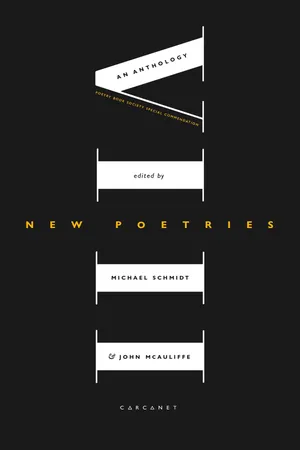
New Poetries VIII
About this book
A Poetry Book Society Spring 2021 Special Commendation Edited by Michael Schmidt and John McAuliffe, this is the latest in Carcanet's celebrated introductory anthology series presenting work by two dozen poets writing in English from around the world. Jason Allen-Paisant, Chad Campbell, Conor Cleary, Hal Coase, Jade Cuttle, Jennifer Edgecombe, Charlotte Eichler, Suzannah V. Evans, Parwana Fayyaz, Maryam Hessavi, Holly Hopkins, Rebecca Hurst, Victoria Kennefick, Jenny King, Joseph Minden, Benjamin Nehammer, Stav Poleg, Nell Prince, Padraig Regan, Tristram Fane Saunders, Colm Tóibín, Joe Carrick-Varty, Christine Roseeta Walker, Isobel Williams.
Trusted by 375,005 students
Access to over 1.5 million titles for a fair monthly price.
Study more efficiently using our study tools.
Information
REBECCA HURST
In 2009, along with two friends – Johnny Marsh, a visual artist, and Siân Thomas, a writer – I began to create work in response to a small patch of Wealden woodland. Over the next two years we spent six full days, from sunrise to sunset, walking, sharing stories, and making environmental art. Although our collaboration looked from the outside like three friends pottering around a wood together, nonetheless what happened during that time – an act of dwelling as well as of making – stuck with me through the years that followed.
In 2014 I left Sussex for the second time in my adult life. The landscape I left behind, however, experienced through friendship, art, and years of repeatedly walking a loop of lanes and footpaths, stayed with me. I began writing poems that mapped the external geography of these walks, and of my internal geography as I made them. In addition to the pace of walking, the rhythms and impulses of oral storytelling, folklore, and fairy tales can be found in my poems.
While ‘Mapping the Woods’ documents a place I have known intimately and physically from birth, my imagination has always been free-roaming; I leave in order to psychically return; I return in order to experience and then act upon the impulse to leave. From my great-grandmother I inherited a mythical Eastern European landscape, experienced through old photographs, letters, and family stories. These stories, which shifted over the course of my childhood much like the borders of the region her family came from, left me with an enduring sense of the tension that can exist between personally embodied and imaginatively inherited landscapes. I am interested in what happens in the space between experiencing something and remembering it; and in what compels us to make art, instead of simply getting on with our lives. In my poems I interrogate and excavate the edge-lands that border the known and tangible world, and the messy dreamscapes beloved of surrealists, mapping wild places I have visited, both geographical and psychological.
*
WALKING DWELLING THINKING
This wood has a thousand exits and entrances:
stiles, gates and tripets, gaps and breaches.
This wood is hammer-pond, chestnut and chalybeate,
charcoal and slag heap, leats and races.
This wood hides the boar-sow in a thickety hemmel;
is home to the scutty, the flindermouse, the kine.
This wood is cut and coppiced and burned.
Each decade catched hurt – it takes a tumble.
This wood is two green and clay flanks pinched
by the link of iron bridge over water.
This wood keeps its secrets: the peaty-black
knuckerhole where the dragon lies sleeping.
This wood scolds with a tawny owl’s brogue
shrucking and shraping, kewick hoohoo.
This wood is ashen, eldern, and oaken
a mile from the village, ring-fenced, well-trodden.
This wood summons you from out of your house
to walk through leaf-fall and bluebells and moss.
MAPPING THE WOODS
Parson’s Wood, Mayfield, East Sussex
Longitude: 51.061001
Latitude: 0.308827
[…] woods are evidently places propitious for wandering, or getting lost in, all woods are a sort of labyrinth.
Francis Ponge, The Noteboo...
Table of contents
- Cover
- Title
- Copyright
- Contents
- Introduction
- Hal Coase
- Jade Cuttle
- Jason Allen-Paisant
- Stav Poleg
- Parwana Fayyaz
- Chad Campbell
- Joe Carrick-Varty
- Jenny King
- Benjamin Nehammer
- Charlotte Eichler
- Nell Prince
- Holly Hopkins
- Conor Cleary
- Isobel Williams
- Victoria Kennefick
- Maryam Hessavi
- Christine Roseeta Walker
- Joseph Minden
- Suzannah V. Evans
- Jennifer Edgecombe
- Rebecca Hurst
- Tristram Fane Saunders
- Colm Tóibín
- Padraig Regan
Frequently asked questions
Yes, you can cancel anytime from the Subscription tab in your account settings on the Perlego website. Your subscription will stay active until the end of your current billing period. Learn how to cancel your subscription
No, books cannot be downloaded as external files, such as PDFs, for use outside of Perlego. However, you can download books within the Perlego app for offline reading on mobile or tablet. Learn how to download books offline
Perlego offers two plans: Essential and Complete
- Essential is ideal for learners and professionals who enjoy exploring a wide range of subjects. Access the Essential Library with 800,000+ trusted titles and best-sellers across business, personal growth, and the humanities. Includes unlimited reading time and Standard Read Aloud voice.
- Complete: Perfect for advanced learners and researchers needing full, unrestricted access. Unlock 1.5M+ books across hundreds of subjects, including academic and specialized titles. The Complete Plan also includes advanced features like Premium Read Aloud and Research Assistant.
We are an online textbook subscription service, where you can get access to an entire online library for less than the price of a single book per month. With over 1.5 million books across 990+ topics, we’ve got you covered! Learn about our mission
Look out for the read-aloud symbol on your next book to see if you can listen to it. The read-aloud tool reads text aloud for you, highlighting the text as it is being read. You can pause it, speed it up and slow it down. Learn more about Read Aloud
Yes! You can use the Perlego app on both iOS and Android devices to read anytime, anywhere — even offline. Perfect for commutes or when you’re on the go.
Please note we cannot support devices running on iOS 13 and Android 7 or earlier. Learn more about using the app
Please note we cannot support devices running on iOS 13 and Android 7 or earlier. Learn more about using the app
Yes, you can access New Poetries VIII by Michael Schmidt, John McAuliffe, Michael Schmidt,John McAuliffe in PDF and/or ePUB format, as well as other popular books in Literature & European Poetry. We have over 1.5 million books available in our catalogue for you to explore.