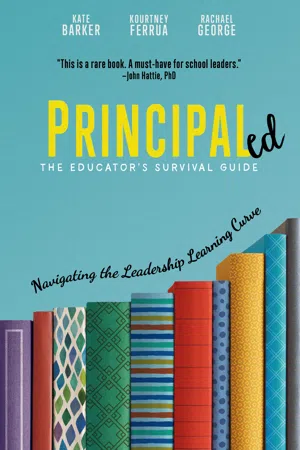
Veteran principals Kate Barker, Kourtney Ferrua, and Rachael George draw back the curtain on their years of experience, revealing the strategies, mind-sets, and practices that have helped them flourish in their roles. With humor, humility, and candor, the authors detail the key ingredients to finding balance as a school leader: taking time to reflect and learn, seeking out mentors, crafting simple and clear goals, and not neglecting self-care.
- English
- ePUB (mobile friendly)
- Available on iOS & Android
eBook - ePub
About this book
Information
Topic
EducationSubtopic
Education GeneralPart Three
Connect
Seven
Know Your People and Navigate Personalities
“There’s no key to great relationships, there’s simply a well-worn welcome mat.”―Curtis Tyrone Jones
You are about to hit send on an email to the entire staff, and you know it is going to trigger some uncomfortable feelings with at least a few of them. You worry about being misunderstood. It is important to get this information out promptly, but you contemplate if email is the best way to communicate. Although efficient, you worry people won’t glean your intonation, even with all those emojis. So, you decide to shift your communication plan and wonder if you should call an emergency staff meeting at the end of the day. This way you could see their reactions, and they could feel your vibe. Although there would be guaranteed scowls and arms folded across chests, maybe it would be worth the risk. Nope . . . you decide against it. If people hear the words “emergency meeting,” they always imagine the worse possible scenario. They are already up to their eyeballs in stress and on the verge of imploding as it is, so you’d better avoid adding to the heap. Would a memo in their mailboxes accompanied by a Hersey’s Kiss have more of a soft touch? You shake your head. Then, everyone hears the information at a different time and the rumor mill explodes. Plus, Harold is allergic to chocolate. Although inefficient, perhaps you could clear your afternoon schedule to share the news in person with as many professional learning teams as possible. Maybe if you just pushed that other project aside, you could make it happen.
Aaaah! The internal struggle is real, friends. Every day we have many choices to make, various personalities to consider, and unpredictable reactions to anticipate. It is a complicated world to navigate, and it takes practice. Let’s dive in and learn strategies and techniques to use with the various personalities and their undoubtedly diverse reactions in your building.
Most of us enter this profession to make a difference. It isn’t merely a job, but a quest to make an impact. We don’t look at our jobs merely as occupations, but rather as occupassions. We’re passionate about teaching those first sounds of the alphabet that ultimately lead students to graduation day, as “Pomp and Circumstance” filters through the auditorium. We’re passionate about coaching struggling teachers who are ready to leave the profession to help them reach exemplary status on the evaluation rubric. We’re passionate about encouraging our families to not merely be bystanders, but active participants in their child’s education. We’re passionate about collaboration and finding synergy with our fellow leaders, so that we can collectively share the burdens and the celebrations of our chosen work. Let’s face it: We are in the people profession. Whether those people are five or fifty-five, ultimately our greatest passion is connecting with others to facilitate learning, generate positive change, and make our world a better place.
Know Your Staff
Although our greatest delight may be working with people, one of the most challenging parts of our chosen profession is—you guessed it—the people. Depending on your situation, you could be interacting with hundreds, if not thousands, of people per day. That means negotiating a massive number of personalities, opinions, and feelings. Although it can be utterly exhausting, it is critically important to creating a cohesive community.
Navigating personalities starts with the lesson that giving and receiving verbal and nonverbal communication is an art. As author and former presidential speech writer James Humes wrote, “The art of communication is the language of leadership.” We must become translators of sorts, skilled at predicting behavior and understanding triggers for glee, sorrow, excitement, and frustration. We must understand the meaning behind mood swings, disengaged blank stares, and midnight emails from parents, staff, or students. There are many of us who also add a multitude of cultures and languages to our interpretive practice. We must learn to ask questions, clarify nonverbal communication, and decipher events. Doing this well takes dedication, practice, and perseverance.
A leader’s most potent superpower is knowing their people. Doing so develops deliberate connections over time, transitions casual affiliations to meaningful relationships, and leads to significant growth and development. Take a moment and brainstorm the ways you purposefully get to know the people in your sphere:
- ___________
- ___________
- ___________
- ___________
Remember, we all have different styles and need to do what is comfortable for both ourselves and the people we are getting to know. Although a team-building weekend retreat may be ideal for some people, you can get the same results by spending a little extra time popping by classrooms to shoot the breeze in the morning, or by making a point of sitting next to someone you don’t know well at a meeting. As you plan your staff meetings, think about incorporating purposeful activities that build trust and connection prior to jumping into the business part of the agenda.
Everyone brings their personality with them to work. While behaviors can change and skills can be learned, personality tends to remain constant. Personality traits are like preferences for the ways people interact with others, take in information, make decisions, and organize their lives. Skills that lie outside of these personality-based preferences can be learned, for example, a shy, reserved person can learn the skills to be a gregarious presenter in front of a classroom, but chances are their preference will always be for quieter interactions. The goal is not to change the personalities of others, or label one personality preferable over others. Recognizing and appreciating the variety of personalities on your team helps you understand how best to work together to amplify your impact on students.
Personality-wise, I am a big-picture person, 100 percent. Details tend to annoy me, and I frequently get them wrong. (Honestly, what’s the difference between 6:00 p.m. and 6:30 p.m.? Answer: A lot when you get it wrong in a newsletter!) I am most inspired when I have the opportunity to dream about systems, possibilities, and making the world a more efficient place. I also tend to make decisions from a place of logic, making the choice to do the thing that is right, whether or not it makes people upset. This is both a blessing and a curse, let me tell you!When I invited my team to do an ice breaker using some Myers Briggs–like prompts, we learned a lot about each other. When I asked them to divide themselves up into big-picture versus fine-detail-oriented people, 80 percent of the staff put themselves in the fine details camp. The majority of the team, I realized, saw the world from a very different perspective than I did.It is truly important to recognize that personalities are not bad or good. We could still share a common vision, set goals together, and make change, but in order to do it, I needed to present information in a way that suited their personalities. For example, I once proposed a change to our master schedule, and learned that a fair number of people on my team preferred to make decisions based on the impact those decisions would have on others. I realized they wanted to understand the human side of change before jumping on board. This led me to pause and tell the stories of our kids who were not getting the interventions they needed because of the limitations of our master schedule. When my team saw the reasoning behind the proposal and connected to it emotionally, they understood the schedule change was necessary.Kourtney
We all occasionally get distracted by the full range of personalities on display in our workplace. One derogatory comment at a staff meeting or one degrading comment on Facebook can propel leaders into a tailspin and make them lose focus. We all have a sensitively meter, and when navigating personalities, this meter can be your best friend or worst enemy. Being attuned to others’ moods, words, and feelings can be a beautiful strength. Harnessed effectively, this kind of sensitivity can lead to curiosity, compassion, and informed decision-making. Being sensibly empathetic can open doors to connection and differentiation. It allows you to receive transparent stimuli to make informed decisions. However, being overly sensitive is like having a weight tied to your ankle in a vast ocean, pulling you down to the darkest depths. Our feelings of inadequacy and the demons of despair can shatter our confidence and plunge our poised presence. On any given day, the dial on our sensitivity meter can vacillate, which makes it critical to know the power of sensitivity so you can regulate accordingly.
How many times have you heard the saying “You need a thick skin in this profession”? “Thick skin” insinuates that we won’t let the actions of others penetrate our hearts and our minds. But do we really want skin so thick that we deflect connection with the very people who can give us valuable feedback to make critical decisions? We can react more thoughtfully and less emotionally if we are prepared to anticipate different personalities. As you are traversing the multitude of dispositions in your day-to-day, don’t forget that all behavior has a function. As leaders, it is important to know the “why” behind the behavior. The more deeply you know your people, the better you’ll come to understand and ultimately react to them. In addition, just like our students, the more we identify the “why,” the less personal the behavior becomes. A staff member’s outburst at a public meeting may suggest they are mad about a decision you made, when, in fact, the staff member may be feeling insecure and simply needs more professional development in a particular area. A person that passes you in the hallway without making eye contact or offering a greeting may not be avoiding you; perhaps their mind is elsewhere because they were up four times with a sick baby. Remember:
- Before you assume, learn the facts.
- Before you judge, understand why.
- Before you hurt someone, feel.
- Before you speak, think...
Table of contents
- Cover
- Title Page
- Copyright
- Dedication
- Contents
- Praise for Principaled
- Introduction
- I. Reflect
- II. Focus
- III. Connect
- IV. Care
- Recommended Resources
- References
- Acknowledgments
- About the Authors
- More from Dave Burgess Consulting, Inc.
Trusted by 375,005 students
Access to over 1.5 million titles for a fair monthly price.
Study more efficiently using our study tools.
Frequently asked questions
Yes, you can cancel anytime from the Subscription tab in your account settings on the Perlego website. Your subscription will stay active until the end of your current billing period. Learn how to cancel your subscription
No, books cannot be downloaded as external files, such as PDFs, for use outside of Perlego. However, you can download books within the Perlego app for offline reading on mobile or tablet. Learn how to download books offline
Perlego offers two plans: Essential and Complete
- Essential is ideal for learners and professionals who enjoy exploring a wide range of subjects. Access the Essential Library with 800,000+ trusted titles and best-sellers across business, personal growth, and the humanities. Includes unlimited reading time and Standard Read Aloud voice.
- Complete: Perfect for advanced learners and researchers needing full, unrestricted access. Unlock 1.5M+ books across hundreds of subjects, including academic and specialized titles. The Complete Plan also includes advanced features like Premium Read Aloud and Research Assistant.
We are an online textbook subscription service, where you can get access to an entire online library for less than the price of a single book per month. With over 1.5 million books across 990+ topics, we’ve got you covered! Learn about our mission
Look out for the read-aloud symbol on your next book to see if you can listen to it. The read-aloud tool reads text aloud for you, highlighting the text as it is being read. You can pause it, speed it up and slow it down. Learn more about Read Aloud
Yes! You can use the Perlego app on both iOS and Android devices to read anytime, anywhere — even offline. Perfect for commutes or when you’re on the go.
Please note we cannot support devices running on iOS 13 and Android 7 or earlier. Learn more about using the app
Please note we cannot support devices running on iOS 13 and Android 7 or earlier. Learn more about using the app
Yes, you can access Principaled by Kate Barker,Kourtney Ferrua in PDF and/or ePUB format, as well as other popular books in Education & Education General. We have over 1.5 million books available in our catalogue for you to explore.